Supplier management involves more than maintaining supplier records. It spans onboarding, qualification, risk, performance, reporting, and ongoing supplier relationships. The Exam Questions have created this guide to help you understand what this certification covers, where to focus your preparation, and how to approach the current exam requirements.
Official C_ARSUM Exam Details
|
Items |
Details |
|
Official Exam |
SAP Certified Associate - Implementation Consultant - SAP Ariba Supplier Management |
|
Official Code |
C_ARSUM_2601 |
|
Format |
1 activity, Scenario Based Assessment |
|
Cut Score |
60% |
|
Duration |
2 hours |
|
Available Languages |
Available languages vary by format
|
|
Learning Journey Size |
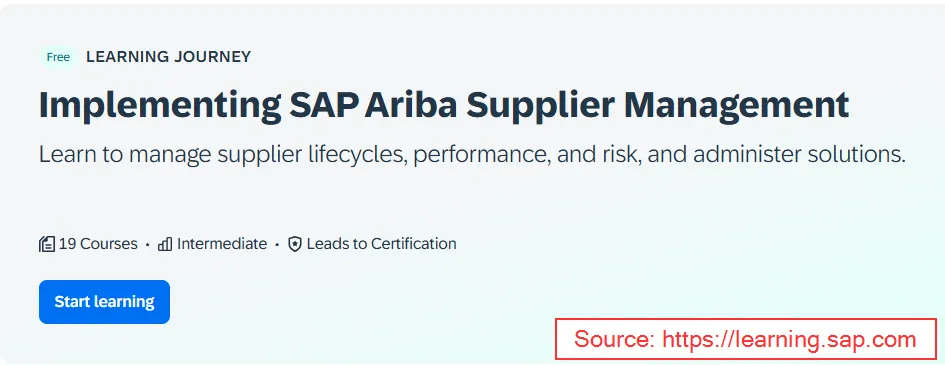
19 courses, Intermediate |
- Source to verify this information: SAP Certified Associate - Implementation Consultant - SAP Ariba Supplier Management.
What Is C_ARSUM_2601 Certification?
C_ARSUM_2601 is a SAP certification related to SAP Ariba Supplier Management professionals. It validates knowledge pertinent to the supplier management solutions and processes supported by SAP Ariba. SAP says the portfolio covers supplier information, lifecycle, performance, compliance and risk management.
What Changed in the C_ARSUM Exam?
The C_ARSUM exam no longer follows the classic multiple choice format of the earlier SAP Ariba Supplier Management certification exams. The present edition is in a practical form in which candidates are asked to use their knowledge in practical situations rather than standard MCQs.
Preparing for this Exam? C_ARSUM_2601 Learning Resources: Find specialized study material and official SAP learning guidance.
SAP Certified Associate - Implementation Consultant - SAP Ariba Supplier Management Exam Format
- Type of assessment: Scenario-based assessment in the form of a time-boxed role-play.
- Exam conditions: Open-book and non-proctored, SAP resources such as SAP Help Portal, SAP Learning, SAP Community and SAP Joule for Consultants are available where applicable.
- Response options: Candidates can either join the AI-guided virtual interview or upload a recorded video that SAP evaluators can review.
- Technical requirements: Microphone access is required, camera access is optional.
- Pausing: You can pause the role-play but the exam timer keeps running.
- Review: When you have finished the assessment, tap on “Save and view analysis” to review your performance and the detailed score before you submit it.
- Scoring: SAP assesses answers based on semantic intent, not only keywords, with each exam objective being graded on a scale from 1 (Insufficient) to 5 (Excellent), using criteria defined by experts.
Want to check how ready you are? Have a look at the C_ARSUM_2601 Free Questions to know where you need to put more emphasis.
SAP Ariba Supplier Management Syllabus and Topic Areas
|
Topics |
Difficulty |
Key Focus |
|
Supplier Management Fundamentals |
Easy |
Supplier Management solutions, capabilities, benefits & processes. |
|
Supplier Information Management |
Medium |
Supplier profiles, contacts, dashboards and supplier data. |
|
Supplier Lifecycle Management |
Medium |
Supplier requests, registering and qualifying suppliers, preferred suppliers and disqualifying suppliers. |
|
Questionnaires & Certificates |
Medium |
Collection of supplier information, forms, certificates and modular questionnaires. |
|
Supplier Performance Management |
Medium to Hard |
Surveys, SPM projects, scorecards, monitoring & reporting. |
|
Supplier Risk Management |
Hard |
Risk exposure, data enrichment, risk assessment of engagement, issue management and reporting. |
|
Configuration & Administration |
Hard |
User groups, configuration, templates, architecture, integrations and admin. |
C_ARSUM_2601 Learning Journey
By the end of this course, you will be able to discuss the features, benefits, and processes of today’s SAP Ariba Supplier Management solutions.
SAP Ariba Supplier Management solutions will provide dashboards and supplier profiles to help business users and consultants manage common supplier information.
- ARM201 - Managing Supplier Requests
In SAP Ariba Supplier Lifecycle and Performance and SAP Ariba Supplier Information and Performance Management (new architecture), business users and consultants can manage supplier requests.
- ARM211 - Managing Supplier Registrations
Business users and consultants will be able to manage supplier registrations in SAP Ariba Supplier Lifecycle and Performance and SAP Ariba Supplier Information and Performance Management (new architecture).
Standalone modular questionnaires and supplier certificates will be managed by business users and consultants in SAP Ariba Supplier Management solutions.
Create process projects for business users and consultants to manage qualification, discontinuation (disqualification), and other lifecycle processes in SAP Ariba Supplier Lifecycle and Performance.
- ARM214 - Managing Preferred Suppliers
This course prepares business users and consultants to manage preferred suppliers within SAP Ariba Supplier Lifecycle and Performance.
At the end of this course, you should be able to explain the important elements of supplier risk management in SAP Ariba, how it fits into procurement decisions, the characteristics of risk exposure and the basic risk management workflow.
- ARM202 - Monitoring Supplier Risk
Business users and consultants will learn how to monitor overall and individual supplier risk in SAP Ariba Supplier Risk after this course.
- ARX104 - SAP Ariba Running Reports
Learners will be introduced to the basic features and functions for running pre-packaged reports and saving and sharing reporting data.
- ARX204 - SAP Ariba Creating Reports
You can create, edit, filter and run reports including custom, multi-fact, aggregated and compound reports while applying basic field operations.
At the end of this course, business users and consultants will be able to report on supplier management projects and activities.
This course will prepare you to report on supplier risk data and activities and to run supplier risk administration reports.
This course will prepare you to manage supplier performance projects, scorecards, surveys, and reports while understanding the purpose of supplier performance management.
Understand supplier risk management, risk issue resolution and assessment, and integration and reporting capabilities.
You will learn to navigate the Administration page and perform key site management tasks that manage data, settings, and end-user access in an SAP Ariba Strategic Sourcing realm.
- ARX280 - Managing Project Templates
You will learn how to manage SAP Ariba Strategic Sourcing project templates, including creating and editing templates, and working with workflows, approvals, documents, groups, tasks, and activities.
You will learn how to set up and upgrade the Supplier Lifecycle and Performance templates, administer user groups, understand the new and classic architectures, support supplier migration, and identify external integration options.
You will learn to set up and configure SAP Ariba Supplier Risk, manage risk data and exposure models, handle enrichment and third party providers, configure engagement risk assessments and templates, manage issues and run reports.
Who Should Take the C_ARSUM Exam
- SAP Ariba Supplier Management process implementers and support consultants.
- Professionals who work with SAP Ariba Supplier Lifecycle and Performance.
- Any person working with SAP Ariba Supplier Risk and other supplier-risk processes.
The products and roles for this exam are listed at Implementing SAP Ariba Supplier Management.
C_ARSUM_2601 Career Benefits
- Validate skills in Supplier Lifecycle and Performance and Supplier Risk.
- Understand supplier lifecycle, performance, risk and reporting.
- Enhance credibility for SAP Ariba Supplier Management consulting roles.
- Keep your skills current with the SAP Stay Certified process.
Warning: Certification is a symbol of proven skills, but does not guarantee a job, a promotion, a raise, or a particular career path.
How to Register and Schedule the SAP Ariba Supplier Management
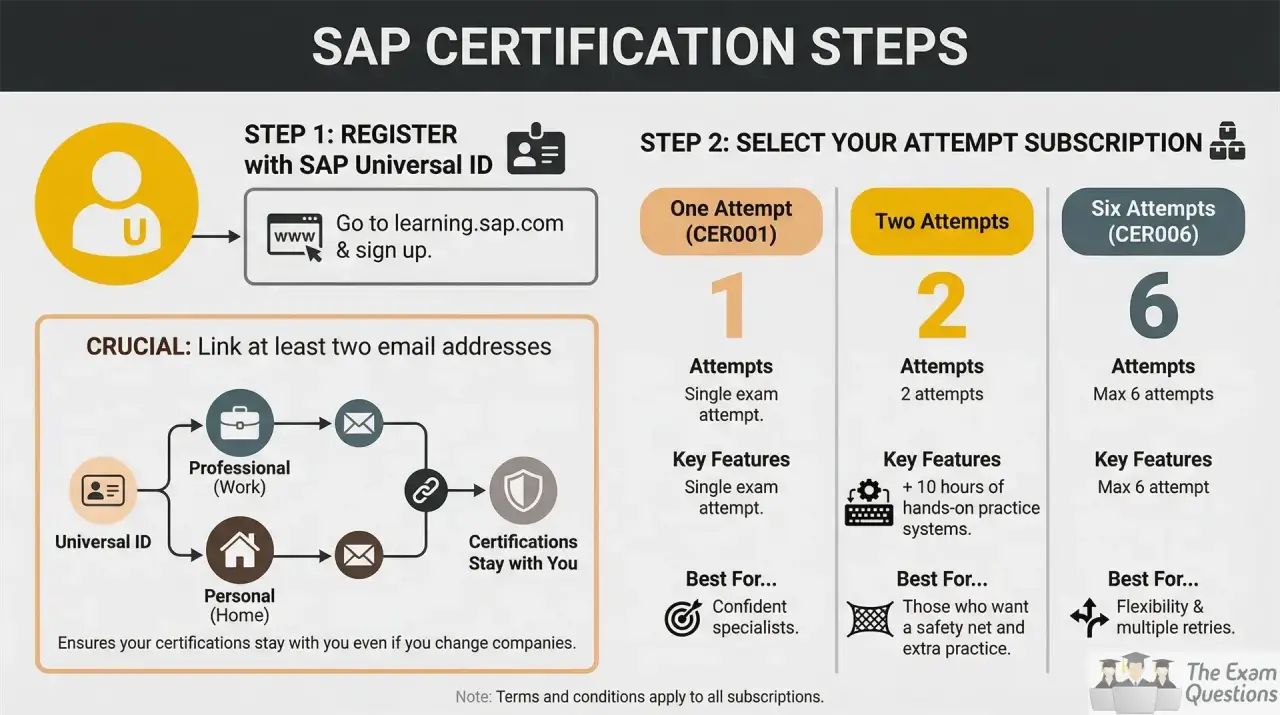
- Configure your SAP Universal ID with at least two email addresses from different domains.
- SAP offers the following options for exam attempts:
|
Purchase |
Attempts |
|
Single exam attempt |
1 |
|
Two-attempt purchase |
2 |
|
Six-attempt purchase |
6 |
|
SAP Learning Hub |
4/year |
- Go to the C_ARSUM certification page and click on “Go to Certification Exam” or choose “Open” from the learning journey.
- Check the number of attempts available and the time allowed for the exam, then start the assessment when you are ready.
C_ARSUM 6-Week Study Plan
Week 1
Get to know the core SAP Ariba Supplier Management solutions, supplier information, dashboards, profiles, and contacts.
Week 2
Supplier requests and registrations, supplier questionnaires, certificates and qualifications, preferred suppliers.
Week 3
Focus on SPM projects, scorecards, surveys and reporting.
Week 4
Risk monitoring, engagement risk assessments, issue management, integrations and reports.
Week 5
Learn about user groups, templates, architecture, migration and configuration, and integrations.
Week 6
Explore the concepts of lifecycle, performance, risk and administration with a focus on their application in real-life situations.
Want more practice with supplier-management concepts? Prepare with the C_ARSUM_2601 Pdf Questions to improve your knowledge before the assessment.
C_ARSUM_2601 Retake Rules
- You may take the same certification up to 4 times within a 12-month period.
- There is a 24-hour wait period between exam attempts.
- If you fail and still have time remaining, you can immediately retake the assessment and it will count as one attempt.
- If you fail four times, you must wait 12 months from your last failed attempt to be eligible to retake the exam.
Need fast answers before you go in? See the C_ARSUM_2601 FAQ for key certification information.
Keeping C_ARSUM Certification Valid
- Stay Certified: Follow SAP’s Stay Certified process to maintain your certification.
- 90-day window: Complete the Stay Certified assessment within 90 days of expiry and extend certification by 12 months from the original expiry date.
- SAP Learning Hub: Stay Certified assessment and preparation materials are available with a subscription only.
- Assessment: This is a short quiz and it is non-proctored. You may take it as many times as you like.
- No subscription: Recertify by retaking the current certification exam.
- Check status: SAP Learning > My Learning > Certifications > Manage Certification.
- Missed deadline: You will lose your certification if you do not complete the required assessment by the deadline.
Conclusion
The best way to prepare for this certification is not to simply memorize terminology, but to concentrate on how supplier-management processes actually function. Use the learning content available already in SAP to identify your areas of weakness and use your last review to build your confidence in these areas. SAP’s Supplier Management content is updated regularly, with new or changed features.
You want another practice round? Before you start your assessment, try the C_ARSUM_2601 Scenario Questions to improve your answers.
To Better Prepare Yourself For The Certification, Refer To:
C_ARSUM_2601 Learning Resources | C_ARSUM_2601 Free Questions | C_ARSUM_2601 Pdf Questions | C_ARSUM_2601 FAQ | C_ARSUM_2601 Scenario Questions

4.jpg)