C_HAMOD_2601 certification is a practical certification exam for SAP HANA - data engineer. It contains data modeling, data provisioning, and HANA data. For additional preparation, The Exam Questions C_HAMOD_2601 guide can be used. This site, along with official SAP learning resources, will help you with extra exam-focused practice.

Data Engineer - SAP HANA Exam Details
Before starting preparation, check the current SAP certification page because SAP has moved several certifications away from older multiple-choice formats. The following table gives the main details currently associated with C_HAMOD_2601.
|
Exam Detail |
Information |
|
Certification Code |
C_HAMOD_2601 |
|
Certification Name |
SAP Certified - Data Engineer - SAP HANA |
|
Products and Roles |
Data Scientist, SAP HANA Cloud, SAP HANA smart data integration |
|
Current Format |
System-Based Assessment |
|
Assessment Activity |
1 activity |
|
Cut Score |
60% |
|
Exam Duration |
180 minutes |
|
Exam Language |
English |
|
Certification Validity |
12 months, extendable by 12 months by staying certified |
|
Learning Journey Level |
Intermediate |
|
Main Courses |
HC300, HAHC55 |
|
Main Skill Areas |
Data Integration, Data Modeling, Data Analysis |
For the latest certification information, registration options, and assessment details, refer to SAP Certified - Data Engineer - SAP HANA. The SAP page should be treated as the final authority if any third-party information differs from the current certification setup.
What Is the Data Engineer - SAP HANA Exam?
The official certification name is SAP Certified - Data Engineer - SAP HANA. The current certification code of C_HAMOD is C_HAMOD_2601.
The certification is intended for professionals who need to work with data provisioning and data modeling in SAP HANA Cloud and SAP HANA. SAP connects the certification with the role of a data engineer - SAP HANA and highlights Data Integration, Data Modeling, and Data Analysis as relevant skills.
This is not a certification where memorizing terminology should be your main strategy. You need to understand how the different parts of HANA data engineering fit together. If you still have any doubts, check C_HAMOD_2601 FAQ for detailed answers.
For example, knowing what a calculation view means is one thing. Being able to create the right view, select suitable nodes, connect data sources, check the result, and correct an error is another skill altogether.
The same applies to data provisioning. You should understand why a remote source, virtual table, replication approach, or transformation method would be used rather than simply remembering definitions.
That practical distinction becomes even more important because the current assessment is system-based.
New Exam Format for C_HAMOD_2601
The current certification page identifies C_HAMOD_2601 with one activity as a System Based Assessment. SAP currently shows a 60% cut score and English as the available language. This format changes the way you should prepare.
Instead of spending most of your time solving old multiple-choice questions, you should practise performing tasks. You need to become comfortable reading a requirement, finding the relevant object, completing the required configuration, checking the result, and moving to the next task.
SAP's system-based assessment guidance explains that candidates work through practical tasks in a system environment. The assessment has a fixed time, and the timer continues if you take a break.
The 180 minute duration gives you reasonable working time, but that does not mean you can work slowly. Navigation, troubleshooting, and repeated corrections can consume more time than expected.
- Warning: Be careful with old C_HAMOD material that presents the certification as a traditional question-based exam. Such resources may still help you revise concepts, but they should not be the foundation of preparation for the current system-based format.
- Quick win: Before beginning your study plan, read the current SAP certification page and system-based assessment guidance. It takes much less time than discovering the format for the first time during the assessment.
- Pro Tip: Use the C_HAMOD_2601 study material for extra resources and preparation.
C_HAMOD_2601 Exam Key Topics
The following topics are the main areas to concentrate on when preparing. The difficulty ratings are practical estimates for preparation and are not official SAP difficulty scores.
1. Building Calculation Views
Difficulty: 9/10
Calculation views deserve the highest level of attention because they bring several HANA modeling concepts together. You should understand different calculation view approaches, common nodes, joins, unions, data slices, ranking, and embedded functions.
E.g., build a simple model, join two sources, filter and check the output. Then change your model and see what happens. This gives you a much better feel for how the pieces act.
A common preparation mistake is building models without checking the result until the end. That makes troubleshooting harder.
- Tip: Validate your output after each major modeling change. It is a small habit, but it can save a lot of time during practical work.
2. Modeling Functions Configuration
Difficulty: 8/10
Modeling functions take a simple way of calculating something to a way that can satisfy a particular business requirement. Pay attention to filters, parameters, hierarchies, rankings, data slices, and embedded functions. You need to know not just what each feature does, but when to use it. If a requirement asks for a particular subset of data, for example, you need to know if a filter, parameter, or some other modeling feature is the right answer. This is where practical judgment is required.
- Quick win: Build one small calculation view and experiment with several functions instead of studying each function only from written explanations.
3. Optimizing the Performance of Models
Difficulty: 9/10
Performance is one of the areas that candidates often postpone. That is a mistake. SAP HANA is designed for high performance, but that does not mean every model automatically performs well. Poor model design, unnecessary layers, unsuitable joins, and excessive complexity can create problems.
HC300 includes material on model performance, performance checking tools, and features intended to improve performance. The practical lesson is to think about performance while building the model rather than treating it as a final cleanup task.
- Warning: Do not memorize performance rules without practicing them. It is easier to understand performance when you can see how a modeling decision affects the result.
4. Managing and Administering Models
Difficulty: 6/10
This is not as technical an area but can affect your performance on a system-based assessment. You should be familiar with the modeling environment, projects, content organization, and model management tools. In the SAP HC300 course, you will learn about project and content management in the SAP Business Application Studio. A technical solution is of little use if you spend minutes looking for the right project or item.
- Tip: Spend some time just exploring the surroundings. Practical familiarity later may help reduce hesitation.
5. Provisioning Data to SAP HANA
Difficulty: 8/10
Data provisioning is the method of data being made available for use in SAP HANA. This includes provisioning technologies, remote sources, virtual tables, virtualization and replication. Specifically, it is about data provisioning, virtualization, replication, and transformation. You should understand the purpose behind each approach.
- Quick win: When studying each provisioning method, write one sentence answering, “Why would I use this method? If you can answer that clearly, the concept is easier to remember.
6. Working With SQL and SQLScript in Models
Difficulty: 7/10
SQL and SQLScript are useful when graphical modeling does not provide the best solution for a particular requirement. You do not need to turn every problem into a coding exercise. A more useful skill is knowing when SQL-based logic is appropriate and where it fits in the HANA modeling.
- Tip: Don’t try to memorize complex code patterns. Rather, try to understand what SQL and SQLScript are there for in relation to HANA models.
7. Secure Models
Difficulty: 6/10
Security is an additional support feature that can’t be overlooked. Find out how to make use of security features on SAP HANA models and how to regulate access to data.
This topic may be less time-consuming to prepare than calculation views or provisioning but still falls under the wider umbrella of HANA modeling skills. Instead of seeing it as a list of terms, it is better to understand the purpose of each security feature.
C_HAMOD_2601 Exam Learning Journey

The official SAP learning journey, Becoming a Certified Data Engineer - SAP HANA Cloud, is at an intermediate level. It is a free learning journey with two main courses and approximately 17 hours of learning content.
The learning journey should be your main study framework. The exam topics above explain what to focus on, while the table below shows where the official SAP learning content fits into your preparation.
|
Code |
Topics |
Approx. Time |
What It Covers? |
|
HC300 |
14 hours |
Main modeling course covering calculation views, nodes, data slices, ranking, embedded functions, joins, unions, modeling functions, SQL, performance, projects, lifecycle management and security, SAP HANA Cloud Knowledge Graph Engine |
|
|
HAHC55 |
3 hours 57 minutes |
Covers data provisioning, data virtualization, Implementing data replication and data transformation |
Who Should Take the C_HAMOD_2601 Exam?
This certification is most suitable for professionals who want to work with data engineering - SAP HANA tasks.
It is a strong fit for data engineers - SAP HANA, data modelers, technical consultants, data provisioning specialists, and analytics professionals moving toward HANA Cloud development.
It can also be useful for SAP technical professionals who already work with databases or analytics and want a more formal HANA credential.
It is less suitable for someone whose work is entirely functional or managerial and does not involve data modeling or technical HANA tasks.
You do not necessarily need many years of experience. However, you should be prepared for a technical learning curve. The official learning journey itself recommends foundational SAP Business Technology Platform knowledge.
Career Benefits of SAP Certified Data Engineer - SAP HANA
- Allows you to show recruiters you have a good grasp of data modeling and provisioning, but you still need real project experience.
- Learn about master data replication, transformation, virtual tables, remote sources, and beyond calculation views.
- A structured learning path for SAP technical professionals and database developers who want to transition into the data engineer role.
- You will earn official SAP recognition. It will help you to boost your credibility and also enhance your SQL and real-world problem-solving skills.
How to Register for C_HAMOD_2601
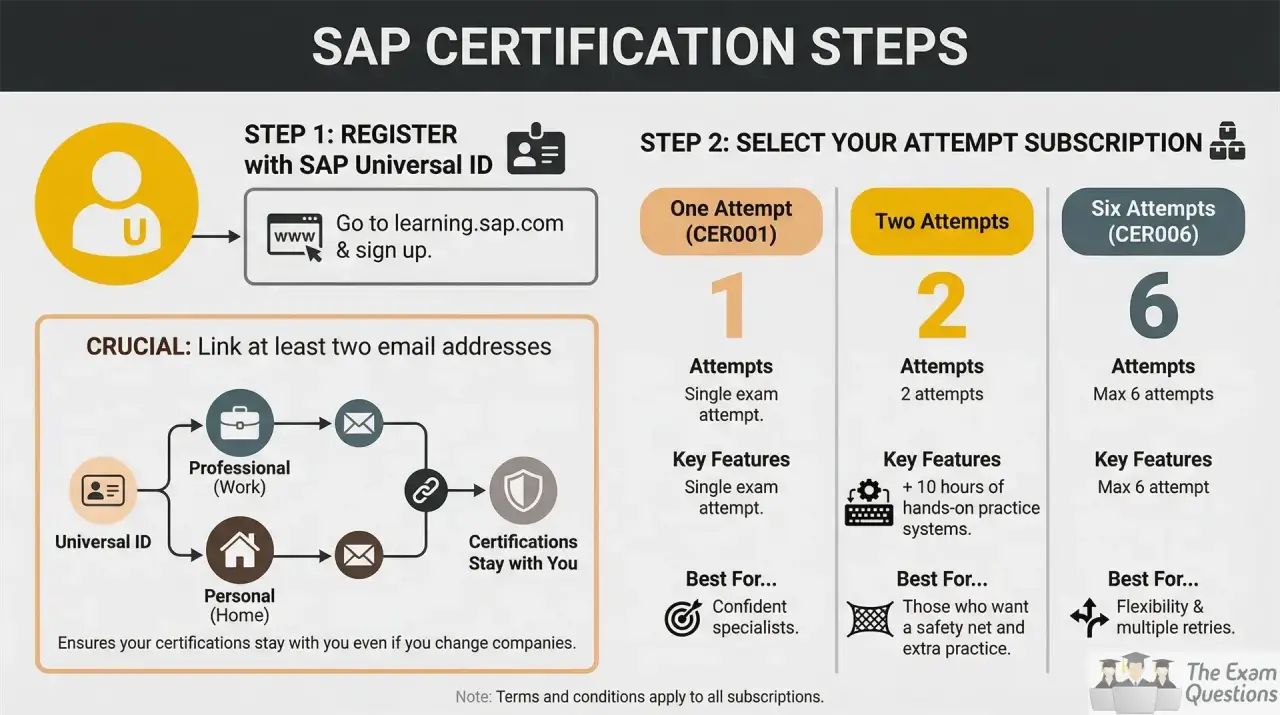
- First create your SAP Universal ID and link at least two email accounts with different domains.
- Purchase either a standalone exam attempt or access the exam through an active SAP Learning Hub subscription.
- Find your target assessment on the SAP Learning Hub or official certification portal, then select Go to Certification Exam or Open.
- Cross-check the assessment type and total duration if in doubt. Also check the remaining attempts before starting the session.
- Note: Configure your Universal ID and make sure your subscription is associated with the right S-User or P-User profile before buying or starting an attempt to avoid system locks and account delays.
C_HAMOD_2601 6-Week Study Plan
Week 1: Understand the Certification and Environment
- Read the official certification page and learning journey. Start your study with the modeling environment.
- In its first week, spend some time navigating the environment before moving into more complex modeling.
Week 2: Calculation View Development
- This week start studying calculation views, common nodes, joins, and unions.
- Build miniatures and see what they output.
Week 3: Functionality and Performance Modeling
- This week, you can focus on data slices, ranking, parameters, functions, dynamic calculation views, hierarchies, and performance concepts.
Week 4: Data Provisioning
- With 2 weeks left, start practicing virtualization, remote sources, replication and transformation, and virtual tables.
Week 5: Combined Practice
- Bring the topics together.
- Build an end-to-end practice scenario where data is provisioned, modeled, filtered, and validated.
- This is also a good time to use C_HAMOD_2601 free questions for additional system-based practice. Use them as a supplement to the official SAP courses, not as a replacement.
Week 6: Final Revision
- In this week, you can review the areas where you made mistakes. Repeat difficult tasks and also practice under a fixed time limit.
- Read the SAP system-based assessment guidance again before your exam.
- Goal: Make your execution reliable enough that you do not waste assessment time searching for basic information.
C_HAMOD_2601 Retake Rules
- SAP currently states that candidates can have up to four attempts per certification.
- There is also a 24-hour waiting period between attempts for the relevant certification process.
- If the certification is not passed after the fourth attempt, a 12-month waiting period applies before another attempt.
- If you fail in the assessment but have time left on the exam clock, SAP allows you to retake the assessment immediately, and it counts as one exam attempt.
- In case the assessment is impacted by a technical problem with the system, adhere to the support process of SAP and supply the information and screenshots that are requested. SAP can examine the situation and determine whether another attempt is suitable.
- Warning: Do not use an actual attempt simply to discover how the system-based format works. You can prepare for the workflow before using one of your available attempts.
Keeping Your C_HAMOD_2601 Certification Valid
- SAP states that the digital certification badge is valid for 12 months. Eligible SAP Learning Hub users can maintain certification through the Stay Certified process and the relevant annual assessment.
- SAP's current certification model is designed around keeping skills current rather than treating certification as something that lasts indefinitely.
- If you have an SAP Learning Hub subscription, check the Stay Certified options available for your certification before its validity period ends.
- If you do not have the relevant subscription, check SAP's current certification renewal rules because the available maintenance route can depend on the certification and your access model.
- Quick win: Set a calendar reminder well before the certification expires. It is much easier to handle renewal when you are not working against the final few days.
C_HAMOD_2601 Exam Preparation Tips
- The biggest mistake would be treating the official learning journey as something to finish quickly and then switching entirely to question practice.
- For this certification, your hands-on work matters.
- Create small models. Break them deliberately. Fix them. Try different joins. Change filters. Test parameters. Work with provisioning scenarios. Check your outputs.
- Keep a simple mistake log with three headings: knowledge gap, execution mistake, and time problem.
- That log will become much more useful during the final week than another set of generic notes.
- Use the official SAP learning content as your foundation. You can use the C_HAMOD_2601 PDF Questions as an additional resource for more system-focused practice.
Conclusion
C_HAMOD_2601 is best approached as a practical data engineering - SAP HANA certification rather than an old-style memorization exam. Follow the official SAP learning journey, give HC300 the most preparation time, complete HAHC55, and practice the actual workflows repeatedly. The C_HAMOD_2601 system tasks support your learning process. A candidate who can build, troubleshoot, validate, and complete HANA tasks calmly will be in a much stronger position when the 180 minute assessment begins.
Looking to Revise Further for the C_HAMOD_2601 Exam? Explore the Resources Below:
C_HAMOD_2601 FAQ I C_HAMOD_2601 PDF Questions I C_HAMOD_2601 system tasks I C_HAMOD_2601 free questions I C_HAMOD_2601 study material

![Free C_HAMOD_2601 Exam Questions: Data Engineer - SAP HANA System Tasks [2026]](https://theexamquestions.com/uploads/questions/C_HAMOD_Free_questions.webp)