This comprehensive guide by The Exam Questions covers everything that you need to know about the C_THR86_2605 exam. Every piece of official information, along with its sources, is listed in this guide.
This guide gives you a current, source-backed view of the exam, the official learning journey, the best way to prepare, how retakes now work, and what you need to do to keep the certification valid after you pass.

Official Exam SAP SuccessFactors Compensation Details
|
Item |
Details |
|
Official exam code |
C_THR86 (version code C_THR86_2605) |
|
Official exam name |
SAP Certified - SAP SuccessFactors Compensation |
|
Format |
New format, 1 activity, Scenario Based Assessment |
|
Cut score |
60% |
|
Certification validity |
12 months, extendable by another 12 months after each successful assessment |
|
Learning path |
Configuring SAP SuccessFactors Compensation(free journey with 2 courses and 2 practical exercises) |
|
Language |
Available languages vary by format:
|
|
Learning path level |
Intermediate |
|
Courses in the path |
SAP SuccessFactors Platform Introduction Academy (THR80) and SAP SuccessFactors Compensation Academy (THR86), each paired with a hands-on practice system |
|
Intended role |
Consultant, especially SAP partner consultants implementing the solution |
|
Provisioning rights |
Only registered SAP partner consultants receive provisioning rights; customers and independent consultants do not, with no exceptions |
|
Skills earned (per SAP) |
Analytics, Reward Strategy, Compensation Management, HRIS, Reward Management |
|
Important note |
SAP's page states the next version of this exam should be available mid-December 2026 |
- Official Source to Verify: SAP Certified - SAP SuccessFactors Compensation
- Pro Tip: As per current updates, treat C_THR86_2605 exam like a practical consulting-readiness milestone. It is no longer a classic question-bank exam.
What Is C_THR86_2605 Certification?
The C_THR86_2605 certificate is an entry-level qualification for consultants to validate their skills and knowledge in the SAP domain. The C_THR86_2605 code is officially titled as “SAP Certified- SAP SuccessFactors Compensation”. This certification is ideal for all the learners who want to get familiar with the fundamentals of SuccessFactors Compensation.
Based on scenario assessment, the C_THR86_2605 certificate confirms your applied skills and implementation knowledge in real projects. Learn more in depth about the certification at C_THR86_2605 FAQs Guide.
Pro Tip: If your day-to-day work already involves compensation templates, worksheets, guidelines, imports, reporting, or statement generation, you are studying for validation of real implementation ability, not just definitions.
What Changed in C_THR86_2605 Exam Format?
The major change in the current exam format is the practical certification model approach rather than a traditional approach. In this new approach, the candidate’s skills are validated based on their practical understanding, hands-on learning experience, and ways to implement appropriate SAP solutions in the real SAP world.
As per official listing, the C_THR86_2605 exam includes 1 activity that is scenario-based assessment and requires a 60% cut score. Candidates launch the exam from the certification details page or the learning journey. The platform can include an AI-guided interview-style experience and lets candidates review their analysis before final submission.Scenario-based platform supports multiple languages.
SAP mentions the approach of open-book and non-proctored for practical certification assessments where candidates may use publicly available SAP resources such as SAP Learning and SAP Help Portal during practical exams.
To have current format-based exam experience for the SAP Certified - SAP SuccessFactors Compensation exam, test your knowledge against realistic, scenario-style business logic at Free C_THR86_2605 Exam Questions. It is designed to mimic the current SAP format, followed by a hidden detailed answer key.
- Pro Tip: Prepare with documentation-based problem solving to be able to interpret a business situation, choose the right configuration path, and explain why it fits.
- Warning: Make sure you do not take too much pause. As it does not stop the overall exam countdown, your timer keeps running.
- Quick Win: Check all the required settings for the test in advance like testing your browser, microphone permissions, and network setup.
Official Topic Areas in C_THR86_2605
|
Topic Area |
Difficulty |
What It Covers (Source) |
Tips and Cautions |
|
1. Platform Foundations and Implementation Kickoff |
Moderate |
THR80 covers platform fundamentals: permissions, admin tools, profile configuration, MDF, business rules, picklists, configuration center.The compensation course then begins with implementation kickoff and project-oriented setup thinking. (THR86)(THR80) |
Build a one-page checklist for permissions, profile elements, business rules, and kickoff dependencies before moving into core compensation topics. |
|
2. Data Integration and Employee-Specific Data |
High |
It includes "Integrating Data into SAP SuccessFactors Compensation" and aligns with employee-specific data and import-driven setup. Data readiness affects worksheet behaviour, eligibility logic, and downstream reporting. (THR86) |
Study data flow, not just field names and focus on what each imported or mapped value changes inside the compensation process. Caution: many candidates memorise import-table terminology without understanding when the data actually drives worksheet outcomes. |
|
3. Compensation Plans and Worksheets |
High |
The compensation course includes "Creating a Compensation Plan and Worksheets." Core exam focus: translating business requirements into plan design, worksheet behaviour, route maps, and setup decisions. Legacy labels (Compensation Worksheets, Plan Settings, parts of Implementation Test) map here. (THR86) |
Practise in this format: business need → configuration choice → expected worksheet result → validation step. Caution: worksheets are not standalone — the logic ties to plan design, eligibility, budgets, guidelines, permissions, and reporting. |
|
4. Budgets, Eligibility Rules, and Guidelines |
High |
"Developing Budgets, Eligibility Rules, and Guidelines for Compensation Plans." Supports the legacy topic Compensation Plan Guidelines; requires balancing policy, configuration, and business control. (THR86) |
Always ask two questions: who is eligible, and what rule or guideline controls the manager's decision range? |
|
5. Publishing Compensation Data to Employee Central |
Moderate to High |
"Publishing Compensation Data to SAP SuccessFactors Employee Central." Signals that downstream publishing and integration consequences matter, not just setup screens. (THR86) |
Trace the full chain from approved compensation outcomes to published employee data. Quick win: list every configuration point where bad upstream data would create a bad downstream outcome. |
|
6. Reports and Compensation Statements |
Moderate |
"Generating Reports and Statements." Corresponds to legacy Reports and Workflows plus Compensation Statements; closes the loop from configuration to business output. (THR86) |
Treat reports and statements as proof-of-configuration topics. A correctly designed plan should produce output that makes sense to both administrators and managers. |
|
7. Consultant Readiness and Exam Execution |
Moderate |
"Succeeding as a Consultant." Scenario-based assessments reward implementer thinking: clarify the requirement, identify dependencies, choose the right setup path, and explain the likely business result. (THR86) |
Narrate your reasoning out loud during practice to improve confidence and response quality in scenario-style assessments. |
Learning Journey For C_THR86_2605
The official learning journey for this certification is Configuring SAP SuccessFactors Compensation and labels the course as free. After completing the whole course including hands-on practice, the learner will be able to perform and configure core functionalities.

The visible learning journey structure currently includes 2 courses and 2 practical exercises:
Course 1: THR80 - SAP SuccessFactors Platform Introduction Academy
This course takes around 8 hr 43 min time to complete and is available in 7 languages(German , Spanish, French, Japanese, Korean, Portuguese, Chinese). The included units are as follows:
- Introducing SAP SuccessFactors
- Setting Up SAP SuccessFactors Provisioning
- Describing SAP SuccessFactors Administrator and Admin Center
- Setting Up Permissions and System-wide Features in SAP SuccessFactors
- Performing Administrator Tasks in SAP SuccessFactors
- Configuring the User Experience in SAP SuccessFactors
- People Profile in SAP SuccessFactors
- Defining MDF and Business Rules in SAP SuccessFactors
- Succeeding as a Consultant
Practical Exercise 1: Hands-on Practice for Introduction to SAP SuccessFactors Academy
Practice system tied to the platform introduction course.
Course 2: THR86 - SAP SuccessFactors Compensation Academy
This course takes around 5 hr 24 min time to complete and is available in 7 languages(German , Spanish, French, Japanese, Korean, Portuguese, Chinese).
The included units are as follows:
- Facilitating the Kickoff of an SAP SuccessFactors Compensation Implementation
- Integrating Data into SAP SuccessFactors Compensation
- Creating a Compensation Plan and Worksheets
- Developing Budgets, Eligibility Rules, and Guidelines for Compensation Plans
- Publishing Compensation Data to SAP SuccessFactors Employee Central
- Generating Reports and Statements
- Succeeding as a Consultant
Practical Exercise 2: Hands-on Practice for SAP SuccessFactors Compensation Academy
Practice system tied to the compensation academy.
- Pro Tip: Finish THR80 before you start THR86 revision, so that compensation scenarios become much easier when platform permissions, profile behaviour, business rules, and admin tools are learnt.
Who Should Take C_THR86 Exam
- Consultants who implement or support SAP SuccessFactors Compensation
- Learns who want formal validation of core configuration knowledge.
- Relevant for SAP partner consultants
- Customers and independent consultants can give the exam for skills validation, but they will not receive provisioning rights based on certification alone.
- Pro Tip: If your real goal is project credibility, align your study examples to implementation conversations by integrating C_THR86 Practice Questions PDF in your daily preparation journey.
- Warning: Compensation implementations rely heavily on platform knowledge and configuration discipline, so focus on learning them over theoretical memorizing.
Career Benefits of C_THR86_2605 Certification
- It helps professionals validate in-demand skills.
- It distinguishes certified expert candidates in the market.
- Gain globally recognised credibility.
- Improve career prospects with high-demand skills for SAP innovations.
- Take advantage of consulting-oriented certification where employers and clients want evidence to showcase their work around structured implementation approaches.
- Quick Win: The day you pass and receive a digital badge by email, download a pdf version, add the digital badge and update your professional headline to validate your SAP skills.
How to Register and Schedule the C_THR86 Exam
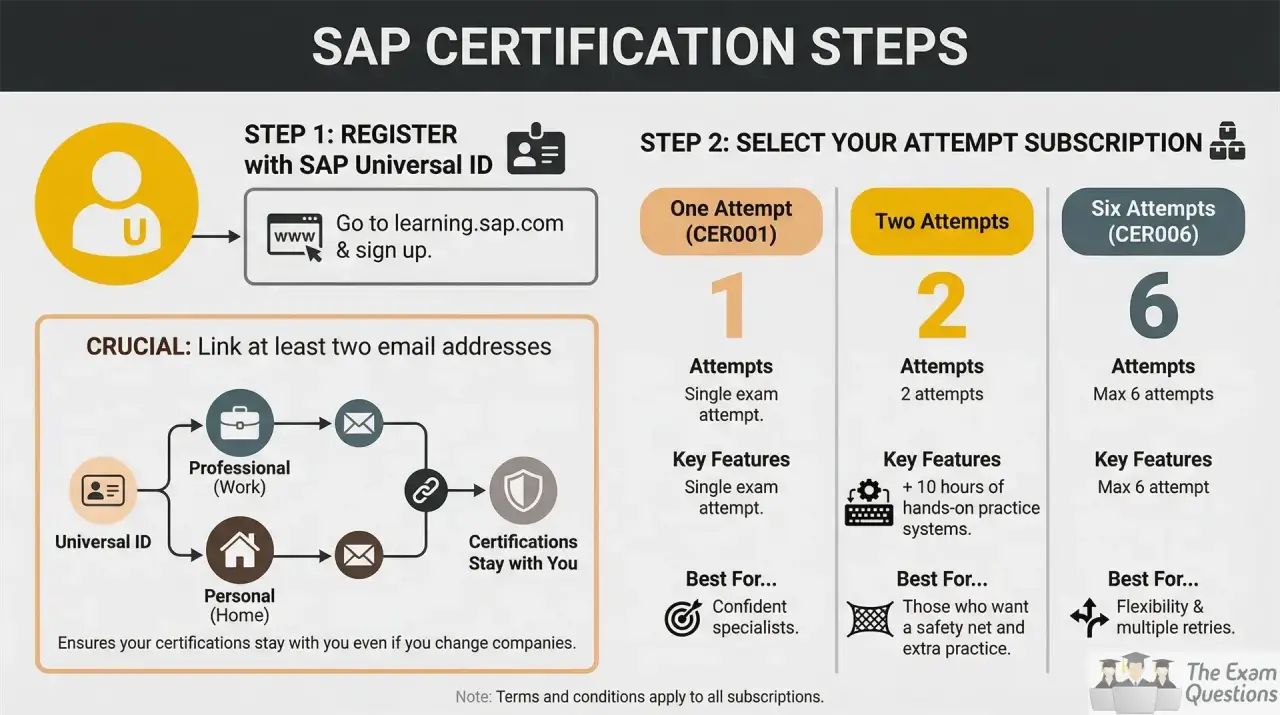
|
Step |
Action |
Key Detail (Source) |
|
1. |
Set up identity |
Configure SAP Universal ID Two email addresses must be assigned; log in with the S-user or P-user linked to the certification subscription. |
|
2. |
Choose purchase option |
Pick one, two, or six-attempt exam access Two-attempt option includes 10 hours of hands-on practice system access. |
|
4. |
Launch the exam |
Start from the certification details page via "Go to Certification Exam", or from the learning journey via "Open" Some assessments require scheduling; others start directly. |
|
5. |
Schedule safely |
Confirm date and time Confirming a slot does not count as an attempt for system-based assessments. |
|
6. |
Verify access |
Check My Subscriptions Shows remaining attempts in the official SAP learning environment. |
6-Week Study Plan For SAP SuccessFactors Compensation
A six-week plan works well for C_THR86_2605 because the official path is compact enough to finish thoroughly, but broad enough that you still need spaced revision and practical thinking. The 6-week study plan are as follows:
Week 1 - Platform Foundations
Initially start completing the first part of THR80. The focus should be on building platform foundation and learning SAP SuccessFactors basics, admin tools, permissions, and system-wide features.
Week 2 - User Experience, People Profile, MDF, and Business Rules
Create notes for every concept that could affect compensation behaviour later.
Week 3 - Compensation Course Core Setup
Start THR86 and focus on implementation kickoff, data integration, and the logic behind compensation plan creation. Make every study session end with one practical question: "What business problem is this setup solving?"
Week 4 - Worksheets, Budgets, Eligibility, and Guidelines
This is the highest-risk week for most candidates. Spend extra time on worksheets, budgets, eligibility rules, and guideline design, because these topics connect directly to scenario reasoning and often expose weak understanding fast.
- Pro Tip: Use week 4 to practise configuration trade-offs, not just feature definitions.
Week 5 - Publishing, Reports, and Statements
Finish the rest of THR86, then revise how published outcomes, reports, and compensation statements reflect the quality of your setup. This is the week to connect configuration with business-facing output.
Week 6 - Full Scenario Practice and Final Readiness Check
Use the final week for timed scenario practice, documentation-based problem solving, and weak-area review. In the final week, practise concise reasoning. You should be able to explain what you would configure, why you would configure it, and what result you expect. Revisit the official SAP help-center articles on practical exam preparation and scenario-based assessments so the format itself does not surprise you on exam day.
Refer to C_THR86_2605 Learning Materials as final-prep to build confidence under scenario pressure, it will stand out in building exam readiness before the live attempt.
C_THR86 Retake & SAP Certification Validity Rules
- Reattempt the same certification exam up to four times in a 12-month period. (mandatory 24-hour wait between attempts).
- If you fail all four attempts, you must wait one full year from the final attempt before retrying.
- If you fail while time still remains on the clock, you can retake immediately.It still counts as one attempt. This rule makes the time management critical in the scenario-based format.
- The certification is valid for 12 months. It extends by another 12 months each time after you pass the required assessment.
- The simplest maintenance route is SAP Learning Hub. It includes the short non-proctored assessments and preparation content to stay certified.
- Without a Learning Hub subscription, you can earn the validity by retaking the full certification exam each year. This replaces older, vague "delta exam" advice.
- Receives extra 12 months of validity from the retirement date. (If the certification is retired)
Pro Tip: If you fail, instead of rushing to take the next attempt, first identify the problem. Whether it was related to topic knowledge, scenario reasoning, or exam execution. Decide whether your long-term path will be SAP Learning Hub maintenance or yearly re-examination.
Conclusion
C_THR86_2605 is a certification focussed on practical compensation knowledge in a consulting context. With the new scenario-based format, the certification validates core knowledge and in-depth hands-on learning experience in SAP SuccessFactors Compensation domain.
To help you achieve your certification goals and ease your learning, add C_THR86_2605 scenario-based practice questions to your study plan. Master SAP SuccessFactors Compensation today with The Exam Questions.
For C_THR86_2605 Exam Prep, Helpful Resources Are Listed Below:
C_THR86_2605 scenario-based practice questions | C_THR86_2605 Learning Materials | C_THR86 Practice Questions PDF | Free C_THR86_2605 Exam Questions | C_THR86_2605 FAQs Guide

![Master SAP SuccessFactors Compensation (C_THR86_2605) with Free Scenario-Based Practice Questions [2026]](https://theexamquestions.com/uploads/blogs/C_THR86_Free_questions.webp)