C_HRHPC_2607 SuccessFactors for Employee Central Payroll is designed for professionals developing implementation, payroll, integration, and administration skills in SAP SuccessFactors Employee Central Payroll. The Exam Questions also provide supplementary resources, while SAP Learning remains the primary source for certification information and preparation.
C_HRHPC_2607 Exam Details
|
Exam Detail |
Information |
|
Official Certification Name |
SAP Certified - Implementation Consultant - SAP SuccessFactors Employee Central Payroll |
|
Official Certification Code |
C_HRHPC_2607 |
|
Current Certification Format |
Scenario-Based Assessment |
|
Assessment Activity |
1 activity |
|
Exam Time |
120 minutes |
|
Cut Score |
60% |
|
Languages Available |
Available languages vary by format: Roleplay with AI guidance: English, Spanish, Italian, French, Japanese +25 more Video recording: English only |
|
Official Learning Journey |
3 free courses |
|
Learning Journey Level |
Intermediate |
|
Role |
Support Consultant, Administrator, Consultant |
- Warning: Before scheduling, check the official SAP Certified - Implementation Consultant - SAP SuccessFactors Employee Central Payroll page.
What Is the C_HRHPC_2607 Employee Central Payroll Certification?
C_HRHPC_2607 focuses on the knowledge required to work with its payroll, integration, configuration, and control processes. The credential is relevant to professionals moving toward implementation and support work.
SAP Certified - Implementation Consultant - SAP SuccessFactors Employee Central Payroll reflects the implementation focus of the credential. The certification should be viewed as a structured demonstration of practical product knowledge. It does not by itself prove that someone can independently deliver a complete payroll implementation.
SAP’s official learning journey recommends HCM Payroll knowledge before beginning the Employee Central Payroll path. That recommendation makes practical sense. Payroll configuration is easier to understand when the learner already knows why payroll activities happen and what business result they are expected to produce.
Before beginning the learning journey, the C_HRHPC_2607 study guide can be used as supplemental reading.
New C_HRHPC_2607 Exam Format
C_HRHPC_2607 is categorized as a Scenario-Based Assessment (SBA) under SAP's updated credential framework. The exam duration is 180 minutes and you will be required to score a minimum of 60% to pass. Remember that some of the scenario-based questions may take you longer to think through and solve.
Candidates should prepare according to the current SAP assessment information rather than relying on older question patterns. SAP has been moving its certification portfolio toward more practical assessments, so check the individual certification page before scheduling.
Scenario-based preparation is more useful than memorising definitions. Learn what happens when employee data changes, where replication is involved, which configuration controls a process, and how an administrator investigates a problem.
- Warning: Do not treat old practice questions as guaranteed exam content. Use them to test understanding.
- Tip: Set a timer when taking practice tests. Or else you can try explaining complex payroll steps aloud to a friend to make sure you truly understand them.
C_HRHPC_2607 Exam Key Topics to Study
|
Key Topic |
What to Study |
Difficulty Level |
|
Employee Payroll Data |
Payroll relevant employee information and how it supports payroll processing |
Medium |
|
Payroll Processing |
Payroll runs, related activities, subsequent processing, and process dependencies |
High |
|
Payroll Alerts |
Alert interpretation, investigation, and resolution activities |
Medium |
|
Off-Cycle Payroll |
Purpose and handling of payroll activities outside the regular cycle |
Medium |
|
Payroll Auditing |
Reviewing payroll activities and supporting payroll controls |
Low |
|
Employee Central Integration |
Configuration relationships between Employee Central and Employee Central Payroll |
High |
|
Data Replication |
Point-to-point replication, mapping, monitoring, and replication issues |
High |
|
Time Data Integration |
Relevant time information and its relationship with payroll processing |
Medium |
|
Technical Communication |
Technical users, communication requirements, and connected system concepts |
Medium |
|
Integration Troubleshooting |
Monitoring, investigating failures, and using troubleshooting tools |
High |
|
Payroll Control |
Payroll monitoring, controls, alerts, and process management |
Medium |
|
Roles and Authorizations |
User access, permissions, roles, and authorization concepts |
Medium |
|
Continuous Payroll |
Continuous payroll concepts and their use in payroll control |
Medium |
|
Fiori and PCC Tools |
Relevant Fiori options, Payroll Control Center tools, and supporting applications |
Low |
- Note: Do not divide study time equally across every row. Integration, data replication, troubleshooting, payroll processing, and employee payroll data deserve deeper revision because they connect several parts of the product.
C_HRHPC_2607 Exam Official SAP Learning Journey
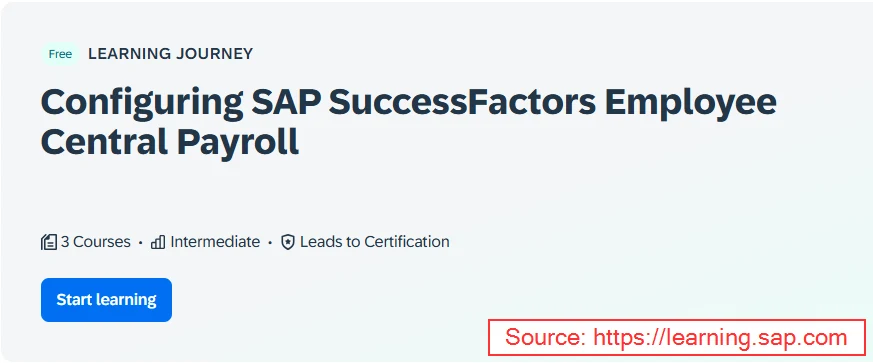
The official Configuring SAP SuccessFactors Employee Central Payroll learning journey brings together three courses with different purposes. Therefore, it should not be treated as one large block of content. Follow the below table for the learning journey:
|
Code |
Topic |
Units |
Time |
What It Covers |
|
HR812 |
SAP SuccessFactors Employee Central Payroll for Payroll Administrators |
8 |
4 hours |
Employee Central Payroll introduction, employee payroll data management, payroll processes and alert resolution, subsequent payroll processes, off-cycle processes, and payroll auditing |
|
HRH60 |
Implementing SAP SuccessFactors Integration with Employee Central Payroll |
5 |
5 hours 8 minutes |
Introducing integration, Understanding process overview, Employee Central configuration, Employee Central Payroll configuration, exploring Appendices |
|
HRH65 |
10 |
12 hours 14 minutes |
Payroll Control Center, Fiori options, best practices, configuration, roles, continuous payroll, subsequent processing, off-cycle processing, authorizations, and tools |
All three courses are available in German, Spanish, French, Japanese, Korean, Portuguese, and Chinese. The first course builds operational payroll knowledge. The second explains integration. The third concentrates on the Payroll Control Center, configuration, roles, and authorizations. SAP lists Consultant, Administrator, and Support Consultant among the relevant roles.
Who Should Take the C_HRHPC_2607 Certification?
This certification is designed for SAP SuccessFactors consultants, payroll specialists, SAP HCM professionals, support consultants, administrators, and those moving to an Employee Central Payroll implementation.
Are you working with payroll processing, employee data, configuration, integration, monitoring, troubleshooting, or payroll control? This course is for you! Someone with no payroll experience can prepare it, but it will take longer to learn.
If you already know payroll, translate that business knowledge into SAP processes. If you're new to both, spend more time on the fundamentals.
Career Benefits of C_HRHPC_2607
1. Builds a Focused Payroll Specialization
The certification gives your professional profile a clearer SAP payroll direction. It can help distinguish a professional who has studied Employee Central Payroll from someone with only general SuccessFactors knowledge. When you differentiate this way, this differentiation can be useful for implementation and support roles in SAP projects.
2. Supports Implementation Career Growth
The implementation focus makes the certification relevant to consultants working on Employee Central payroll projects. Preparation covers configuration, integration, replication, payroll control, and troubleshooting concepts that can appear in real implementation discussions.
Those concepts can help you participate more confidently in implementation discussions.
3. Strengthens Integration Knowledge
Employee Central Payroll does not operate as an isolated payroll application. Employee information, replication, configuration, and monitoring can all impact the end payroll process. It is also essential to understand relationships between elements to help consultants to investigate issues in a more logical way. It will surely be useful in troubleshooting problems crossing system boundaries.
4. Provides Professional Credibility
An SAP certification offers an official credential to back up a resume and professional profile. It shows that the candidate has successfully completed the required assessment for the credential.
Certification shows knowledge, not years of implementation experience.
- Tip: Add your SAP payroll skills as a resume highlight so you can be considered for an implementation project. Skills such as Employee Central Payroll integration and data replication are good to have.
- You may also take help from the C_HRHPC_2607 FAQ for your doubts.
How to Register for the C_HRHPC_2607 Exam
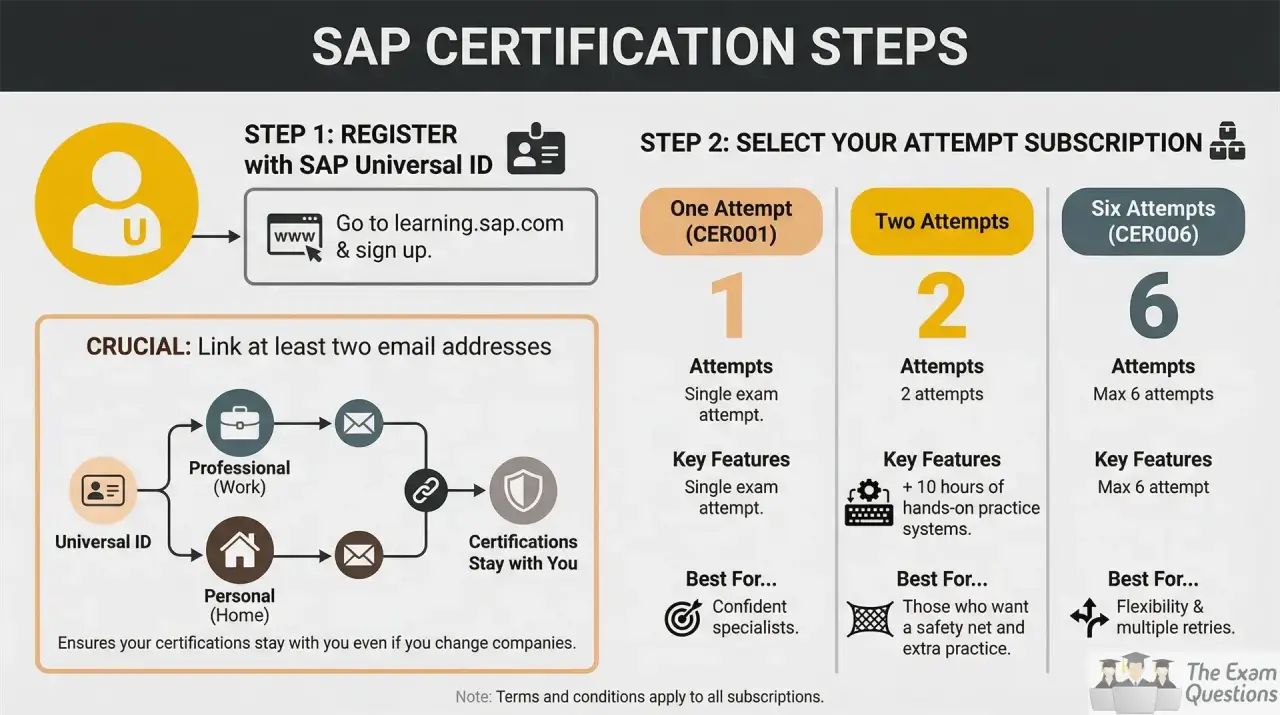
- The first step is to create or sign in to your SAP Universal ID. Use the same account for certification records.
- Open the official SAP certification page. On this page, verify the certification name, exam code, current version, and assessment information. After that make sure to review the purchasing options carefully before paying for an attempt.
- Check the certification benefits included with SAP Learning Hub. SAP Learning Hub offers a broader learning and certification package. It includes certification and maintenance resources for qualified users.
- If you do not have Learning Hub, SAP also provides standalone certification purchase options. The right choice depends on whether you want one certification attempt or expect to continue using SAP’s wider learning and certification ecosystem.
- After purchasing, open your certification dashboard and follow the scheduling instructions. Check technical requirements before exam day. Book when you can explain the major processes without notes.
- Tip: Before you buy, make sure that your S-User or P-User ID is correctly linked with your SAP Universal ID. This helps to avoid delays in account assignment.
Six-Week C_HRHPC_2607 Exam Study Plan
Week 1: Payroll Foundation
In the first week, try to finish the Payroll Administrators course. Then, review Employee Central Payroll, employee payroll data, payroll procedures, alerts, and auditing. You can build a simple process map.
Week 2: Payroll Operations
In the 2nd week go ahead with payroll processes, off-cycle processing, alert resolution, and auditing. Find out what business problem each feature solves.
Week 3: Integration Study Employee Central & Employee Central Payroll Integration
In this week, focus on configuration dependencies, mappings, communication, technical users, and data flow.
Week 4: Replication and Troubleshooting
Continue with point-to-point replication, time information, monitoring, data sharing and troubleshooting since Week 4 is critical.
Trace a hypothetical employee data issue from Employee Central to payroll.
Week 5: Payroll Control Center
Complete the Payroll Control Center course. Study configuration, roles, authorizations, continuous payroll, subsequent processes, off-cycle processes, and tools. SAP’s current course contains ten units and covers these areas directly.
Week 6: Final Revision
Stop collecting new material. Review weak areas and practice scenarios.
- Quick Win: After completing the official SAP material, use the C_HRHPC_2607 PDF questions resource as a revision checkpoint. Mark questions you cannot explain in your words, then return to the related SAP lesson instead of memorising the answer.
C_HRHPC_2607 Exam Retake Rules
If you do not pass C_HRHPC_2607, do not immediately repeat the same practice questions. First identify the weak subject, return to the relevant SAP learning section, and rebuild the concept. Keep these six rules in mind:
- You may retake the same certification exam a maximum of four times within a 12-month period.
- There is a 24-hour waiting period between attempts on the exam.
- In the same exam session, if you do not pass the assessment but there is still time left on the clock (the time remaining for the exam), SAP may give you a second chance to take the assessment immediately. This counts as one exam attempt.
- If you do not pass after four attempts, you must wait 12 months from the date of the last attempt before taking the certification exam again.
- Do not simply repeat questions after an unsuccessful attempt. Go back to the corresponding SAP learning. Change the weak topic and test yourself again with these C_HRHPC_2607 Free questions.
- Before you book another attempt, check the waiting time, remaining attempts, and exam rules that apply to your SAP certification dashboard.
- Tip: Understand the concept, understand why the answer is correct, and then practice. Memorising questions alone is a poor strategy for a retake.
Keeping C_HRHPC_2607 Certification Valid
SAP certification is generally valid for 12 months. To keep an eligible certification active, complete the relevant Stay Certified assessment within the 90 day period before the expiry date; passing it extends the certification for another 12 months.
With an eligible SAP Learning Hub subscription, you can access the required Stay Certified learning content and assessment. Without Learning Hub, the same maintenance assessment may not be available, so you may need to retake the applicable certification exam instead.
- Note: There are variations in SAP rules. Please confirm your certification requirements.
- Quick Win: Put a reminder on your calendar before the 90 day window opens so you don’t miss your certification renewal.
Conclusion
To pass the SAP C_HRHPC_2607 exam, you need to have a good understanding of core payroll processes. Also, you should have knowledge about the integration, and Payroll Control Center configurations. Instead of rote memorization, SAP’s data official learning process helps you prepare for scenario-based assessment challenges effectively.
Want a successful career as an SAP SuccessFactors Payroll Consultant? Pair your credential with hands-on practice and C_HRHPC_2607 Scenario Questions to build a solid foundation for your success.
Want C_HRHPC_2607 Related Supporting Resources? Check below:
C_HRHPC_2607 FAQ | C_HRHPC_2607 PDF questions | C_HRHPC_2607 Free questions l C_HRHPC_2607 Scenario Questions l C_HRHPC_2607 study guide