The Exam Questions presents this article as a practical guide to the C_BCBDC certification, detailing all the essential exam information and preparation strategy.
Official SAP Business Data Cloud Exam Details
|
Items |
Details |
|
Exam Code |
C_BCBDC_2605 |
|
Exam Name |
SAP Certified - SAP Business Data Cloud |
|
Format |
1 activity, scenario-based assessment |
|
Cut Score |
60% |
|
Duration |
2 hours |
|
Learning Journey Size |
4 courses |
|
Learning Journey Level |
Intermediate |
|
Learning Journey Access |
Free |
|
Available Languages |
Available languages vary by format
|
|
Skills Earned |
Data Storytelling, Database Management, Analytics |
- Source to verify this information: SAP Certified - SAP Business Data Cloud.
What Is the C_BCBDC Exam?
SAP Certified - SAP Business Data Cloud is a SAP credential that confirms a candidate’s knowledge of SAP Business Data Cloud. This certification is to demonstrate that the candidate understands the fundamental ideas and capabilities associated with this exam, and can apply that understanding in relation to the solution.
The certification offers professionals a way to validate their SAP Business Data Cloud expertise in a formal manner.
What has changed in the SAP Certified - SAP Business Data Cloud Exam?
The certification has changed from the traditional multiple choice questions to a practical, scenario based approach. This move is part of SAP’s larger shift to performance-based certifications, which measure how candidates apply their knowledge in real world work scenarios.
Want to get some focused practice before taking the assessment? Explore the C_BCBDC_2605 Learning Resources to build your knowledge before the exam.
C_BCBDC_2605 Exam Format
- This exam is available in a scenario-based assessment format.
- The assessment is open-book and non-proctored. This means that candidates may refer to appropriate resources when undertaking the assessment. SAP recommends resources such as SAP Help Portal, SAP Learning, SAP Community, and SAP Joule for Consultants.
- Candidates can take the scenario-based assessment via an AI-guided virtual interview or by recording a video for a SAP evaluator to review.
- Candidates must enable microphone access to start the assessment and can choose to enable camera access.
- Candidates may pause the assessment as needed, however, the overall exam countdown timer continues to run during the paused assessment.
- Once the assessment is complete, candidates can select “Save and view analysis” to see their performance and detailed score before submitting.
- In AI-driven assessment, SAP is focused on semantic intent of the answers, not just on matching keywords.
- Each exam objective is rated on a 1-to-5 scale, from Insufficient to Excellent, according to criteria defined by subject matter experts.
Want to test your understanding ahead of the assessment? Get a sense of the exam style with the C_BCBDC_2605 Free Questions.
Syllabus Coverage Map for C_BCBDC Exam
|
Topics |
Difficulty |
Key Focus |
|
SAP Business Data Cloud Fundamentals |
Medium |
Understand the purpose, key components, main capabilities, business challenges and use cases of SAP Business Data Cloud. |
|
SAP Business Data Cloud Architecture and Provisioning |
Hard |
Understand the architecture of SAP Business Data Cloud and how the platform is provisioned and structured. |
|
Intelligent Content and Intelligent Applications |
Medium |
Discover intelligent content and intelligent applications, and learn how to find, install, and extend them in SAP Business Data Cloud. |
|
Data Products and Data Management |
Hard |
Know data products, their role in SAP Business Data Cloud and how to find, use and extend them. |
|
SAP BW Modernization with SAP Business Data Cloud |
Hard |
SAP BW Transformation Path including SAP BW Modernization, Data Products for SAP BW Data, Data Subscriptions and SAP BW use Cases. |
|
Open Data Ecosystem and Data Sharing |
Medium |
Discover the open data ecosystem and how SAP Business Data Cloud enables you to share SAP data with external data platforms and tools. |
Learning Journey for SAP Business Data Cloud
1. BDC100 - Introducing SAP Business Data Cloud
Duration: 1hr 3min
Units: 3
Contains the key components, capabilities, intelligent content, data products and use cases of SAP Business Data Cloud.
2. BDC150 - Developing Detailed Knowledge of SAP Business Data Cloud
Duration: 1hr 51min
Units: 3
The technical architecture, provisioning, intelligent content, data products and intelligent applications of the platform are discussed.
3. BDCBW1 - Transforming SAP BW with SAP Business Data Cloud
Duration: 4hr 10min
Units: 9
SAP BW transformation, data products, data subscriptions, query templates and use cases of SAP BW.
4. BDCODE - Introducing the Open Data Ecosystem for SAP Business Data Cloud
Duration: 57min
Units: 3
Introduction to the open data ecosystem, types of connections, external tools and sharing data with partner tools.
Who Should Take the C_BCBDC Exam?
- Business users who want to know how SAP Business Data Cloud can help address business data challenges and use cases.
- Consultants with SAP Business Data Cloud experience and data capabilities.
- Business Data and Analytics Professionals.
- Data Scientists interested in learning how to leverage SAP Business Data Cloud to develop data-driven insights.
- SAP Business Data Cloud professionals looking to build or validate their knowledge of the platform, its architecture, data products and use cases.
The products and roles for this certification are listed at Exploring SAP Business Data Cloud.
Career Benefits of the SAP Certified - SAP Business Data Cloud
- Boost your professional credibility with an internationally recognized SAP certification.
- Validate your skills in SAP Business Data Cloud and related SAP technologies to help you grow in your career.
- Get recognized in the job market with certified SAP skills
- Stay on top of SAP’s continuing education and certification strategy.
- Warning: SAP Certification is an asset for career growth and gives you an upper hand over others. But this does not guarantee a job or salary hike.
How to Register and Schedule the C_BCBDC_2605 Exam
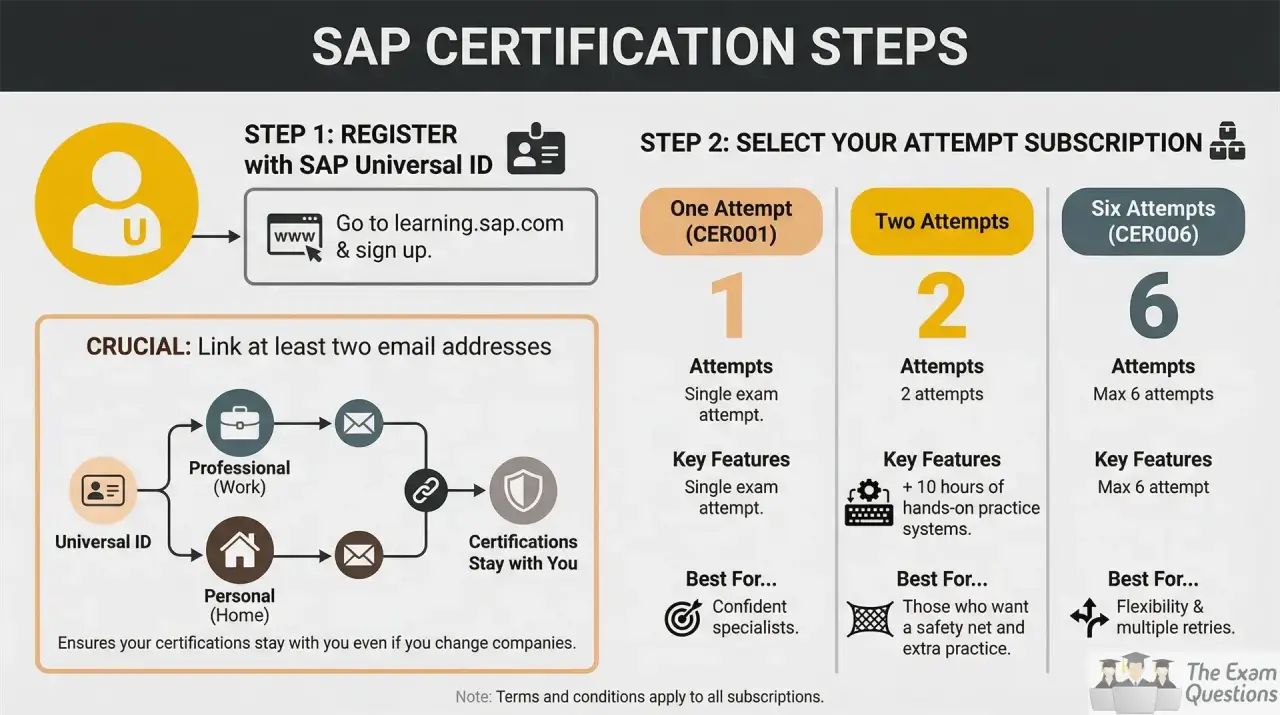
- Ensure that you have a valid certification attempt and your SAP Universal ID is set up correctly.
- Open the certification from the SAP Certification details page via “Go to Certification Exam” or from the learning process via “Open”
- Check the type of assessment, the time available and the number of attempts remaining before you start.
- Click “Start the Certification Exam” to start the scenario-based assessment and countdown.
- Enable microphone access and select between the AI-guided roleplay and human-review option that requires recording and uploading a video.
- Candidates are allowed to use relevant publicly available resources during open-book assessment including the SAP Help Portal, SAP Learning, SAP Community and SAP Joule where applicable.
- The overall exam countdown doesn't pause for you when you pause the roleplay.
- After you complete the assessment, click “Save and view analysis” to find out how you did and receive a detailed score. If you pass, you can submit the assessment.
- If you select the human review option, your recorded video will be reviewed before the result is released and the review process may take up to 20 business days.
6-Week Study Plan for C_BCBDC
1 Week - Lay the Foundations
Discover the complete introduction to the SAP Business Data Cloud course, understand the core components, intelligent content, data products, and use cases.
2 Week - Get to know the Architecture
Discover the technical architecture and provisioning of SAP Business Data Cloud, intelligent content and data products.
3 Week - Expand your knowledge
Understand how data products and intelligent applications are discovered, installed, and extended, and learn more about the platform’s core capabilities.
4 Week - Learn SAP BW Transformation
Focus on SAP BW transformation path, data product generation, subscriptions, query templates and SAP BW use cases.
5 Week - Discover the Open Data Ecosystem
Learn how SAP Business Data Cloud connects with other external tools and shares data across the open data ecosystem.
6 Week - Final Rehearsal
Review the entire learning process, go back to weaker areas and practice applying the concepts to the types of use cases covered by the certification.
Need more practice before the exam? Get hold of key concepts and prepare yourself with C_BCBDC_2605 Pdf Questions.
Common Mistakes in Scenario-Based Assessments
- More attention to keywords rather than the real meaning of your answers.
- Not handling the timer well, especially if you stop the roleplay, since the countdown for the exam is still running.
- Not checking your performance before submission with “Save and view analysis.”
- 2. Not using the available SAP resources for your preparation for the open-book assessment.
- Not checking the assessment language and the technical setup before the start of the exam.
Retake Rules for C_BCBDC_2605
- You may sit for the same certification exam up to four times in any 12-month period.
- You will need to wait 24 hours before trying to take the exam again.
- If you fail the assessment but you have time left on the exam clock, then SAP allows you to retake the assessment immediately and it counts as one exam attempt.
- If you fail four times, you have to wait 12 months from the last attempt before taking the certification exam again.
Have questions about the exam? Check the C_BCBDC_2605 FAQ to clear your doubts.
Keeping Your C_BCBDC Certification Valid
- The certification is valid for 12 months and certification must be maintained with a yearly assessment.
- Complete the Stay Certified assessment within the 90-day window before your certification expires. Passing it extends certification by another 12 months from its original expiration date.
- You need an active SAP Learning Hub subscription to access the Stay Certified assessment and preparation materials. Without Learning Hub, you need to retake the certification exam annually.
- The Stay Certified assessment is a short, non-proctored quiz that you can take as many times as you need.
- Check your certification status and Stay Certified due date under My Learning → Certifications → Manage Certification in SAP Learning.
- If you miss the Stay Certified deadline, you are not certified anymore. You can retake the exam for re-certification.
Conclusion
The C_BCBDC_2605 certification is all about understanding SAP Business Data Cloud and applying its capabilities to business and data use cases. By finishing the official learning path and reviewing the important concepts assessed, candidates can gain the confidence they need to take the exam. SAP’s practical certification approach is designed to test how well candidates can apply their knowledge, rather than simply recall information.
Want to use your new knowledge in real-life situations? C_BCBDC Scenario Questions: Get Prepared & Boost Your Confidence.
For C_BCBDC_2605 Related Resources, Refer To:
C_BCBDC_2605 Learning Resources | C_BCBDC_2605 Free Questions | C_BCBDC_2605 Pdf Questions | C_BCBDC_2605 FAQ | C_BCBDC_2605 Scenario Questions

![Ace the SAP Business Data Cloud C_BCBDC_2605 Exam with Free Real-World Scenario Questions [2026]](https://theexamquestions.com/uploads/blogs/C_BCBDC_Free_questions.webp)