If you are preparing for the SAP Certified - SAP S/4HANA Cloud Private Edition, Service exam, start with the official learning journey and build your preparation around practical service processes. You can also use The Exam Questions resources to strengthen your revision.
Official C_TS470_2601 Exam Details
|
Exam Detail |
Current Information |
|
Certification |
SAP Certified - SAP S/4HANA Cloud Private Edition, Service |
|
Exam Code |
C_TS470_2601 |
|
Type |
System-based Assessment |
|
Assessment Activity |
1 |
|
Duration |
180 minutes |
|
Passing Score |
71% |
|
Language |
English |
|
Validity |
12 months, with an extension path through the stay-certified process |
|
Number of Courses |
5 courses |
|
Roles |
Business User, Consultant |
|
Learning Journey |
Implementing SAP S/4HANA Cloud, Private Edition for Service |
|
Learning Journey level |
Intermediate |
The current SAP certification page presents the exam as a new-format, system-based assessment rather than a traditional multiple-choice exam. SAP also lists the current certification information, including the format, score requirements, and certification path, on its SAP Certified - SAP S/4HANA Cloud Private Edition, Service page.
- Quick Win: Save the official certification page before you begin studying.
What is the SAP Certified - SAP S/4HANA Cloud Private Edition, Service Exam?
The C_TS470_2601 certification is aimed at people who want to understand SAP S/4HANA Service and work with it in a practical way.
The educational process goes beyond learning basic terminology.
You need to understand how service processes work and which service processes manage and support organizational data. Also, how service-related configuration fits into a bigger SAP environment.
This is why reading notes might not be enough. A person can understand what a service contract is but still have difficulty when asked to work through a related process or configuration task.
- Quick Win: Study complete service processes instead of isolated topics.
- Warning: Understanding the theory may not be sufficient for a system-based assessment.
C_TS470_2601 New Exam Format
The current C_TS470_2601 certification uses a system based assessment. The assessment is conducted in English and lasts 180 minutes. You need to score 71% to pass.
Instead of answering a long series of traditional multiple-choice questions, you do activities in an SAP environment. Grasp the process and perform the required tasks within the stipulated time.
A different exam format may be described in older study material. Don’t just accept it as it is; check the facts today. For this assessment, it matters if you have practical knowledge, are able to use the system, understand the process, and execute tasks.
Good time management is also important because the exam clock keeps running while you are working. You can look at tasks that will help you decide if you need to strengthen your product knowledge, process knowledge, configuration skills, or speed.
- Tip: Before you start studying, check out the current C_TS470_2601 exam details on the official SAP page. This way you can start in the right format from day one.
- Quick Win: Now that you know the exam format, you can begin studying with the C_TS470_2601 Free Questions.
C_TS470_2601 Exam Key Topics to Study
|
Key Topic |
What to Focus On |
Difficulty |
|
Service Order Management |
Process flow, service orders, execution steps, and related activities. |
5/5 |
|
Organizational Data |
Organizational elements, their assignments, and application in service processes. |
4/5 |
|
General service processing configuration |
General settings, configuration steps, and their effect on service processing. |
5/5 |
|
RISE with SAP Methodology |
Methodology, SAP Activate Link, main components, and tools. |
3/5 |
|
SAP S/4HANA Service Fundamentals |
Service solutions, organization structures, master data, processes, and analytics. |
3/5 |
|
In-House Repair |
Repair process flow, data, service activities, and closing steps. |
4/5 |
|
Service Contracts |
Contract process, validity, service activities, and configuration dependencies. |
5/5 |
- Quick Win: Allow more time to adapt service contracts, in-house repairs, and service order management. These subjects require more process knowledge than just memorization.
Official C_TS470_2601 Learning Journey
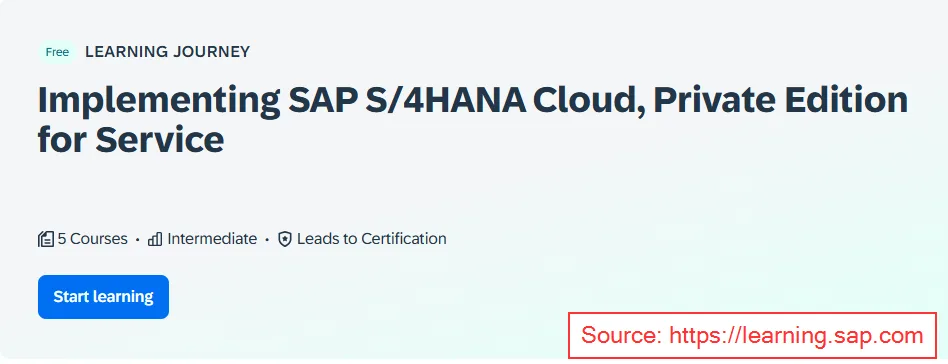
The official learning journey, Implementing SAP S/4HANA Cloud, Private Edition for Service, consists of five courses. The course is of an intermediate level and has no prerequisites.
1. Discovering SAP S/4HANA Service
Course code: S47900 Course level: Beginner
It has a duration of 4 hours and 40 minutes.
Discovering the SAP S/4HANA Service course sets the stage for the rest of the educational experience. It covers employee activities, SAP solutions for service processing, master data and organizational structures, service processes, and service analytics.
The five units are Describing the Day to Day Activities of Employees Working with SAP S/4HANA Service, Identifying Solutions for Service Processing from SAP, Working with Master Data and Organizational Structures in SAP S/4HANA Service, Executing Service Processes with SAP S/4HANA, and Analyzing Service Processes with SAP S/4HANA.
- Tip: Do not rush through this course. It gives you the terminology and process background needed for the harder courses.
- Quick Win: Make short notes on the main service processes before moving to configuration.
- Warning: Skipping the foundation can make later configuration topics much harder to connect.
2. Identifying Business Processes in SAP S/4HANA Service
Course Code: S47000
This is one of the most important courses for C_TS470_2601. It covers solutions and deployment, UI clients, organizational levels, master data, Interaction Center. Also, Service Order Management, additional service processes, In-House Repairs, Service Contracts, Recurring Service, and Analytics.
The course has 11 units, with Service Order Management receiving a significant amount of learning time. That is a good indication that you should not treat every topic as equally important during revision.
- Tip: Do not memorize transactions/screens. Follow the full process.
3. Configuring Organizational and Master Data in SAP S/4HANA Service
Course Code: S47100
This course focuses on the data and structures required to run service processes.
The five units are Creating Organizational Data, Creating Master Data for Organizational Elements, Creating Products and Product Bundles, Configuring and Creating Technical Assets, and Configuring and Creating Measuring Points and Counters.
- Tip: Pay attention to how master data supports the actual service process.
- Quick Win: Create a simple connection between each major master data object and the service process where it is used.
- Warning: Do not study organizational data and technical assets as isolated definitions. Their practical relationship matters.
4. Performing Basic Customizing for Service in SAP S/4HANA and SAP S/4HANA Cloud Private Edition
Course Code: S47500 Course level: intermediate
It has a duration of 17 hours 49 minutes.
This is the longest course in this learning journey. It covers service processing, general configuration, on-site service, In House Repair, Service Contracts, and the technical architecture and configuration of the user interface.
Its six units include Introducing Service Processing in SAP S/4HANA and Learning its Process Steps, Learning the General Configuration of Service Processing, Configuring an On Site Service Process, Configuring In House Repair, Configuring Service Contracts, and Appendix: Understanding the Technical Architecture and the Configuration of the User Interface.
SAP also covers integration with Logistics, Controlling, and CATS in this course.
- Quick Win: Learn the business process first, then study the configuration behind it.
- Warning: This is a dense course. If you try to hurry it, you might end up creating holes in the configuration logic.
5. Introducing RISE with SAP Methodology for SAP Partners and Customers
Course Code: SL_RISE419 Course Level: Beginner
It has a duration of 1 hour 35 minutes.
This course introduces the RISE with SAP Methodology and its connection with SAP Activate. It contains the methodology, main components, recommended tools and the methodology dashboard.
The three units are
- Understanding the RISE with SAP Methodology
- Defining the Key Components of the RISE with SAP Methodology,
- Exploring the RISE with SAP Methodology Dashboard.
- Quick Win: Revise the three units together after completing the course. It is short enough to review in one sitting.
- Warning: Do not ignore this course simply because it is shorter than the configuration courses. It is still part of the official learning journey.
Who Should Take the SAP S/4HANA Cloud Private Edition, Service Exam?
This certification is intended for consultants, SAP service professionals, and business users who are involved with service-related processes in SAP S/4HANA Cloud Private Edition.
It is also ideal for professionals moving into SAP service consulting. It might help to have worked on something like this before. But the preparation should be about understanding how the service processes interact, not memorizing individual screens.
If you work with service orders, technical objects, in-house repair, service contracts, recurring services, analytics, master data, or service configuration, this exam might be particularly relevant to you.
C_TS470_2601 Certification Career Benefits
1. Build SAP S/4HANA Service Expertise
This certification confirms your skills in SAP S/4HANA Cloud. This certification can help you showcase your knowledge.
2. Supporting SAP Service Consulting Roles
If you are looking to move into SAP service consulting or implementation roles, then this certification can help. This certification will enhance your ability to work on configuration and service process-oriented projects.
3. Better Understand Service Processes
You will gain experience in areas including Service Order Management, In House Repair, Service Contracts, Recurring Services and Analytics. This broader knowledge will help you see how the different service activities connect in SAP S/4HANA.
4. Improve Your SAP Career Profile
Adding C_TS470_2601 to your professional profile helps you prove to potential employers that you have invested in a specialized SAP area. Practical knowledge of the system and working on projects can be very useful for career growth.
- Quick Win: In case you have any questions, you can check the C_TS470_2601 FAQ.
How to Register for the C_TS470_2601 Exam
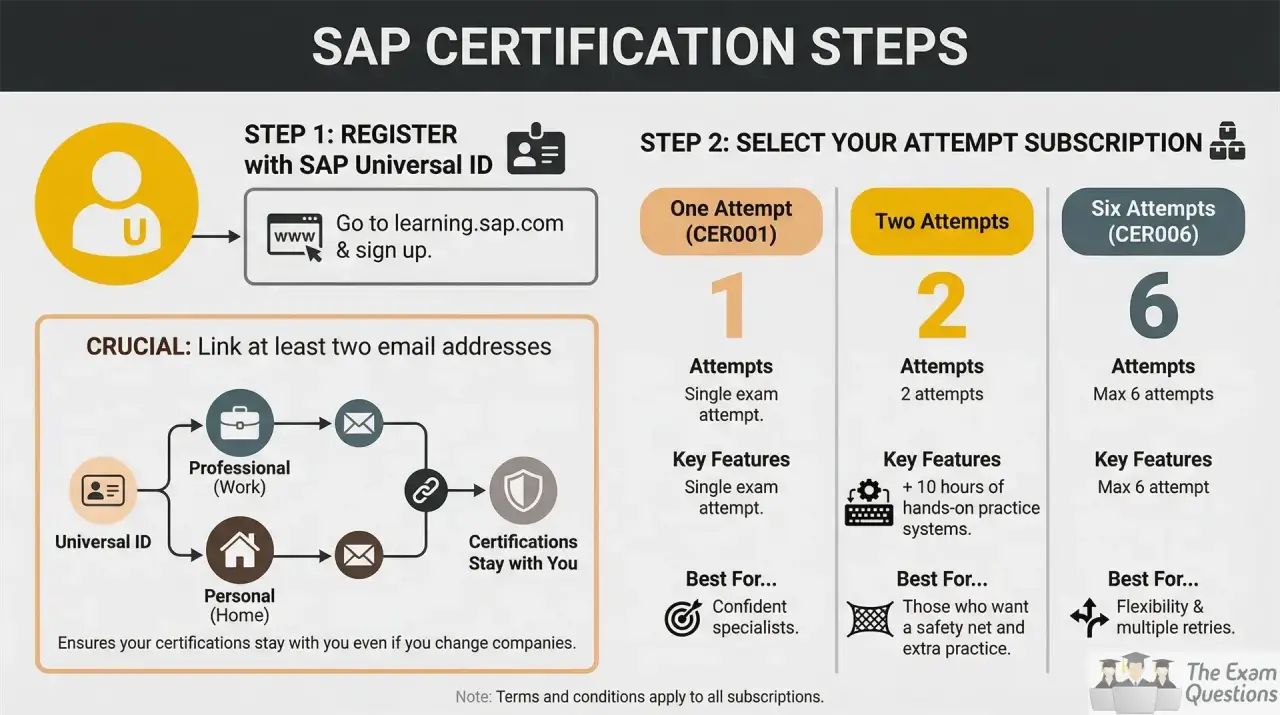
Step 1: Create Your SAP Universal ID
Create or confirm your SAP Universal ID and ensure certification access is linked to the right account.
Step 2: Verify Your Certification Access
Depending on the option you have, either a subscription or an exam attempt, you can become SAP certified. Before starting the registration, please take a look at the available certification options.
Step 3: Go to Official Certification Page
Check the official SAP Certified - SAP S/4HANA Cloud Private Edition, Service certification page for the latest exam updates.
Step 4: Check Current Format
Check the length, passing score, available languages, remaining attempts, and instructions for the assessment. It’s worth being assessed even if you’ve already read a previous exam guide.
Step 5: Start or Schedule the Assessment
Follow the instructions available through SAP's certification path. System-based assessments require you to understand the assessment environment and timing before beginning.
- Warning: Do not assume that registration rules, attempt availability, or assessment processes remain unchanged from an older certification version. Check the live SAP information before committing an attempt.
C_TS470_2601 6-Week Study Plan
Week 1: Build the Foundation
Complete Discovering SAP S/4HANA Service. Focus on service fundamentals, organizational structures, master data, service processes, and analytics. Do not rush through this part. Check out the C_TS470_2601 Study Material; it will help you to study for 6 weeks.
Week 2: Focus on Business Processes
Study Identifying Business Processes in SAP S/4HANA Service. This week you have to pay extra attention to Service Order Management, and Advanced Execution. Additionally, go through In-house Repairs, Service Contracts, Recurring Services, and Analytics.
Week 3: Master Organizational and Master Data
Let's begin week 3 with Configuring Organizational and Master Data in SAP S/4HANA Service. Try to understand in detail about how organizational structures, products, technical assets, measuring points, and counters support service activities.
- Quick Win: Create a simple dependency map showing which master data is connected to each major service process.
Week 4: Study Basic Customizing
It’s already week 4, so complete the basic customizing course. You have to spend extra time on general configuration, on-site service, in-house repair, service contracts, and integration points.
Week 5: Learn RISE with SAP and Start Practical Revision
Complete the RISE with SAP methodology course. Then revisit your weakest areas and begin timed practice.
This is also a good time to compare your understanding with practical scenarios. Do not simply memorize answers. Try to explain why a task or process works.
Week 6: Practice, Review, and Prepare for the Assessment
In week 6, do only revision. Don’t introduce any large new topics of learning. Also think about service processes, master-data dependencies, configuration logic, and where you have made mistakes before.
- Note: Three hours may appear to be sufficient until you start switching between tasks, double-checking details, and correcting errors.
- Tip: During the final week, keep your notes short. Long notes are useful while learning. They are rarely useful during last-minute revision.
C_TS470_2601 Exam Retake Rules
If you do not pass the C_TS470_2601 assessment, avoid immediately repeating the same questions or tasks.
Remember these six rules:
- You may take the same SAP certification exam up to four times within a 12 month period.
- A 24-hour waiting period applies before you can attempt the exam again.
- If you fail while time remains on the exam timer, SAP may allow you to restart the assessment immediately. This still counts as one attempt.
- After four unsuccessful attempts, you must wait 12 months from your most recent attempt before taking the same certification exam again.
- If a technical problem occurs during the assessment, you can submit a support case. For that you have to submit the relevant information and screenshots. SAP will check and tell whether a replacement attempt is available.
- Tip: First understand the concept, then understand why a step/answer is correct, and then practice it.
- Warning: Memorising questions alone is a weak strategy, especially for a system-based assessment.
- Quick Win: You can also use the C_TS470_2601 PDF Questions as an additional revision resource and retake your exam. It will surely help you.
Keeping Your SAP Certification Valid
SAP certification is generally valid for 12 months. To keep an eligible certification active, the maintenance route can depend on whether you have an eligible SAP Learning Hub subscription.
|
Certification Access |
What You Need to Do |
When to Complete It |
What Happens After Passing |
|
Eligible SAP Learning Hub Subscription |
Complete the relevant Stay Certified learning content and annual assessment. |
Within the 90-day period before the certification expiry date |
Your certification validity is extended for another 12 months |
|
Without an Eligible SAP Learning Hub Subscription |
Check the current renewal options available for your certification and access model. If the Stay Certified assessment is not available to you, you may need to retake the applicable certification exam |
Before or around the current SAP rules certification expiry period |
The renewal depends on the certification. Also, it depends on the current SAP access and maintenance rules |
- Quick Win: Add your certification expiry date to your calendar and set a reminder before the 90-day renewal window begins. It is much easier to complete the required assessment when you are not working against the final few days.
How to Prepare for a C_TS470_2601 Certification
The biggest mistake would be treating this certification like an old-style theory exam. Reading is necessary, but practical understanding needs to follow.
First, learn the business process. Then understand the organizational and master data behind it. Then look at the configuration that supports the process. This creates a much stronger mental connection than learning screens or definitions separately.
Practice your weak areas repeatedly. If Service Order Management takes you longer than expected, return to it. If technical assets and measuring points are confusing, review the master-data course again instead of hoping the topic will disappear.
Conclusion
The SAP Certified - SAP S/4HANA Cloud Private Edition, Service certification is best approached as a practical system-based assessment, not a traditional multiple-choice exam. Start with the official SAP learning journey, understand the service processes properly, and give yourself enough time to practice configuration and task flow.
You can use the updated C_TS470_2601 System Tasks as additional learning resources with this guide and SAP learning. When an exam is near, spend time on system tasks, because practical execution and time management can make a real difference in a three-hour assessment.
For Additional Help With Your C_TS470 Exam Preparation, Access These Resources:
C_TS470_2601 Free Questions l C_TS470_2601 Study Material l C_TS470_2601 PDF Questions l C_TS470_2601 FAQ l C_TS470_2601 System Tasks

![Free C_TS470_2601 Exam Questions: SAP S/4HANA Cloud Private Edition, Service System Tasks [2026]](https://theexamquestions.com/uploads/questions/C_TS470_Free_questions.webp)