This article from The Exam Questions will help you explore all the required information related to the C_RISME_2511 exam.
Official Exam RISE with SAP Methodology and Experience Details
The code referred for SAP Certified - RISE with SAP Methodology and Experience exam is C_RISME_2511. The completion time of the C_RISME_2511 exam is 2 hours and contains one activity(Scenario-based assessment).
For the course-related official information, kindly check the details below!
Source to verify latest information regarding C_RISME: https://learning.sap.com/certifications/sap-certified-associate-rise-with-sap-methodology-and-experience
|
Metric / Detail |
Information |
|
Official Exam Code |
C_RISME_2511 |
|
Official Title |
SAP Certified - RISE with SAP Methodology and Experience |
|
Format Label |
1 activity - Scenario Based Assessment |
|
Cut Score |
67% |
|
Validity Period |
12 months (extendable by passing a "stay certified" assessment). |
|
Prerequisite Expectation |
Substantial recent project experience, including at least 24 months of active ERP project involvement within the past 36 months. |
|
Learning Journey Status |
Free |
|
Learning Journey Level |
Intermediate |
|
Core Target Audience |
Consultant, Project Manager, Architect |
|
Language Support |
SAP's platform supports multiple languages in general, but you should verify the exact language offered on your live exam screen before starting. |
What is C_RISME_2511 certification?
The C_RISME_2511 code is the public exam code for the certification titled SAP Certified - RISE with SAP Methodology and Experience. As per SAP, this certification validates consultants by testing their understanding of customer business requirements and successful implementation execution in the real-world. As per official SAP site, the three main skills to earn with this examination are Project Implementation, SAP Clean Core, and System Implementation.
- Pro Tip: It is important to note the prerequisite for the certification exam to understand what level of judgment the scenarios expect from the SAP candidates.
- Warning: Do not get confused with the sites or pages that mix the naming, level, and version logic, instead prefer using the official SAP Learning page as the source to verify the current certification title and format.
What changed in the C_RISME_2511 Certification Model?
The SAP exam for C_RISME_2511 has changed the traditional memorization approach to a new practical certification model and labels it as a scenario-based assessment. This new-format tests your knowledge & ability based on how well you can explain decisions, and apply the RISE with SAP Methodology in real scenarios. This contributes in adding problem-solving skills, hands-on experience, implementation and configuration skills with subject-based practical knowledge.
These scenario-based exams can run in an AI-guided mode or through a human-reviewed video submission. The scoring focuses on the candidate’s semantic understanding and expert-defined criteria which makes it a practical-driven assessment rather than a classic multiple-choice test.
- Pro Tip: To be exam-ready, refer C_RISME_2511 Learning Guide.The candidate must build their preparation around spoken explanations by building the ability to understand and define methodology steps.
- Warning: Do not prefer sites or resources that list outdated materials for C_RISME_2511 or claim it as a standard MCQ exam.
- Quick Win: Instead of following legacy prep advice, first go through the official certification page and the scenario-based assessment FAQs to get the latest update on its syllabus, format and exam objective.
Exam format for C_RISME_2511
As per the official certification page, there will be 1 activity - Scenario Based Assessment and a 67% cut score while practical exams are open-book and non-proctored. In SAP’s practical exam, the candidates are able to use public SAP resources such as SAP Learning (where allowed). This approach is granted for finding & researching valuable information instead of memorizing notes during exams.
- Take the exam from the official SAP’s certification page which requires a valid certification attempt and a properly configured SAP Universal ID to submit the test.
- You must allow microphone access(mandatory), and camera access.
- You may complete the assessment in an AI-guided mode or use the human reviewer route by recording and uploading a video and make sure to review performance through save and view analysis before you make any submission.
- If you choose the human reviewer route while completing the assessment then the result can take up the time of 20 business days to get revealed.
- The pause button stops the roleplay interaction. It does not stop the exam countdown.
- The scenario-based assessments are evaluated based on semantic intent and against expert-defined scoring criteria.
If the new scenario format feels unfamiliar, then try Free C_RISME_2511 Exam Scenario Questions. The Exam Questions has prepared this practice question set based on the current exam format to help you master response structure, gain exam confidence, and build decision logic before exam day.
- Pro Tip: As scenario-based assessments reward clear reasoning, so to avoid bloated answers, practice answering out loud in 60 to 90 second blocks.
- Warning: Pausing the interaction does not extend time; the countdown continues running even during a pause.
Learning Journey Breakdown
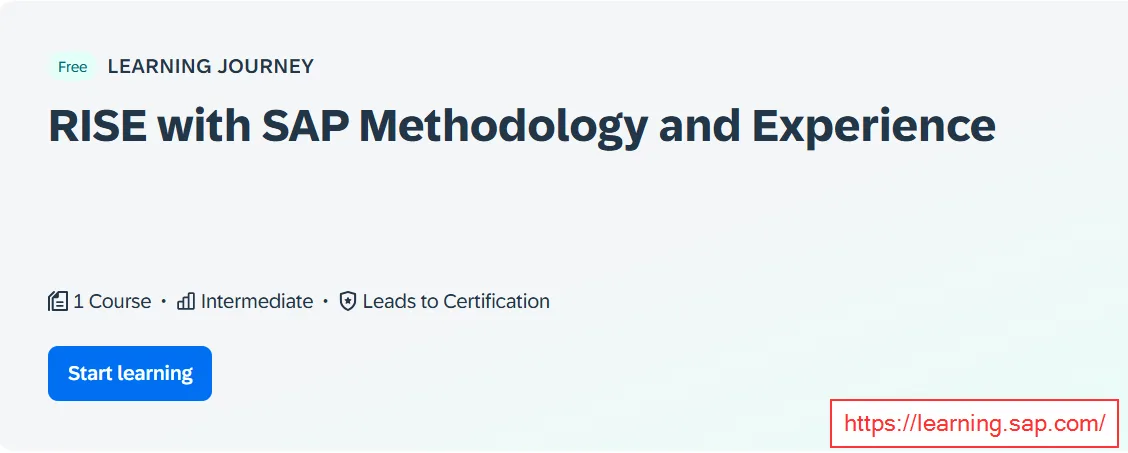
The official learning journey lists one course with the course card as Introducing RISE with SAP Methodology for SAP Partners and Customers.The level is marked as intermediate and the journey is aimed for Architect, Consultant, and Project Manager roles.
Course 1: SL_RISE419 - Introducing RISE with SAP Methodology for SAP Partners and Customers
This course gives you the learning path as follows:
- Introducing the SAP Business Suite
- The RISE with SAP Methodology
- The Standardized Framework
- The Transformation Preparation Service
- Clean Core Fundamentals
- The RISE with SAP Methodology Dashboard
- RISE with SAP Validated Partners
- Joule for RISE with SAP Methodology
Prerequisites and Readiness Check
SAP designed this certification for professionals having substantial recent project experience, including at least 24 months of active ERP project involvement within the past 36 months. Along with the project experience, the prerequisite is to have a deep understanding of the RISE with SAP Methodology concepts, where the candidate is able to explain project phases, clean core trade-offs, and toolchain roles without reading a script.
Syllabus and Topic Priority Map
|
S.NO |
Topic |
Difficulty |
Key Focus |
Tip / Warning |
|
1 |
RISE with SAP Methodology Foundations |
2/5 |
Understand why the methodology exists and what business problem it solves. It supports cloud transformation through four pillars: a structured approach, a standardized framework, an integrated toolchain, and expert guidance. |
Learn the "why" before the "what". |
|
2 |
Standardized Framework & SAP Activate Linkage |
3/5 |
How the methodology augments SAP Activate across the six phases (Discover, Prepare, Explore, Realize, Deploy, Run). Know where onboarding, digital discovery, quality gates, questionnaires, and enterprise architecture feedback fit in each phase. |
Know the governance intent, not just phase names. |
|
3 |
Clean Core Fundamentals |
4/5 |
The five clean core dimensions: processes, extensions, data, integrations, and operations. Also cover why SAP pushes extensions to BTP, and how governance runs through Cloud ALM plus a Customer Center of Expertise. |
Standardize core → extend on BTP → govern → keep upgrades clean. |
|
4 |
RISE With SAP Methodology Dashboard & Cloud ALM |
4/5 |
More than a feature list: system view, operations view, clean core adherence, version insights, tool readiness, upgrade preparation, and KPI aggregation. Cloud ALM is the central engine for visibility and governance. |
Memorize three verbs for the dashboard: access, analyze, manage. |
|
5 |
Transformation Preparation Service |
4/5 |
How TPS turns vision into execution: tailored roadmaps, entitlement mapping, governance sessions, AI and SAP Build use cases, and toolchain activation, all aimed at faster time-to-value. |
Not a workshop, it's the vision-to-execution bridge. |
|
6 |
Expert Guidance, Validated Partners & Stakeholder Roles |
3/5 |
How guidance flows across SAP, partners, onboarding advisors, and enterprise architects. Learn clean core quality gates, and project quality discipline. |
Know who does what, not just theory. |
|
7 |
Joule for RISE with SAP Methodology |
3/5 |
Joule as context-aware guidance embedded in ERP and Cloud ALM, enabling guided actions, project phase awareness, and clean core success plan execution. |
Explain workflow value, skip buzzwords. |
Who should take this exam
- SAP consultants
- Project managers on SAP transformation programs.
- Architects
- Experienced partner-side transformation leads.
Explore RISE with SAP Methodology and Experience Learning Journey to verify the course-based required skills, prerequisite details and other relevant information.
Career benefits of C_RISME_2511
- Target roles: SAP transformation consultant, solution/enterprise architect, and project or engagement manager on RISE with SAP programs.
- Validated skills: project implementation, clean core adherence, system implementation, and methodology-driven governance.
Steps (Buying Guide) to take exam C_RISME_2511
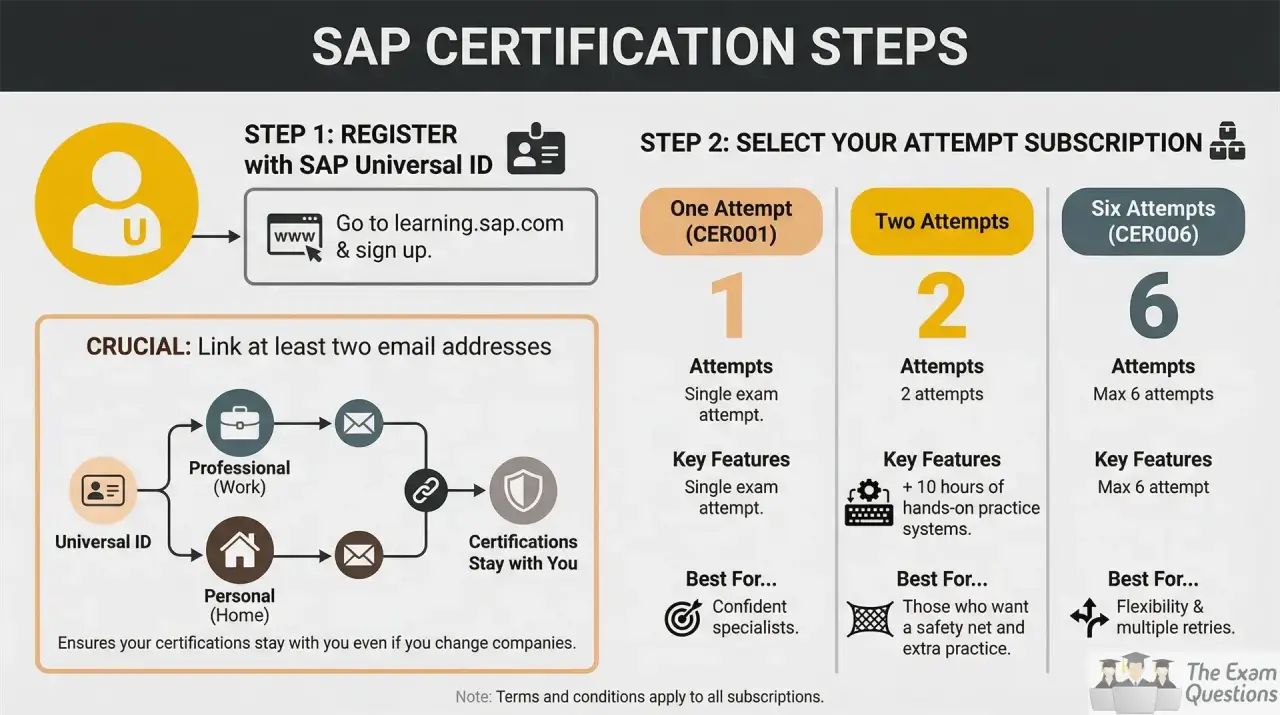
1. Register with an SAP Universal ID
Sign up at the official SAP Learning site. To ensure your certifications stay with you even if you change companies, link at least two email addresses (professional + personal) to your Universal ID.
2. Select Your Attempt Subscription
|
Subscription Type |
Attempts |
Key Features |
|
One Attempt (CER001) |
1 |
Single exam attempt. |
|
Two Attempts |
2 |
2 attempts + 10 hours of hands-on practice systems. |
|
Six Attempts (CER006) |
6 |
Max 6 attempts (max 3 per specific exam). |
- Pro Tip: For study materials, consider the SAP Learning Hub subscription for "Stay Certified" assessments and 4 exam attempts per year plus full access to all the training content.
3. Purchase, Access and Schedule via the Exam Dashboard
- Click the "Schedule" or "Go to Certification Exam" button.
- Click on "Exam Dashboard" to find your exam in the list and click the Calendar Icon to pick a date and time.
- Important: Set your Time Zone manually, otherwise it defaults to UTC if left blank.
4. Prepare for the New Exam Formats
- Explore new format based material : C_RISME_2511 PDF Questions
5. Maintain Your Badge ("Stay Certified")
Retake rules for C_RISME_2511
- You can retake the exam immediately if you fail while there is still time left on the clock. It will be counted as one exam attempt.
- You can reattempt the same certification up to four separate times in a 12 month period, but make sure to wait 24 hours between exam attempts.
- Considering the worst case: if you do not pass after four attempts, you must wait one year after the final attempt before taking the exam again.
Clear your doubts regarding the course with C_RISME_2511 Exam FAQs.
Keeping your certification valid
Within 15 minutes of SAP certification completion, the scores are available in My Learning > My Certifications. To keep it valid for 12 months, SAP certifications require an annual "maintenance" to remain valid.To further extend its validity, you must make sure to complete a "Stay Certified" assessment on the SAP Learning portal before the expiration date.
If somehow SAP retires a certification,then any learner who still holds a valid certificate on the retirement date gets an additional 12 months of validity from that retirement date to extend its timeline.
- Pro Tip: Put your expected expiry month in your calendar to make yourself alert before its expiration.
Conclusion
Simply utilising C_RISME_2511 summary notes for preparation are no longer enough. It is the kind of exam where you should prepare questions related to scenario-based and practical implementation to gain hands-on experience, clean-core thinking ability, and strong methodology communication.
To help you succeed on this journey, The Exam Questions has curated effective learning materials. Get expert-based 2026 updated C_RISME_2511 scenario questions featuring downloadable PDFs only at The Exam Questions.
For More C_RISME_2511 Related Study Resources, Check Below:
C_RISME_2511 FAQ | C_RISME_2511 Scenario-based practice tests | C_RISME_2511 Pdf questions | C_RISME_2511 Free questions | C_RISME_2511 Learning Guide