Preparing for the SAP Certified - Data Analyst - SAP Analytics Cloud exam requires more than remembering definitions or feature names. The Exam Questions can support your preparation with exam questions and practice resources that help you check how well you understand the concepts.
C_SAC_2601 Official Exam Details
|
Item |
Detail |
|
Certification |
SAP Certified - Data Analyst - SAP Analytics Cloud |
|
Certification Code |
C_SAC_2601 |
|
Passing Score |
60% |
|
Assessment Format |
Scenario-Based Assessment |
|
Exam Duration |
120 minutes |
|
Languages Available |
Available languages vary by format: Roleplay with AI guidance: English, Spanish, Italian, French, Japanese +25 more Video recording: English only |
|
Learning Journey |
Becoming a Certified Data Analyst in SAP Analytics Cloud |
|
Learning Journey Level |
Intermediate |
|
Stay Certified Model |
12 month validity with an annual renewal path |
|
Skill Areas |
Data Visualization, Business Planning, Data Modeling, and Data Analysis |
- Warning: Do not assume details from an older SAP Analytics Cloud certification apply automatically to C_SAC_2601. Use the SAP Certified - Data Analyst - SAP Analytics Cloud page as your final reference.
What Is the SAP Certified - Data Analyst - SAP Analytics Cloud Exam?
The C_SAC_2601 exam checks your understanding of important SAP Analytics Cloud tasks. These are about working with data, building and using models, analyzing information, building stories, and using planning features.
The assessment is based on applied knowledge. You will be required to analyze a business situation to determine which SAP Analytics Cloud feature or approach applies to the requirement.
For example, knowing what a dimension means is useful, but you should also know where it belongs and how it affects the model.
- Quick Win: After each topic, explain the feature in your own words without looking at your notes.
- Warning: A high score from repeatedly answering the same questions does not always mean you understand the topic.
New C_SAC_2601 Exam Format
The SAP Certified - Data Analyst - SAP Analytics Cloud code is C_SAC_2601. This exam uses a scenario-based assessment format. Some questions can set up a scenario and ask you to find the best course of action, characteristic, or strategy. So don't just focus on exact definitions.
You have 120 minutes to complete the assessment, so reading carefully matters.
Start by understanding what the question is asking. Then think about the SAP Analytics Cloud feature that fits the requirement. This approach is more reliable than searching immediately for a familiar keyword.
The exam requires a 60% cut score. Your goal should therefore be understanding the major concepts across the learning journey.
- Quick Win: During practice, read the requirement before reading the answer options.
- Tip: If two answers seem correct, compare them against the exact business requirement in the question. For additional practice, you can use the C_SAC_2601 free questions.
C_SAC_2601 Key Areas to Cover
SAP connects this certification with four main skill areas: Data Modeling, Data Visualization, Data Analysis, and Business Planning. The suggested study hours below are practical recommendations.
1. Data Modeling and Data Preparation
- Recommended Study Time: 18 to 20 hours
- Let’s start with how data gets into SAP Analytics Cloud and is prepared for use. Data sources and links; models, dimensions and measures; calculations, and hierarchies. Transformations, Import models and live models, geographic data, and basic data security.
- The main purpose is to understand the structure of the data and why a certain model is suitable for a requirement.
- Quick Win: Spend extra time on dimensions and model structures, as you will use these concepts everywhere in the rest of the areas.
2. Data Visualization and Story Design
- Recommended Study Time: 14 to 16 hours
- In this unit you’ll learn about study stories, story pages, charts and tables, filters, input controls, calculations, sorting, formatting, and presenting.
You need to know how different elements in a story help users to read and explore information. Creating a chart is only half the work. Filters, calculations, layout, and interaction can also affect the usefulness of a story.
- Quick Win: Build one small story after studying the topic instead of only reading about the features.
3. Data Exploration and Analysis
- Recommended Study Time: 12-15 hours
This area is about getting deeper into the subunits. In this area you will learn filtering, sorting, calculations, drill-down, comparisons, navigation, and data exploration. You will also study how data analysis helps you look at that information, compare results, find patterns, and understand differences in numbers.
4. Business Planning
- Recommended Study Time: Around 10 to 12 hours
In this section you will learn about planning models, versions, and dimension members. Also study more on planning tables, manual planning, Fluid Entry, mass entry, planning features, and planning processes.
Planning can feel different from reporting because users may enter or change values. This makes it useful to understand the role of versions and planning activities.
5. SAP Analytics Cloud Basics and Content Management
- Recommended Study Time: About 5 to 7 hours
It is also an important section of the course. It covers the SAP Analytics Cloud environment and the relationships between its key capabilities. You have to study well about how to organize, share, and manage analytics content at a high level.
SAP Certified - Data Analyst - SAP Analytics Cloud Learning Journey
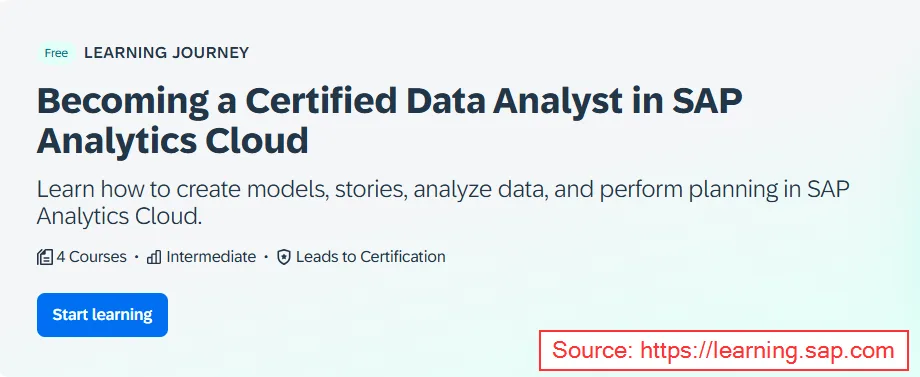
The official learning journey, Becoming a Certified Data Analyst in SAP Analytics Cloud, contains four main courses. These courses should form the main structure of your preparation. All four courses are available in German, Spanish, French, Japanese, Korean, Portuguese, and Chinese languages.
|
Code |
Topic |
Level |
Unit |
Time |
What It Covers |
|
SACE11 |
Beginner |
8 |
4 hours 55 min. |
Core SAP Analytics Cloud features, data sources and connections, data modeling, basic and advanced stories, planning, augmented analytics, and collaboration features. |
|
|
SACS21 |
Intermediate |
5 |
5 hours 2 min. |
Stories, Building Stories, Configuring Story Elements, Manipulating Data in Stories, Presenting Stories |
|
|
SACP23 |
Intermediate |
6 |
5 hours 51 min. |
Exploring SAC Planning, Working with Versions & Dimensions, Performing Manual Planning, Using Core Planning Features, Coordinating & Controlling Processes, Performing Seamless Planning |
|
|
SACP34 |
Leveraging Advanced Features in SAP Analytics Cloud for Planning |
Advanced |
8 |
7 hours 32 min. |
Advanced SAC Planning Features, Copying Data, Advanced Formulas, Multi Actions, Data Allocation, Currency Conversion, Forecasting & Simulation, Planning Process with Calendar |
Who Should Take the C_SAC_2601 Exam?
- The C_SAC_2601 certificate is for SAP Consultants working with SAP Analytics Cloud solutions.
- This certification helps Reporting and BI Professionals to enhance their knowledge on reporting, business intelligence, and analytics.
- This certification may be beneficial for Business Users working regularly on data, reports, and analytics in SAP Analytics Cloud.
- It will also benefit candidates who have reporting experience and can better understand stories and visualize data.”
- Data modeling concepts may be easier for people with data experience to learn.
- Quick Win: First, identify your weakest area and allocate your study time accordingly.
Career Benefits of C_SAC_2601 Certification
1. Develops Clear SAP Analytics Credential
With C_SAC_2601 you can demonstrate that you have acquired the fundamental abilities of SAP Analytics Cloud in Data Modeling, Visualization of Data, data analysis, and Business Planning. If you are new to SAP analytics, this certification can give employers and recruiters a better idea of what technology area you are preparing for. Combined with projects, hands-on learning, or relevant work experience, it can add weight to a profile.
- Quick Win: Add the certification on SAP Analytics Cloud to your CV.
2. End-to-End Analytics Workflow
The learning process demonstrates the linkage of different tasks in SAP Analytics Cloud. You're not just learning how to make a chart. You work the path from data and models through to analysis, stories, and planning, too. This wider understanding can be useful when you get a business requirement because you can think beyond the final dashboard and think about the data and model behind it.
- Quick Win: Build one small project that follows the entire process from data to story.
- Tip: When studying, relate each new feature to the stage it belongs to.
3. Supports Multiple Analytics
SAP Analytics Cloud expertise can support the roles associated with data analysis, business intelligence, reporting, dashboard development, and SAP analytics consulting. Different companies use different titles, so you may be doing the same work but calling it something else.
4. Provides SAP Knowledge
The certification can help you get experience in SAP data and analytics. Once you understand the basic environment, models, stories, analysis, and planning features, it becomes easier to contextualize related learning. The value does not finish when you pass the assessment. By continuously practicing with datasets, stories, models, and planning scenarios, you can over time turn certification knowledge into practical capability.
- Tip: See the C_SAC_2601 FAQ for detailed answers about preparation, eligibility, and certification access.
How to Register for C_SAC_2601
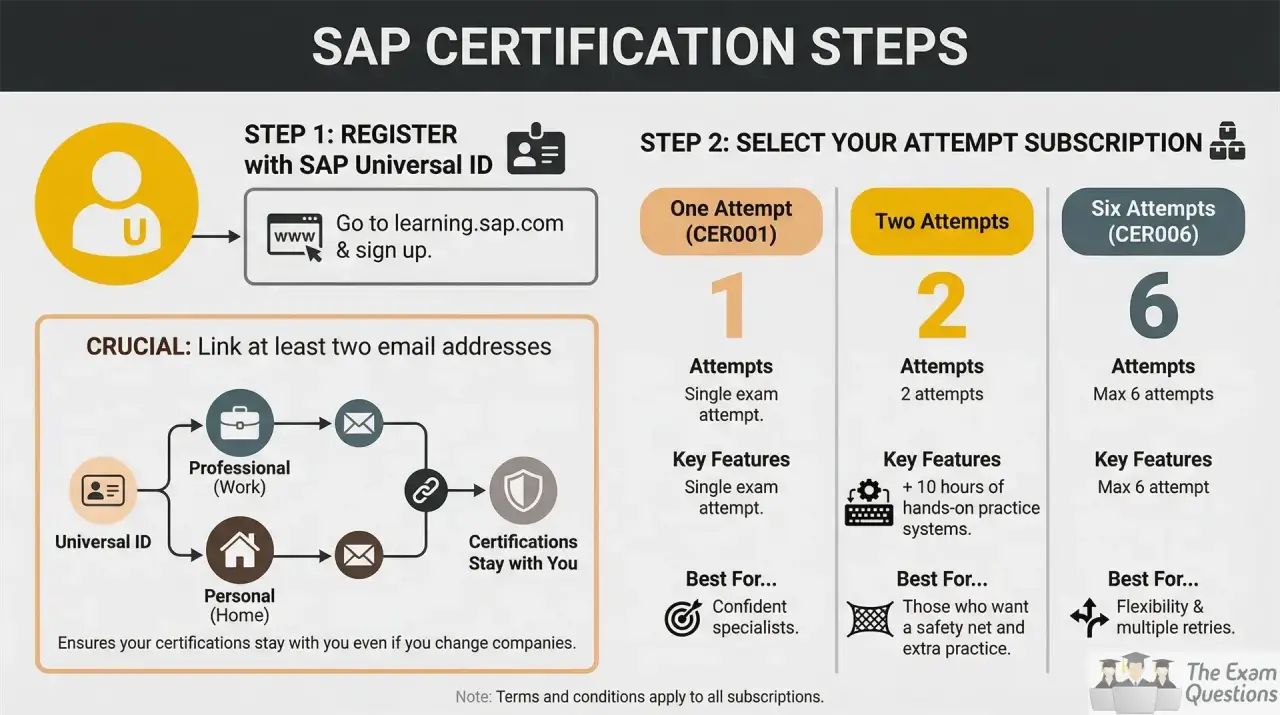
- Create your SAP Universal ID and ensure that you have an active account with updated certification requirements. Learn the different ways to get certified.
- SAP also states that two e-mail addresses should be assigned to the Universal ID for certification use.
- Go to the official certification page for SAP Certified Data Analyst - SAP Analytics Cloud and check that the exam code is C_SAC_2601.
- Make sure your device, browser, account, and system are compliant well before exam day. See your System Tasks link for detailed practical requirements.
- Quick Win: Get your account, access, booking, and system checks done well before the exam date you want.
- Note: SAP may change certification availability and requirements; please check the official information before booking.
C_SAC_2601 Exam Six-Weeks Study Plan
Week 1: SAP Analytics Cloud Introduction
You can start with SAP Analytics Cloud exploration in 1 week. Before we go into the detailed topics, spend some time getting to know the platform, data sources, modeling, stories, planning, and collaboration.
- Quick Win: Make short notes on new terms you come across.
- Warning: Do not jump into practice questions without knowing the basics.
Week 2: Move to Data Modeling
Once you are familiar with the basics, then you can move on to Data Modeling. Spend most of your time this week on dimensions, data structures, transformations, import models, live models, geographic data, and security.
Week 3: Understanding Stories
In the third week you can proceed to Designing Stories in SAP Analytics Cloud. Now, start studying story elements, calculations, filters, sorting, exploration, and presentation.
- Quick Win: Create a simple practice story while you’re studying.
Week 4: Learn Manual Planning
By the fourth week you can move to Performing Manual Planning with SAP Analytics Cloud. Learn about planning models, versions, dimension members, tables, manual input, and planning processes.
- Warning: Don't leave the whole planning section for the last couple of days.
Week 5: Return to Weak Spots and Practice
In the fifth week, you will be able to review all the material you have studied and see what is still challenging for you. This is a good time to test your understanding with C_SAC_2601 study material.
Week 6: Exam Preparation & Revision
You can revise through your notes in the final week. Practice more on your weak areas; practice reading scenario-based questions.
- Quick Win: Your final week should be about revision and filling in small gaps.
C_SAC_2601 Exam Retake Rules
- You may retake the same certification exam a maximum of four times within a 12 month period.
- There is a 24-hour waiting period between exam attempts.
- If you fail and there is time remaining on the exam clock, SAP might give you a chance to retake the test immediately. This is considered one exam attempt.
- If you fail after 4 attempts on the certification exam, you have to wait 12 months from the date of your last attempt to retake it.
- Warning: Do not book another attempt without your remaining attempts.
How to Keep Your C_SAC_2601 Certification Valid
SAP certification is generally valid for 12 months. Eligible SAP Learning Hub users can maintain certification through the Stay Certified process and the relevant annual assessment.
Complete the required Stay Certified assessment within the 90 day period before the certification expiry date. Passing the assessment extends the certification for another 12 months.
Completing the assessment early within that 90 day period does not reduce your remaining validity. The extension is based on the original expiry date.
Without the relevant SAP Learning Hub subscription, the same maintenance assessment may not be available. You may have to retake the relevant certification exam, depending upon the current SAP rules.
- Note: Certification maintenance rules can vary according to access and current SAP requirements.
- Warning: Missing the renewal period may mean you need to follow a different route to regain certification.
C_SAC_2601 Preparation Mistakes to Avoid
Avoid starting with practice questions before learning the basic concepts. You can use the C_SAC_2601 PDF questions for revision. Do not give every topic equal time if Data Modeling or Business Planning is clearly weaker for you. Also avoid collecting too many unrelated resources because it can create confusion.
- Quick Win: Pick one primary resource to study and a few secondary resources.
Conclusion
C_SAC_2601 covers Data Modeling, Data Visualization, Data Analysis, and Business Planning. Along with the scenario questions practice, the official SAP learning journey should remain the center of your preparation.
Give more time to the areas you genuinely find difficult. Before exam day, complete your preparations with C_SAC_2601 scenario questions. This brings you closer to your certification.
For C_SAC_2601 Related Resources, Refer To:
C_SAC_2601 FAQ l C_SAC_2601 study material l C_SAC_2601 free questions l C_SAC_2601 PDF questions I C_SAC_2601 scenario questions