The C_ARP2P_2601 certification is designed for professionals preparing for SAP Ariba Procurement implementation and scenario-based assessment. The Exam Questions article brings together the exam details, key topics, learning journey and practical preparation guidance. The best approach is to use practice material to test your understanding.

Official SAP Ariba Procurement Exam Details
|
Exam Detail |
Current Information |
|
Exam Name |
SAP Certified - Implementation Consultant - SAP Ariba Procurement |
|
Exam Code |
C_ARP2P_2601 |
|
Exam Type |
Scenario-Based Assessment |
|
Assessment Activity |
1 activity |
|
Duration |
120 minutes |
|
Languages Available |
Available languages vary by format:
|
|
Passing Score |
60% |
|
Certification Validity |
12 month validity with an annual renewal path |
|
Official Learning Journey |
Implementing SAP Ariba Procurement |
|
Learning Journey Level |
Intermediate |
|
Learning Journey Courses |
18 |
- Note: For the latest certification information, always check the SAP Certified - Implementation Consultant - SAP Ariba Procurement page before registering.
What Is the SAP Certified - Implementation Consultant - SAP Ariba Procurement Exam?
The C_ARP2P_2601 is the certification exam for SAP Ariba Procurement. It is aimed at people who need to understand SAP from an implementation perspective.
This exam also tests how different procurement functions connect in a real implementation. For example, a configuration decision can affect approvals, receiving, invoice reconciliation or the overall buying process, so you should study the relationship between features rather than treating each topic separately.
- Note: Study the procurement process as one complete flow instead of memorizing individual features.
- Pro Tip: You can use the C_ARP2P_2601 study guide to prepare for the exam.
What Changed in C_ARP2P_2601 Exam Format?
The current C_ARP2P_2601 assessment uses a scenario-based assessment with 1 activity and a 60% cut score. The listed duration is 120 minutes.
The scenario format changes how you should study. Instead of just asking what a feature does, your preparation should help you explain what you would do in a practical situation.
For example, do not only learn approval rules. Understand how an approval condition can change the approval flow and why an administrator would configure it.
- Warning: Do not prepare only by memorizing questions. SAP is moving its certification portfolio toward scenario-based formats, so understanding how to apply the concepts matters.
- Quick Win: During revision take one procurement scenario and explain what action you would take at each stage.
Key Topics to Cover for C_ARP2P_2601 Certification
The key topics for the certification are listed below. The C_ARP2P_2601 Free Questions can also help you understand and revise each topic more effectively.
1. Procurement Process Flow
- Difficulty: 3/5
In this section understand the flow from requisition and approval to purchase orders, receiving, invoicing and reconciliation.
2. Core Configuration
- Difficulty: 4.5/5
Now focus on the configuration decisions that define the behavior of SAP Ariba Procurement. This is particularly relevant for an implementation-focused certification.
3. Approval Rule
- Difficulty: 4.5/5
Study approvable, approval processes, approval conditions, approvers, chain rules, edit rules and approval parameters.
4. Guided Buying
- Difficulty: 4/5
In this section learn how Guided Buying enhances the buying experience and enforces business rules to determine which approvals are required for requests and documents.
5. Catalog Management
- Difficulty: 4/5
In this section learn about catalog setup, catalog content Items and attributes Loading and management
6. Contract Compliance
- Difficulty: 3.5/5
Now let us understand the relation between procurement transactions and contracts and the different strategies for contract compliance.
7. Receiving
- Difficulty: 4/5
Receiving means confirming that ordered goods or services have been received. Study receipt approval rules, receiving by the requester, central receiving and the conditions that determine who performs or approves a receipt.
8. Invoice Reconciliation
- Difficulty: 4/5
Understand how invoices are checked and reconciled against procurement information including the rules and exceptions that can affect processing. Invoice management is part of the official learning path.
9. Integration
- Difficulty: 4/5
Integration is one of the core areas. In this topic study how SAP Ariba Procurement connects with other SAP Ariba capabilities and external systems.
- Quick Win: Link each topic to a real procurement scenario before revising.
- Warning: Don’t study configuration topics in isolation. Their settings can affect the wider procurement flow.
C_ARP2P_2601 Exam Official Learning Journey
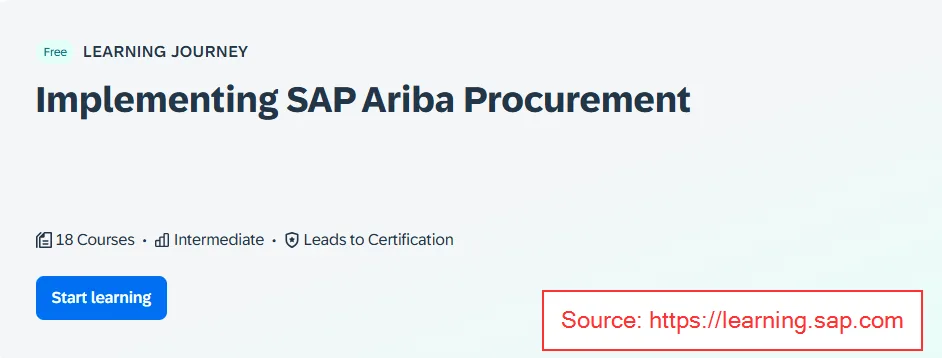
The official learning journey Implementing SAP Ariba Procurement is at an intermediate level and includes 18 courses.
|
Course Code |
Course Name |
Time |
|
ARP010 |
1 hr 6 min |
|
|
ARP100 |
1 hr 23 min |
|
|
ARP101 |
2 hr 5 min |
|
|
ARP102 |
3 hr 10 min |
|
|
ARP104 |
20 min |
|
|
ARP200 |
59 min |
|
|
ARP201 |
46 min |
|
|
ARP203 |
2 hr 24 min |
|
|
ARP204 |
4 hr |
|
|
ARP300 |
2 hr 33 min |
|
|
ARP301 |
3 hr 40 min |
|
|
ARP340 |
4 hr 10 min |
|
|
ARP341 |
1 hr 53 min |
|
|
ARP342 |
3 hr 40 min |
|
|
ARP343 |
4 hr 10 min |
|
|
ARP344 |
4 hr 21 min |
|
|
TAR73 |
SAP Ariba Procurement: Implementation Consulting and Configuration |
1 hr 12 min |
|
AR820 |
1 hr 47 min |
The 18 courses move from core procurement processes such as requisitions, purchase orders, receiving and invoicing to advanced areas such as catalogs, approval rules, configuration and integration. This gives you both process knowledge and implementation-focused understanding.
The courses are not equally difficult, so spend more revision time on configuration, approval rules, catalogs, receiving and integration.
- Quick Win: Think Request → Approve → Order → Receive → Invoice → Reconcile. Then connect the relevant course to each stage instead of studying all 18 courses as separate topics.
Who Should Take the C_ARP2P_2601 Exam?
This exam suits SAP Ariba consultants, administrators and business users who want to move toward implementation work. It can also help professionals working with procurement processes, buying and invoicing, catalog management or SAP Ariba integrations. This certification may be especially useful for professionals who already understand procurement workflows and want to build stronger SAP Ariba configuration skills.
It is less suitable for someone who only knows basic end user navigation. The implementation consultant title gives you a clear clue about the expected mindset.
- Tip: Review your current SAP Ariba knowledge first and identify whether you are comfortable with both procurement processes and configuration concepts.
- Quick Win: If you can explain how a requisition moves through approval, ordering, receiving and invoicing you already have a useful foundation for this certification.
Career Benefits of SAP Ariba Procurement Certification
- The certification demonstrates structured knowledge of SAP Ariba Procurement and can strengthen your professional profile.
- It supports SAP Ariba consulting roles and implementation focused opportunities.
- In addition, this certification offers proof to your employers of your SAP knowledge and your commitment to developing relevant skills.
- The certification can support future career opportunities when combined with practical SAP Ariba project experience.
- Quick Win: The C_ARP2P_2601 PDF Questions will help you revise key concepts. Also it will help you to practice applying your knowledge before the assessment.
How to Register for C_ARP2P_2601 Certification
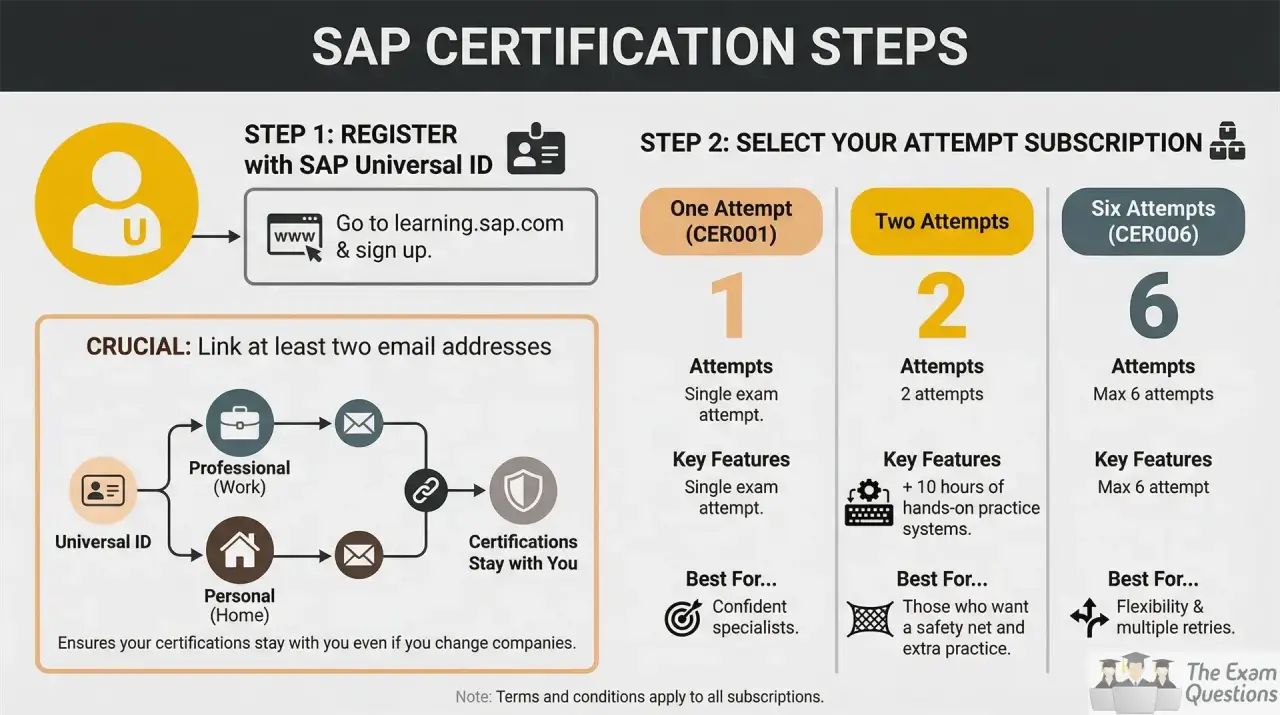
- Create or verify your SAP Universal ID.
- Add and verify your email addresses so your certification record remains connected to you.
- Choose a valid certification attempt or SAP Learning Hub option.
- Open the certification details and confirm your exam entitlement.
- Start the assessment using the SAP certification option.
- View your SAP digital certification badge and certification status after you pass.
- Registration Path: SAP Universal ID → Certification → Valid attempt → Exam launch → Certification result → Digital badge
Before you click Start:
- Check your SAP Universal ID
- Check your certification entitlement
- Test your browser and permissions
- Keep your network stable
- Know where the assessment launches from
Six Week C_ARP2P_2601 Study Plan
Week 1: Complete the overview, requisition, purchase order and receiving courses. Understand the complete procurement flow.
Week 2: Study invoice creation with invoice reconciliation and reporting. Connect each transaction with its business consequence.
Week 3: Cover catalogs, catalog items, contract compliance and Guided Buying. Compare release and no release contract situations.
Week 4: Focus on receiving configuration, approval rules and realm configuration. Spend extra time here because configuration logic is harder to learn passively.
Week 5: Complete implementation consulting and integration. Practise explaining master data, transactional data and integration points.
Week 6: Stop collecting new resources. Practice scenario answers and reinforce weak areas. Use the official learning content first then use practice material to test recall and decision making.
- Six-Week Rule: Weeks 1 to 4 = Build | Week 5 = Connect | Week 6 = Challenge
- Tip: By the final week, stop collecting new study material and focus on applying what you already know to procurement scenarios.
Retake Rules for C_ARP2P_2601 Certification
- SAP's current scenario-based rules allow you to retake the same certification exam a maximum of four times within a 12 month period.
- There is a 24-hour waiting period between attempts.
- If you do not pass the assessment but there is still time left on the exam clock, SAP may provide a second chance to take the assessment immediately. This is counted as one exam attempt.
- If you fail after four attempts, you must wait 12 months from the date of your last attempt before taking the certification exam again.
- Pro Tip: If you still have doubts you can go through the C_ARP2P_2601 FAQ for quick answers.
Keeping C_ARP2P_2601 Certification Valid
- SAP digital certifications are generally valid for 12 months. Eligible SAP Learning Hub users can maintain certification through the Stay Certified process and the relevant annual assessment.
- For eligible certifications complete the relevant Stay Certified assessment within the 90 days before the certification expiry date. Passing it extends the certification for another 12 months.
- If you have an SAP Learning Hub subscription check whether C_ARP2P_2601 is eligible for the Stay Certified option before its validity period ends.
- If you do not have the required subscription check SAP's current renewal rules. You may need to retake the applicable certification exam instead.
- Quick Win: Add the expiry date to your calendar and set a reminder when the 90-day renewal window opens. This will leave you with enough time to complete the required maintenance assessment.
Conclusion
The C_ARP2P_2601 SAP Ariba Procurement exam requires a good understanding of the end-to-end procurement flow and key implementation areas. Review the official SAP learning plan and focus on your weakest courses and don’t add too many new resources at the last minute. Make your final preparation practical and focused. Revisit the topics where configuration decisions can impact the broader procurement process.
You have to keep your final preparation practical and focused. Also you can revisit topics where configuration decisions affect the wider procurement process.
The C_ARP2P_2601 Scenario Questions can help you practise key SAP Ariba Procurement processes and configuration concepts. They also reinforce the official course content and improve your practical understanding.
For Additional C_ARP2P_2601 Exam Study Materials, Checkout:
C_ARP2P_2601 FAQ l C_ARP2P_2601 Study Guide l C_ARP2P_2601 Free Questions l C_ARP2P_2601 PDF Questions l C_ARP2P_2601 Scenario Questions