The C_THR85_2605 certification helps companies to identify, evaluate, and develop replacements for future roles. SAP SuccessFactors Succession Management is designed for professionals who require practical knowledge of configuring and working with Succession Management. You can get exam-ready by visiting The Exam Questions. This guide compiles current exam information, key topics, the SAP learning journey, preparation strategies, registration steps, retake advice, and certification validity.

C_THR85_2605 Official Exam Details
The below table has all SAP SuccessFactors Succession Management exam details:
|
Exam Detail |
Information |
|
Exam Name |
SAP Certified - SAP SuccessFactors Succession Management |
|
Exam Code |
C_THR85_2605 |
|
Exam Type |
System-Based Assessment |
|
Format |
1 activity |
|
Duration |
180 minutes |
|
Passing Score |
58% |
|
Language |
English |
|
Delivery |
Online |
|
SAP Role |
Consultant |
|
Certification Validity |
12 months |
- Note: Before scheduling the assessment, check the SAP Certified - SAP SuccessFactors Succession Management page for the latest certification information. SAP may change the assessment schedule, eligibility criteria, or learning materials.
What Is the SAP SuccessFactors Succession Management Exam?
The certification code for SAP Certified - SAP SuccessFactors Succession Management is C_THR85_2605. This is to cover the skills needed to get up and running with Succession Management.
Succession Management is more than simply finding an employee to fill a future role. It combines jobs, successors, preparedness, talent information, permissions, talent pools, reporting, and other talent procedures.
A useful way to study is to map each feature to a business question.
Question: "What's getting fixed here?" Then ask “Who needs access to it?” and “What will the user see after I configure it?” This makes technical issues easier and prepares you for real situations.
Moreover, the C_THR85_2605 study materials will help you to grasp key concepts and find areas that might need more revision.
- Tip: Whenever you study any topic, do not memorize the definition of it. Try to relate the feature to a configuration task, user role, permission, and intended system result. This is especially helpful for practical, system-based examinations.
New C_THR85_2605 Exam Format
C_THR85_2605 is a System-Based Assessment that consists of one activity and takes 180 minutes to complete. This varies from earlier SAP certification formats, which were mainly reliant on multiple-choice tests.
According to SAP's practical assessment guidance, system-based examinations require applicants to perform practical activities in an SAP environment. The result is decided by completing the necessary activities and achieving the desired system output. Thus, reading about a configuration is beneficial. However, knowing where to make the change and understanding its impact are more important.
- Warning: Do not assume that the exam can be passed just by knowing the theory behind each feature. Read each task carefully. Plan your time for the 180-minute assessment.
Key Topics for C_THR85_2605 Exam
|
Key Topic |
What to Cover |
Priority |
Difficulty |
|
Succession Management Configuration |
Provisioning, Admin Center, company settings, role-based permissions, XML, readiness ratings, Check Tool |
Very High |
High |
|
Succession Nomination Methods |
Role-Person, Position-Based, and MDF-Position-Based Nominations |
Very High |
High |
|
Position Model and Position Data |
Position creation, maintenance, relationships, and succession use |
Very High |
High |
|
Succession Org Chart |
Navigation, XML, nominations, readiness, criticality, Bench Strength, history, integrations |
Very High |
High |
|
Role-Based Permissions |
Permissions for Succession, Talent Search, Talent Pools, and Matrix Grid Reports |
Very High |
High |
|
Talent Search |
Search criteria, filters, exact matching, saved searches, ranking, Search Toolbar |
High |
Medium to High |
|
Succession Talent Pools |
Pool nominations, permissions, filters, columns, role associations |
High |
Medium |
|
Matrix Grid Reports |
Permissions, rating scales, settings, icons, filters, XML, Performance Potential, How vs. What |
Very High |
High |
|
Position Tile View and Lineage Chart |
Position search, filters, and succession relationships |
High |
Medium |
|
People Profile and Succession Data |
Employee data, configuration, XML translations, picklists |
High |
Medium |
|
Talent Cards and Presentations |
Talent Card configuration and employee information for talent discussions |
Medium |
Medium |
|
Succession Data Imports and Calibration |
Successor imports and Calibration in succession planning |
High |
Medium |
|
Position Criticality and Bench Strength |
Critical positions and readiness-based Bench Strength |
High |
High |
For additional practice, you can also try the free questions available at C_THR85_2605 Free Questions. These can help you strengthen your practical understanding alongside the official SAP learning content.
C_THR85_2605 Exam Learning Journey

The Configuring SAP SuccessFactors Succession Management has all detailed concepts for the exam. You can find areas that require more revision or use additional resources to reinforce concepts.
The THR80 SAP SuccessFactors Platform Introduction Academy contains 9 units. This 8 hour, 43 minute course is designed for beginners. The basic configuration concepts are included, such as MDF and Business Rules, and Role-Based Permissions. This course also covers the SAP SuccessFactors platform, user and employee data, navigation, and a basic platform architecture. This foundation is important because Succession Management builds on principles at the platform level before going into module-specific setup.
The main certification study subject is THR85 – SAP SuccessFactors Succession Management Academy. There are 11 units and roughly 9 hours and 37 minutes of learning content in this course. This is an intermediate-level course. These units include configuration, People Profile, Position Model, nomination methods, Talent Search, Talent Pools, and Succession Org Chart. This course also includes the Position Tile View and Lineage Chart, Matrix Grid Reports, Talent Cards, presentations, succession data, calibration, and guidance for consultants.
The Hands-on Practice for Introduction to SAP SuccessFactors Academy provides the opportunity to practice basic navigation and features of the course. The Hands-on Practice for SAP SuccessFactors Succession Academy gives you hands-on practice to apply succession management principles to real-life exercises. These exercises will help the learners understand how the concepts work in a real SAP SuccessFactors environment.
Both academies are available in German, Spanish, French, Japanese, Korean, Portuguese, and Chinese, in addition to the English content. The courses can be useful if you prefer reviewing complex concepts in another supported language.
For preparation, complete the Platform Introduction Academy first and then move to the Succession Management Academy. Keep the learning journey as your main study map and complete the academy topics in sequence wherever possible.
Knowing the basics first can make the more difficult topics much easier to understand. After you have completed each unit, think about how you might apply them in a real work situation. If you can connect your learning to examples in the real world, it can help you remember it.
- Quick Win: Focus on the concepts. Once you understand it, it will help you on how they interact in the system. Also, consider what a consultant should think about when implementing the solution.
- Note: The exam may contain a variety of tasks or scenarios, so don't rely just on memorization of predetermined certification questions.
How to Register for the C_THR85_2605 Exam?
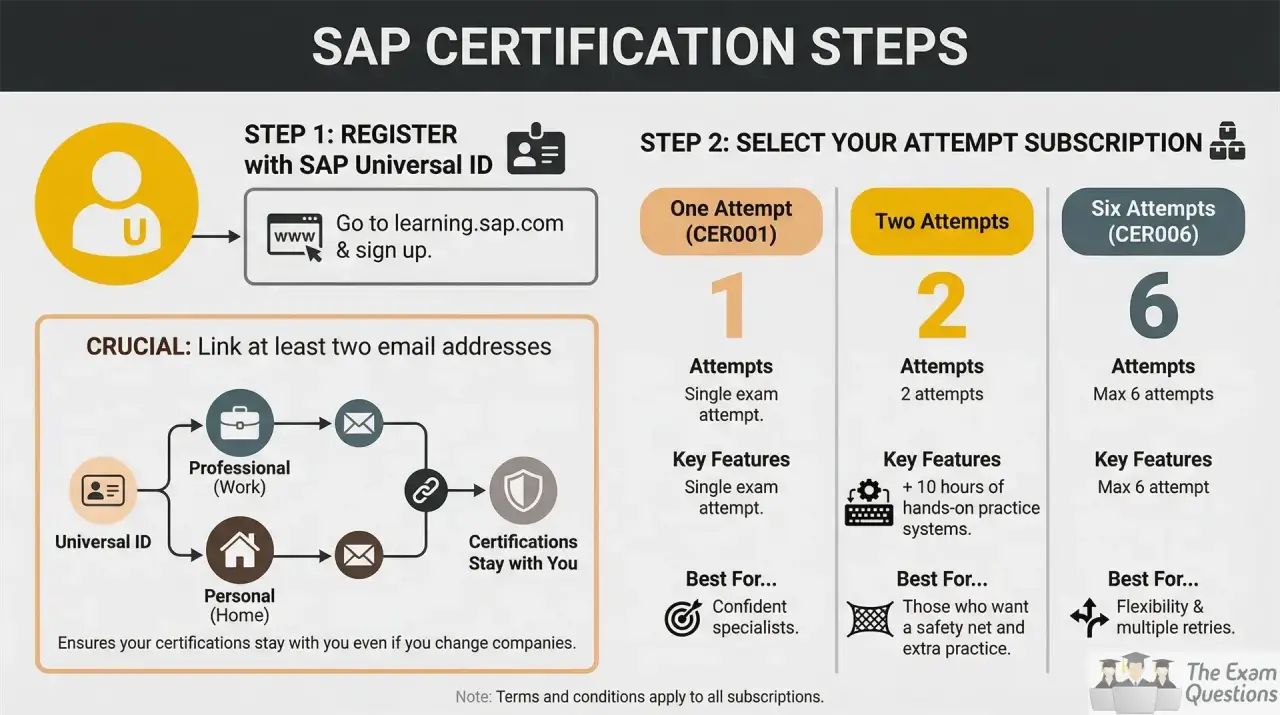
- Create or sign in to your SAP Universal ID.
- Open SAP Learning and locate the C_THR85_2605 certification.
- Review the current assessment format, eligibility, and available attempts.
- Purchase the required certification attempt or use an eligible SAP Learning Hub subscription.
- Open the certification in the SAP Learning certification area.
- Follow instructions for the System-Based Assessment and start when prepared.
A Practical Six-Week Plan
Week 1
Complete the foundation material and begin Succession Management configuration. Review Provisioning, Admin Center, permissions, company settings, and the general platform structure.
Week 2
During week 2, focus on nomination methods, the position model and position data. Compare Role Person, Position Based, and MDF Position Based Nominations instead of memorizing names.
Week 3
Spend most of your time on the Succession Org Chart. Cover readiness, nominations, position criticality, Bench Strength, XML, permissions, and nomination history.
Week 4
Study Talent Search, Talent Pools, Position Tile View, and Lineage Chart this week. Then practice choosing the right tool for a given business requirement.
Week 5
This is a make-or-break week. Start with Matrix Grid Reports, Talent Cards, presentations, succession imports, and Calibration.For more revision resources, you can practice scenarios with C_THR85_2605 PDF Questions. This will help strengthen what you have learned.
Week 6
Go over all topics, as this is the last week. Additionally, you can practice completing tasks in a specific amount of time. Revisit weak areas instead of repeatedly studying topics you already know.
- Quick win: create a one-page revision sheet with only configuration names, purpose, dependencies, and common permission considerations. This is more useful than carrying pages of copied definitions into the final review.
Who should take the C_THR85_2605 exam?
The certification is important for SAP SuccessFactors consultants, implementation experts, HR technology experts, and learners who are developing their skills in Succession Management. Candidates preferably have a fundamental understanding of the SAP SuccessFactors platform and complete the recommended THR80 – SAP SuccessFactors Platform Introduction Academy before preparing for the THR85 – SAP SuccessFactors Succession Management Academy.
You don’t need years of SAP experience to start preparing, but having a base in SuccessFactors and knowing basic configuration principles may make the learning process a lot smoother.
Career Benefits of C_THR85_2605
The C_THR85_2605 certification will help you get a better understanding of SAP SuccessFactors Succession Management and its core functions. It can also help you find positions such as SuccessFactors Consultant and Implementation Consultant. This certificate is also useful for positions as an HR technology professional.
Certification prep gives you a “hands-on” understanding of configuration, permissions, talent data, and succession processes. It can also help you understand configuration, permissions, talent data, and succession processes in real work situations.
C_THR85_2605 Retake Policy
Here are the critical retake policies for the system-based C_THR85_2605 exam:
- You may retake the same certification exam a maximum of four times within a 12-month period.
- There is a 24-hour waiting period between attempts on an exam.
- If you don’t pass the assessment, but there is still time left on the exam clock, you can retake the assessment immediately (counted as a one exam attempt).
- If you do not pass, after four attempts you must wait 12 months from the date of your last attempt before retaking the certification exam.
- In case of any technical issue with the system, you can raise the support case. For this you have to submit details and screenshots. SAP will check the issue and decide whether a replacement attempt can be provided.
- Tip: Keep a record of your attempts and the times between before booking another assessment.
- Note: Rules for certification can be changed; please check the current SAP certification page before you take the assessment again.
C_THR85_2605 Maintenance of Certification
SAP certifications are usually valid for 12 months. If you are an eligible candidate with an active SAP Learning Hub subscription, you can use the Stay Certified process. This includes a mandatory yearly assessment. SAP states that the assessment is an unproctored assessment and that candidates have unlimited attempts. The Stay Certified window is normally open 90 days prior to certification expiration.
Without SAP Learning Hub, candidates generally have to buy and retake the full certification exam to renew. Always check SAP’s current Stay Certified guidance before renewing your certification. Eligibility, assessment requirements, and renewal rules may change.
- Warning: Do not wait till the last days before expiry; check with SAP the latest renewal rules and your eligibility.
Preparation Checklist - Final
Before the evaluation, be ready to describe the objective and configuration of key areas (e.g., permissions, nomination methods, roles, preparedness, Succession Org Chart, Talent Search, Talent Pools, Matrix Grid Reports and related data processes).
Remember, knowing that a feature is available is not the same as knowing how to configure it. Instead of memorizing long definitions, focus on the right screen, configuration, dependencies, permissions, and intended outcome for a realistic assessment. You can also check out the C_THR85_2605 FAQ for other common certification questions for extra revision.
- Tip: Think like a consultant: what has to be configured, where, why, and what should the user see afterward?
Conclusion
The C_THR85_2605 certification is hands-on; therefore, focus on practical understanding. Start with THR80, then go for the Succession Management Academy and SAP standard learning experience. Configuration, authorization, nomination methods, Succession Org Chart, Matrix Grid Reports. Focus on using real-world examples rather than trying to memorize answers. For revisions and exact preparation, you can take help from the C_THR85_2605 system tasks. Learn the system, do the activities, and check the latest exam criteria before you sit your exam.
Keep Building Your C_THR85_2605 Knowledge with These Resources.:
C_THR85_2605 study materials I C_THR85_2605 Free Questions I C_THR85_2605 PDF Questions I C_THR85_2605 FAQ I C_THR85_2605 system tasks

![Free C_THR85_2605 Exam Questions: SAP SuccessFactors Succession Management System Tasks [2026]](https://theexamquestions.com/uploads/questions/C_THR85_Free_questions.webp)