This guide by The Exam Questions is a great resource to prepare for the current exam format, key areas to prepare for, educational journey, registration process, study plan, retake rules and certification validity.

Official C_FIORD Exam Details
|
Items |
Details |
|
Exam Name |
SAP Certified - SAP Fiori Application Developer |
|
Exam Code |
C_FIORD_2601 |
|
Format |
1 activity, Scenario Based Assessment |
|
Cut Score |
60% |
|
Duration |
2 hours |
|
Available Languages |
Available languages vary by format
|
|
Prerequisites |
Learning the basics of SAP Fiori |
|
Learning Journey Size |
6 courses |
|
Learning Journey Level |
Intermediate |
|
Learning Journey Access |
Free |
- Source to verify this information: SAP Certified - SAP Fiori Application Developer.
What Is SAP Certified - SAP Fiori Application Developer?
This certification validates skills and knowledge to develop SAP Fiori applications using SAP development technologies and tools. It includes concepts and techniques for building and extending SAP Fiori applications, SAPUI5 and SAP Fiori elements, working with application data and services.
The SAP Fiori Application Developer certification is a globally recognized validation that identifies persons who are capable of demonstrating a thorough knowledge of SAP Fiori application development.
What’s New in the C_FIORD Exam?
SAP has rolled out a new performance-based certification model that is more than just multiple-choice testing. The new model emphasizes application of knowledge and skills and does not emphasize the recall of theoretical knowledge.
The thinking here is that this is a more practical way to validate professional skills and to see if candidates can apply their knowledge to situations relevant to their certification.
Need focused prep materials? Broaden your knowledge with C_FIORD_2601 Learning Resources.
SAP Fiori Application Developer Exam Format
- C_FIORD_2601 is a scenario based test.
- This is an open-book, non-proctored assessment. This means that candidates may refer to any useful material in completing the exam.
- SAP recommends the following resources, where applicable: SAP Help Portal, SAP Learning, SAP Community, SAP Joule for Consultants.
- Candidates can complete the assessment either through an AI-guided virtual interview or by recording and uploading a video to be evaluated by SAP experts.
- You'll need microphone access to start the assessment. Camera access is optional.
- If necessary, the candidates may pause the roleplay, but the exam timer continues to run during the pause.
- Candidates can click on “Save and view analysis” after completing the assessment to check their performance and detailed score before submission.
- SAP uses semantic understanding instead of keyword matching to score the AI-driven responses. Each exam objective is scored from 1 (Insufficient) to 5 (Excellent) based on criteria defined by subject matter experts.
Want to test yourself before the assessment? C_FIORD_2601 Free Questions will help you learn key concepts to prepare for the types of scenarios you might encounter.
Syllabus and Topic Areas for C_FIORD
|
Topics |
Difficulty |
Key Focus |
|
SAP Fiori Elements |
Medium |
Get to know SAP Fiori elements and its architecture, including the main floorplans and their use. |
|
SAP Fiori Elements Application Development |
Hard |
Develop, extend, and customize SAP Fiori elements applications using SAP development tools and Guided Development. |
|
SAPUI5 Application Development |
Hard |
Get to know SAPUI5 initialization, views, controllers, controls, fragments, models, data binding, localization, and components. |
|
SAP Fiori Application Data and Services |
Medium to Hard |
Understand how applications interact with models, data binding, and the services that provide application data. |
|
SAP Fiori Application Adaptation and Extension |
Hard |
Adapt and extend SAP Fiori applications according to the development requirements and using the right SAP Fiori development approaches. |
C_FIORD_2601 Learning Journey
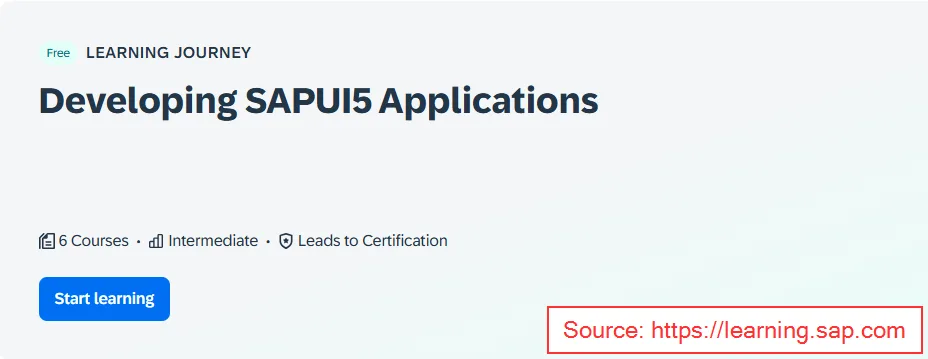
1. UX100 - Learning the Basics of SAP Fiori
Duration: 23hr 25min
Units: 7
Upon completion of this course developers will be able to: work with SAP Fiori applications, understand the architecture and principles of SAP Fiori, configure and customize applications, adapt and mobilize SAP Fiori applications, and integrate SAP Fiori across different environments.
2. UX400 - Developing UIs with SAPUI5
Duration: 11hr 21min
Units: 10
After completing this course you will be able to describe SAP’s UX strategy and SAPUI5, use SAP Business Application Studio, load and initialize SAPUI5, modularize applications, work with XML views, view controllers, components and fragments, adapt applications for various device types, implement models and data binding, internationalize applications, consume OData services, and use SAPUI5 routing and navigation features.
3. UX402 - Advanced SAPUI5 Development
Duration: 8hr 42min
Units: 6
In this course you will learn how to implement full-screen and list-detail applications, work with UI5 controls, ensure software quality in your UI5 applications and implement version control.
4. UX405 - Developing an SAP Fiori Elements App Based on a CAP OData V4 Service
Duration: 9hr 19min
Units: 14
You will learn about the key benefits of SAP Fiori elements and the newest features of SAP Fiori tools. You will gain practical experience with SAP Business Application Studio, CAP-based data models and OData services, advanced List Report and Object Page features, multiple table views, side effects, external navigation, and the flexible programming model for extending SAP Fiori elements applications with custom code.
5. UX406 - Getting Started with Creating an SAP Fiori Elements App Based on an OData V4 RAP Service
Duration: 5hr 38min
Units: 11
On successful completion of this learning process, developers will be able to: describe the benefits of SAP Fiori elements, identify the benefits of OData V4 and SAP Fiori elements for OData V4, configure UI features by using the corresponding ABAP CDS annotations in the backend, use SAP Fiori tools to create and develop SAP Fiori elements applications efficiently, differentiate between available SAP Fiori elements templates, explain internal and external navigation, use the flexible programming model for custom code, manually deploy SAP Fiori elements applications to a SAP BTP account.
6. UX410 - UI Development with SAP Fiori
Duration: 1hr 50min
Units: 5
After completing this course, you will be able to apply the Golden Rules of SAPUI5 development and SAP Fiori design guidelines, provide applications through SAP Fiori Launchpad implementation, implement SAPUI5 flexibility, and extend existing SAP Fiori applications.
Who Should Take the C_FIORD_2601 Exam?
- SAP Fiori developers who build, customize and enhance SAP Fiori apps.
- SAPUI5 developers who develop SAPUI5 applications, controls, models, data binding, OData services and navigation.
- Developers who use SAP Fiori elements and wish to develop applications with SAP Fiori tools, templates and the flexible programming model.
- SAP developers working with SAP Cloud Portal service and SAP Fiori who want to prove their application-development skills.
- Developers who use SAP Fiori technologies and want to take a SAP certification exam to validate their knowledge and skills.
The prerequisites and products and roles for this certification are listed at Developing SAPUI5 Applications.
Career Benefits of SAP Fiori Application Developer
- Earn a globally recognized SAP certification to validate your SAP Fiori development skills.
- Establish professional credibility by demonstrating certified knowledge and skills in SAP technology.
- Demonstrate certified SAP skills to boost your employability.
- Keep your SAP skills aligned with new technologies and solutions to help your career growth and mobility.
- Share your credential in a professional way with a digital SAP Certification badge.
- Warning: SAP says that certification may help you move your career forward and show that you have the skills to support your knowledge, but does not guarantee a job, promotion, salary increase or any specific career outcome.
How to Register and Schedule the C_FIORD Exam
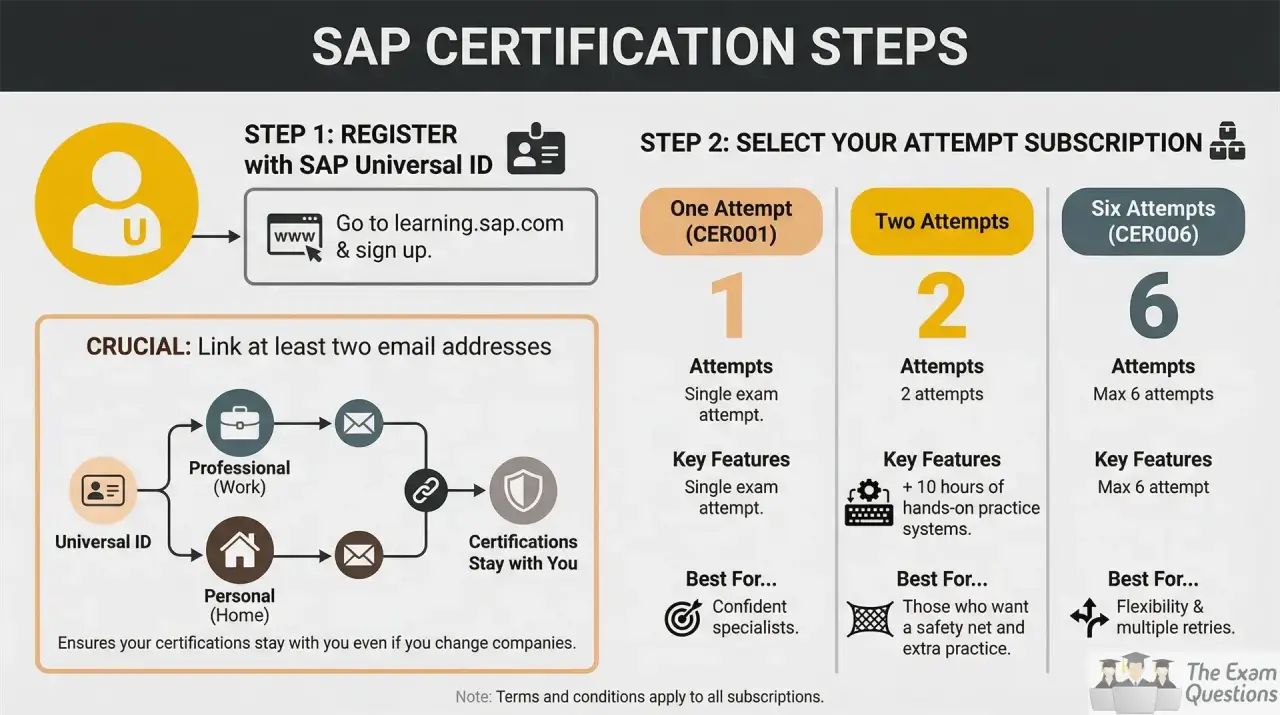
- Configure your SAP Universal ID with at least two email addresses attached to it.
- Make a valid attempt for the certification. Certification Exam Products are available in 1, 2 or 6 attempts. With a SAP Learning Hub subscription, you get 4 certification exam attempts per year.
- Go to the C_FIORD_2601 certification details page and review assessment details including assessment type, available time and remaining attempts.
- From the certification details page, click on “Go to Certification” Exam to start the exam. Or you can access it within the relevant learning process by clicking on “Open.”
- Follow the instructions of C_FIORD_2601, start the assessment. The certification page will list the requirements for the exam that apply and will tell you how many attempts you have.
- Once you pass, you’ll receive your SAP digital badge by email. The badge is claimable and managed through Credly.
Study Plan for C_FIORD
Week 1 - Introduction to SAP Fiori and SAPUI5
Understand SAP Fiori architecture and design principles, SAPUI5 basics, SAP Business Application Studio, app initialization, views, controllers, components and fragments.
Week 2 - Development of SAPUI5 Applications
SAPUI5 controls, models and data binding, localization, responsive applications, OData services, routing and navigation, application quality.
Week 3 - SAP Fiori Elements
Understand what SAP Fiori elements are, their architecture and advantages, available templates and how to work with SAP Fiori tools for application development.
Week 4 - Fiori Elements Configuration and Customization
Practice configuring List Reports, Object Pages, tables, actions, navigation and other application features. How the extensible programming model allows custom extensions.
Week 5 - Application Development & Deployment
Get to know OData V4, SAP Fiori tools, SAP Business Application Studio, CAP based development and deployment of SAP Fiori elements applications to SAP BTP.
Week 6 - Review and Practice
Revisit the whole learning path, identify the areas you are less confident in and practice applying SAPUI5 and SAP Fiori elements concepts to development scenarios presented in the official learning content.
Want to practice more before the test? Review and improve your preparation with C_FIORD_2601 Pdf Questions.
Retake Rules for SAP Certified - SAP Fiori Application Developer
- Candidates may take the same certification exam up to four times in 12 months to pass.
- There is a 24 hour waiting period between exam attempts.
- Should a candidate fail the assessment while time is still remaining on the exam clock, SAP allows an immediate retake, which counts as one exam attempt.
- If a candidate fails 4 times, then he/she needs to wait 12 months from the date of last attempt to write the certification exam again.
Have questions about the certification? Get quick answers to common questions about the exam, eligibility, attempts and certification process by visiting the C_FIORD_2601 FAQ page.
Keeping C_FIORD Certification Valid
- The C_FIORD_2601 certification is valid for 12 months. It may be renewed for another 12 months by passing the required Stay Certified assessment.
- The Stay Certified assessment may be completed at any time during the 90 days before the expiration of your certification.
- When you pass the assessment, your certification is extended for 12 months from the original expiration date.
- The Stay Certified assessment is a short, non-proctored quiz with unlimited attempts.
- You need a subscription to SAP Learning Hub to access the Stay Certified assessment and preparation materials.
- You can check your certification status and Stay Certified due date in SAP Learning → My Learning → Certifications → Manage Certification .
- If you do not meet the Stay Certified requirement prior to your certification expiration date, your certification will become invalid. You can be re-certified without SAP Learning Hub by taking the current certification exam.
Conclusion
The SAP Fiori Application Developer certification is a structured way to demonstrate your expertise in SAPUI5 and SAP Fiori application development. The official learning content, combined with getting comfortable with the development tools, frameworks and application patterns, will better equip you with the abilities being measured when you take the certification. SAP’s certification model is also moving more and more to certify skills that can be applied in the real-world of work rather than just theoretical knowledge.
Feel like putting your SAP Fiori knowledge to the test? Have a look at the C_FIORD_2601 Scenario Questions to make your preparation stronger and get yourself familiar with the practical situations.
For More C_FIORD_2601 Exam Related Resources, Visit:
C_FIORD_2601 Learning Resources | C_FIORD_2601 Free Questions | C_FIORD_2601 Pdf Questions | C_FIORD_2601 FAQ | C_FIORD_2601 Scenario Questions

![Free SAP Fiori Developer Scenario Questions for C_FIORD_2601 [2026]](https://theexamquestions.com/uploads/questions/C_FIORD_Free_questions.webp)