You're standing at a career crossroads. Should you pursue SAP certification for that contract role? Or skip it for a permanent position?
Here's what matters:
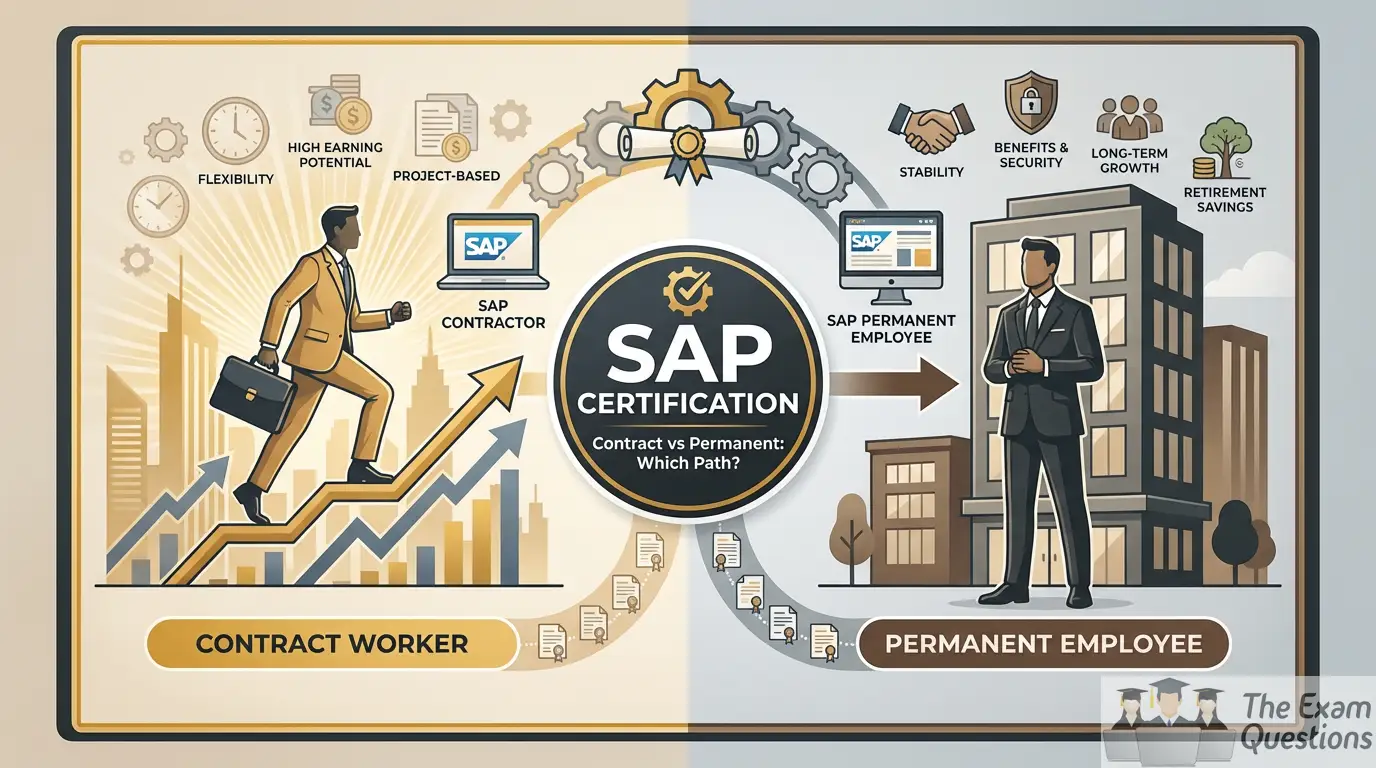
SAP certification is NOT mandatory for either contract or permanent roles. But - and this is crucial - it can dramatically impact your earning potential, marketability, and career trajectory depending on which path you choose.
I've analyzed current market data, interviewed dozens of SAP professionals, and reviewed official SAP certification requirements to give you the complete picture. By the end of this guide, you'll know exactly when certification makes sense for your career goals.
Let's dive in.
The Truth About SAP Certification Requirements
Here's the deal:
Neither contract nor permanent SAP roles legally require certification. SAP itself has stated that certification is voluntary, not mandatory.
But here's where it gets interesting.
What the Data Actually Shows
According to a 2024 SAP user-group survey:
- 70% of employers rated certification as "important" or "very important"
- 80% saw significant value in verifying certifications through SAP's public registry
- 50% of partner practitioners are expected to hold at least one valid certification by the end of 2025
Want to know the best part?
The market is speaking louder than official requirements. While certification isn't mandatory, it's becoming a de facto industry standard - especially in competitive markets.
Contract Roles: When Certification Becomes Your Competitive Edge
You might be wondering:
"Do I really need certification as a contractor?"
The short answer: Not legally, but practically? Absolutely.
Why Contractors Benefit More from Certification
Here's the kicker:
Contract roles are project-based and competitive. You're constantly proving your value to new clients. Certification acts as your professional passport - instant credibility without the need for lengthy reference checks.
Real-world contractor advantages:
|
Benefit |
Impact |
|
Higher day rates |
€900-€1,200/day in Germany (2025 data) |
|
Faster client trust |
Certification validates skills immediately |
|
Project preference |
Clients favor certified consultants for S/4HANA migrations |
|
Global mobility |
Recognized credential across 180+ countries |
The ROI Math for Contractors
Let's break down the numbers:
Total Investment:
- SAP certification exam (2 attempts): $276 USD
- SAP Learning Hub (optional): €1,025 - €1,302 per year
- Training materials: $200-500
Total: Approximately $1,000-2,000
Potential Return: Certified SAP professionals earn 20-30% more than non-certified peers. For a contractor earning $120/hour, certification could mean an additional $24-36 per hour.
That's $49,920-74,880 extra per year (based on 2,080 working hours).
Payback period? Less than one month.
Permanent Roles: The Hidden Certification Calculus
Now:
Permanent positions have a different dynamic entirely.
When Permanent Employees Should (and Shouldn't) Get Certified
Certification makes sense for permanent roles when:
✅ You're targeting international companies (certification shows standardized expertise)
✅ Your company offers training subsidies or pays for certification
✅ You're aiming for career advancement within your organization
✅ You're working in S/4HANA, SAP BTP, or SAP Analytics Cloud (high-demand areas)
Skip certification if:
❌ You have extensive hands-on experience and strong internal references
❌ Your employer values project delivery over credentials
❌ You're staying within one company long-term with no mobility plans
❌ Training costs come out of your pocket with no reimbursement
The Permanent Employee Advantage
Here's what permanent employees have that contractors don't:
- Company-sponsored training: Many employers cover SAP Learning Hub subscriptions
- Time for preparation: Paid work hours for exam prep
- Career path clarity: Certification tied to promotions and salary increases
- Lower risk: Job security allows strategic career planning
But here's the bottom line:
Certification for permanent roles is about internal progression, not external validation.
The 2025-2026 Certification Landscape: What's Changed
It gets better:
SAP completely overhauled its certification program in 2024, and the changes matter.
Major Updates You Need to Know
1. Annual Renewal Requirements
SAP certifications now expire after one year. If your certification was issued before April 2024, it expires March 31, 2025.
This means:
- Ongoing investment in maintaining certification
- Emphasis on continuous learning
- Higher long-term costs for certified professionals
2. Role-Based Certifications
SAP shifted from product-based to role-based certifications:
- Developer
- Administrator
- Architect
- Consultant
Why this matters: Content is more practical and aligned with real job responsibilities.
3. The SAP Learning Hub Evolution
The cloud-based Learning Hub now offers:
- 24/7 access to training materials
- E-learning courses and expert-led sessions
- Practice systems for hands-on experience
Pricing: $1,840 USD for professional subscriptions (varies by region)
Top SAP Certifications in Demand for 2025-2026
You're probably asking:
"Which certifications actually matter?"
Here are the certifications with the highest market demand:
1. SAP S/4HANA Certifications 🔥
Why: S/4HANA makes up 22% of all SAP job postings. With the 2027 migration deadline looming, demand is exploding.
Best for: Both contract and permanent roles
Modules to focus on:
- SAP S/4HANA Sourcing and Procurement
- SAP S/4HANA Sales
- SAP S/4HANA Finance
2. SAP Business Technology Platform (BTP)
Why: Cloud transformation is driving demand for BTP expertise
Best for: Technical consultants and developers
Earning potential: $164,332 average salary (Los Angeles, 2025)
3. SAP Analytics Cloud (SAC)
Why: Data-driven decision-making is non-negotiable in 2025
Best for: Business analysts and data professionals
4. SAP SuccessFactors
Why: HR digital transformation is accelerating
Best for: HR consultants in permanent roles
5. SAP Back-End Developer - ABAP Cloud
Why: Technical developers with ABAP skills are scarce
Best for: Contract developers (high day rates)
Certification Investment Breakdown: Real Costs
What's the bottom line?
Here's exactly what you'll pay:
|
Cost Item |
Price |
Required? |
|
Single certification exam (2 attempts) |
$276 USD |
Yes |
|
Six-exam bundle |
$543 USD |
Optional |
|
SAP Learning Hub subscription |
€1,025-1,302/year |
Recommended |
|
Training courses |
Free |
Recommended |
|
Practice exams |
$50-200 |
Recommended |
|
Study materials |
$100-300 |
Optional |
Total for one certification: $500-2,500
Important: Prices exclude taxes and vary by region.
The Hidden Differences: Contract vs Permanent Certification Strategy
Here's what most people miss:
For Contractors: Build Your Certification Portfolio
Strategy: Accumulate multiple certifications in complementary areas
Why: Each certification opens new project opportunities and justifies higher rates
Recommended path:
- Core functional certification (MM, SD, FI/CO)
- S/4HANA migration certification
- Technical or cross-module specialization
Timeline: 18-24 months for three certifications
For Permanent Employees: Strategic Depth
Strategy: Focus on certifications aligned with your company's roadmap
Why: Deep expertise in your organization's systems leads to promotions
Recommended path:
- Certification in your primary module
- Certifications in your company's strategic focus areas (e.g., BTP if moving to cloud)
Timeline: 12-18 months for two targeted certifications
Common Certification Myths Debunked
Let's clear up the confusion:
Myth #1: "You can't get an SAP job without certification"
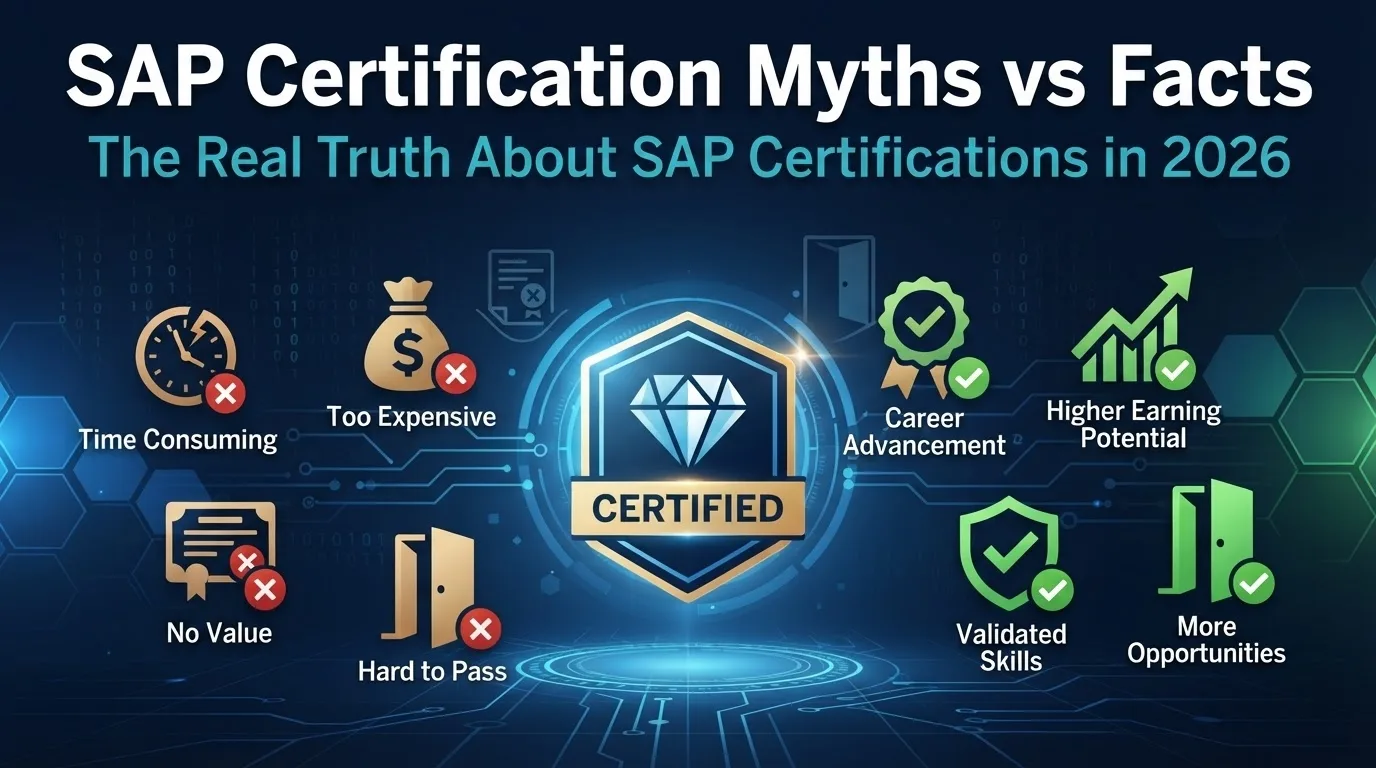
Reality: False. Many top consultants built careers on experience alone. Certification opens doors faster but isn't a gatekeeper.
Myth #2: "Certification guarantees a risk-free implementation"
Reality: No credential replaces experience. Certification validates knowledge; experience builds wisdom.
Myth #3: "All certifications are equally valuable"
Reality: Market demand varies wildly. S/4HANA certifications are gold in 2026; legacy ECC certifications are declining in value.
Myth #4: "Certification is a one-time investment"
Reality: Since 2024, certifications require annual renewal. Budget for ongoing costs.
Myth #5: "Permanent employees don't need certification"
Reality: It depends. Certification helps with promotions, transfers, and future job security - especially in uncertain economic times.
Your Certification Decision Framework
Want to know if certification is right for you?
Use this decision tree:
START HERE:
- Are you a contractor or permanent employee?
- Contractor → Certification strongly recommended (especially for S/4HANA roles)
- Permanent → Continue to question 2
- Does your employer subsidize certification?
- Yes → Get certified (low-risk investment)
- No → Continue to question 3
- Are you in a high-demand area (S/4HANA, BTP, SAC)?
- Yes → Certification adds significant value
- No → Weigh ROI carefully
- Do you have less than 3 years of SAP experience?
- Yes → Certification helps establish credibility
- No → Experience may outweigh certification
- Are you seeking international opportunities?
- Yes → Certification essential
- No → Focus on local market requirements
How to Maximize Your Certification ROI
It gets better:
Here are insider strategies to get the most value from certification:
1. Time Your Certification Strategically
For contractors: Certify before project hunting (not during active contracts)
For permanent employees: Align certification with annual review cycles for salary negotiation leverage
2. Leverage SAP Learning Hub Effectively
Pro tip: The Learning Hub subscription covers ALL SAP training materials. If you plan to pursue multiple certifications, get the annual subscription and "binge learn" multiple areas.
Cost savings: Up to 60% compared to individual course purchases
3. Use Employer Negotiation Leverage
For permanent roles: Negotiate certification costs as part of your:
- Hiring package: "I'll get certified in my first 6 months"
- Retention package: "Support my certification and I'll commit to 2 more years"
- Promotion discussions: "Certification will enhance my team leadership"
4. The "Certification Cluster" Strategy
For contractors: Stack complementary certifications close together:
- Example: SAP S/4HANA MM + SAP Ariba = Supply chain expert premium
- Result: Command 30-40% higher rates than single-certified peers
5. Market Your Certification Immediately
Update within 24 hours:
- LinkedIn profile (with SAP badge)
- Resume
- Portfolio website
- SAP Community Network profile
Why: Fresh certifications signal active learning and current knowledge
The Future of SAP Certification (2026 and Beyond)
You might be wondering:
"Is certification still going to matter in 5 years?"
Here's what the trends tell us:
Increasing Importance
- SAP partners pushing for mandatory certification requirements by 2027
- AI and automation making specialized skills more valuable
- S/4HANA migration deadline (2027) creating certification surge
Evolving Format
- More role-based and scenario-based assessments
- Integration with AI-driven learning paths
- Micro-credentials for specific skills
Market Reality
The bottom line: Certification is becoming more important, not less. But it's shifting from "nice to have" to "table stakes" in competitive markets.
Your Next Steps: Contract or Permanent, Here's What to Do
So where do you go from here?
If You're Pursuing Contract Work:
✅ Step 1: Identify the highest-demand certification in your region (check SAP job boards)
✅ Step 2: Purchase SAP Learning Hub subscription
✅ Step 3: Complete certification within 3 months
✅ Step 4: Update all professional profiles immediately
✅ Step 5: Target contract roles with 25-30% higher rate expectations
If You're in a Permanent Role:
✅ Step 1: Discuss certification with your manager (frame as business benefit)
✅ Step 2: Request company sponsorship for Learning Hub + exam fees
✅ Step 3: Align certification with performance review timeline
✅ Step 4: Use certification as leverage for promotion or salary increase
✅ Step 5: Plan for annual renewal as part of professional development
If You're Still Unsure:
✅ Research salary differences in your target market (certified vs. non-certified)
✅ Network with SAP professionals in your desired role
✅ Calculate your personal ROI using the framework in this article
✅ Test the waters with one certification before committing to multiple
The Final Word
Here's what you need to remember:
SAP certification isn't mandatory - but it's becoming essential in competitive markets. Whether you choose contract or permanent work, certification acts as your professional passport, opening doors and commanding higher compensation.
The key is strategic alignment:
- Contractors: Invest in certification for immediate credibility and higher rates
- Permanent employees: Pursue certification when it aligns with career advancement and employer support
The SAP market is evolving rapidly. S/4HANA migration deadlines, AI integration, and role-based certifications are reshaping the landscape. Those who invest in certification today will be best positioned for tomorrow's opportunities.
Your career trajectory depends not just on whether you certify - but on when, what, and how you leverage that certification strategically.
Explore SAP certification courses and articles.