You’ve decided to chase an SAP certification course. Good call. But now you’re staring down three separate paths: Associate, Professional, or Specialist? It’s easy to get stuck if you pick the wrong one; you might waste months studying for something that doesn’t fit your goals.
Here’s what this guide sorts out for you:
- What each SAP certification level actually means no jargon, just the facts.
- How to pick the track that suits your experience and where you want your career to go.
- How each choice really affects your salary, with real numbers.
- A simple framework that’ll help you make your decision in five minutes, tops.
By the end, you’ll know exactly which SAP certification puts your career into high gear.
Understanding SAP Certification: Why It Matters in 2026
Here’s the reality: SAP powers over 87% of Fortune 500 companies. Nothing’s changing there, not with the big move from ECC to S/4HANA coming in 2027.
But SAP certification isn’t just another bullet point for LinkedIn. It proves you have skills that:
- Get you noticed for higher-paying jobs.
- Put you ahead of folks who didn’t bother to certify.
- Show you can back up your SAP knowledge in real scenarios.
But let’s be clear, not all SAP certs are equal. What you pick shapes where you go, how much you can command salary-wise, and the kind of work you get.
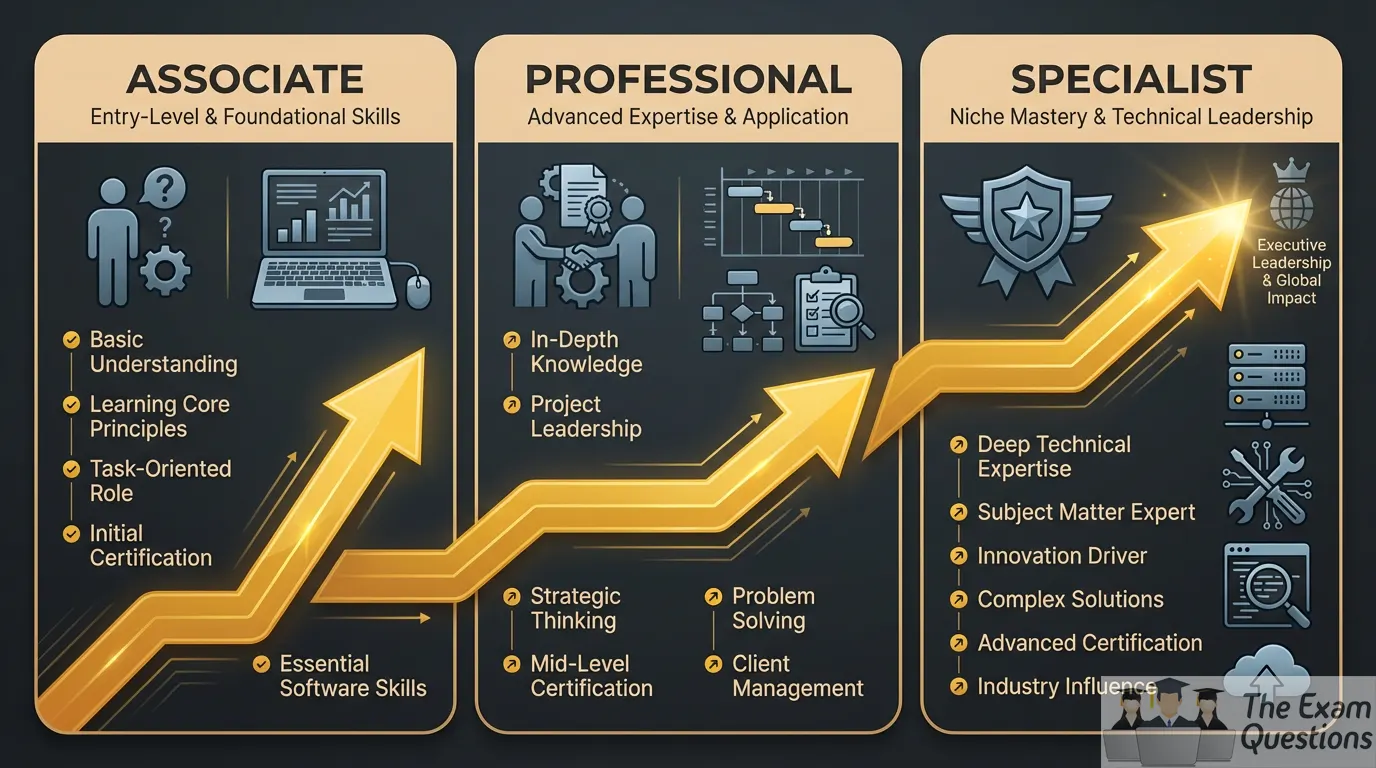
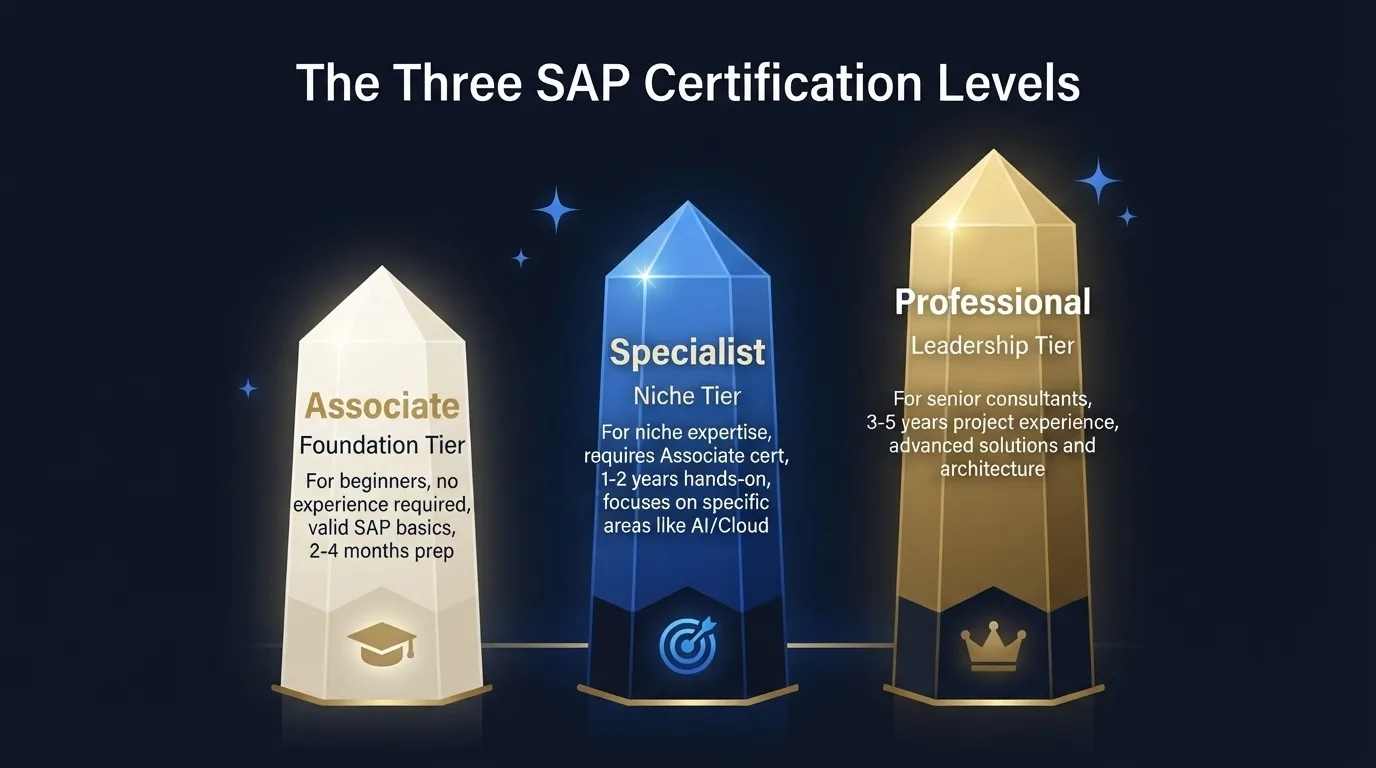
The 3 SAP Certification Levels: The Basics
Here’s the lay of the land:
- Associate: For beginners and career-switchers. No serious SAP experience needed. The focus is basic SAP know-how.
- Specialist: For those who want to go deep in a niche area. You need an Associate cert plus some hands-on time.
- Professional: For consultants or pros with solid SAP project history think years, not months. Advanced, leadership-level skills.
Let’s break them down so you know where you stand.
SAP Associate Certification: Getting Started
What is it?
Associate certification is your foundation. It proves you know SAP basics and can get up and running right away.
Who’s it for?
- New IT pros dipping their toes in SAP
- Fresh grads looking for their first ERP job
- People moving into SAP from other tech
- Anyone with basic SAP exposure
What you need:
- No strict education requirements, good news, right?
- SAP recommends their official training courses so you cover the essentials.
- Budget 2–4 months to get ready, depending on what you already know.
- You’ll want real access to SAP systems to practice (via their Learning Hub or training providers).
- No prior certs needed.
Here are the Top Associate Certifications to Watch for in 2026:
- SAP S/4HANA Cloud Public Edition
- SAP S/4HANA Cloud Private Edition, Financial Accounting
- SAP S/4HANA Cloud Private Edition, Sales
- SAP S/4HANA Cloud Public Edition, Sourcing and Procurement
- SAP Integration Developer
Big change coming up: the exams are shifting. You’ll deal with fewer multiple-choice questions and see more performance-based tasks, where you need to react to real situations instead of just picking an answer.
Here’s what you can expect:
- 120–180 minutes per test
- Cut score around 59–75% (varies by exam)
- Two attempts with your registration
SAP Specialist Certification: Get Your Niche
What is it?
Specialist certs are for a specific area of SAP and prove you are the person to go to for that niche.
Who’s it for?
- Folks who already have an Associate cert
- People with a year or two of SAP work under their belts
- Consultants who live and breathe SAP processes
- Integration developers or other tech pros who stay deep in the system
What do you need to get started?
- That Associate certification in the right field
- Hands-on SAP experience, at least 1-2 years in your speciality
- Deeper training, not just the basics
- Real project work you’ve actually solved problems, not just watched videos
Which Specialist Certifications are Getting Noticed for 2026?
- SAP Certified - SAP BW/4HANA Delta
- SAP Certified - Implementation Consultant - SAP S/4HANA Cloud Private Edition
- SAP Certified - Project Manager - SAP Activate for Agile Implementation Management
- SAP Certified - SAP S/4HANA Conversion and SAP System Upgrade
How’s the Test Set Up?
You get 90 minutes. It’s all focused on specifics, except real-world scenarios, not just theory. And you’ll need your Associate certification before you can even register.
SAP Professional Certification: For Leaders
What is it?
Professional certification is for the heavy hitters those with several years leading SAP projects and a real knack for complex solution design.
Who’s it for?
- SAP consultants with 3–5 years of serious project work
- Project managers running SAP implementations
- Senior analysts overseeing major processes
- Anyone gunning for leadership
What you need:
- At least 3 years on SAP projects, with full cycles under your belt.
- Multiple project involvements, implementations, upgrades, or migrations.
- The ability to troubleshoot complex business challenges.
- You don’t need prior certs, but it helps if you have the Associate.
Top Professional SAP Certifications for 2026
If you’re looking to boost your SAP career in 2026, a handful of Professional certifications are leading the pack. These programs focus on newer tech, anything cloud-related, and the kinds of business processes that keep you ahead of the curve.
- SAP Certified - Configuration Administrator - Concur Request Professional Edition
- SAP Certified - Configuration Consultant - Concur Expense Professional Edition
- SAP Certified - Configuration Consultant - legacy Concur Travel Professional Edition
- SAP Certified - Configuration Consultant - Concur Invoice Professional Edition
What the Professional Exam’s Like
Professional SAP exams run about three hours. Passing scores usually fall somewhere between 68% and 73%, depending on your focus. These tests aren’t just multiple-choice guesses; they're heavy on real-world scenarios, so you’ve got to know your stuff and think practically.
How to Pick Your Certification: The Simple Path
Step 1: Gauge Your SAP Experience
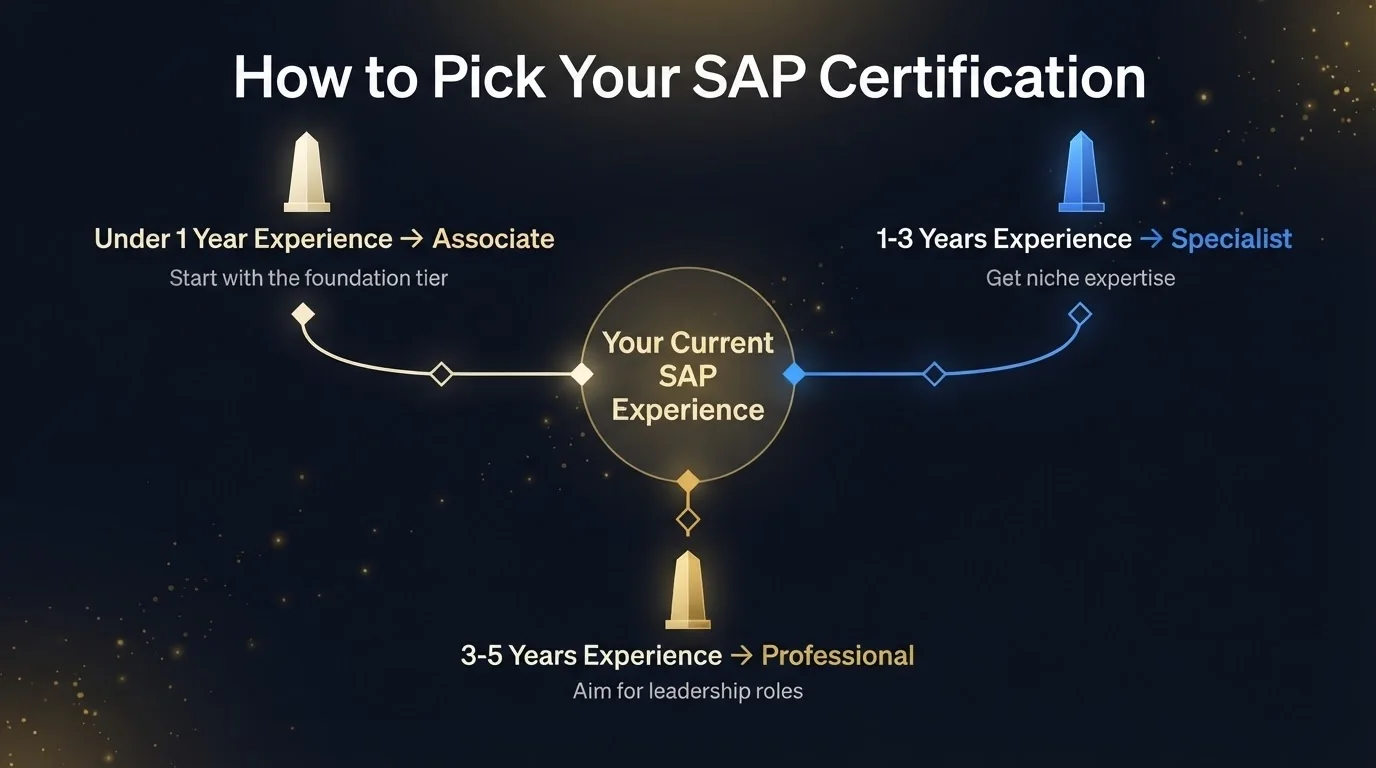
If SAP’s completely new to you or you’ve got under a year, start with an Associate certification. Those with one to three years in SAP and an Associate badge should look at a Specialist cert. If you’re three to five years in with real project work, you're good to aim for a Professional certification.
Step 2: Set Your Career Goal
Trying to break into SAP? Associate. Want to dig deep in one area? Specialist's way. If you’re thinking about leadership or managing projects, go for a professional.
Step 3: Pinpoint Your Interest
Go with Associate or Professional if you want to work across lots of SAP business areas. Interested in techy stuff: AI, Integration, Analytics? A specialist makes more sense. Solution design and architecture? That’s a job for a Professional certification.
Quick Reference Chart
|
Your Situation |
Recommended Path |
Time to Certification |
|
Fresh graduate, no SAP experience |
Associate |
3-4 months |
|
1 year as SAP user, want niche |
Specialist |
2-3 months (after Associate) |
|
3+ years consulting, want promotion |
Professional |
4-6 months |
|
Certified Associate, exploring AI/Cloud |
Specialist (AI/BTP) |
2-4 months |
Breaking Down the Certification Levels
- Associate: Good for SAP newcomers with broad knowledge; helps you land that entry-level role.
- Specialist: Targets a specific SAP area, lets you build real expertise in a focused niche.
- Professional: Covers advanced subjects from many fields. Best fit for experienced folks heading toward leadership.
Prerequisites
- You don’t need SAP certification for the Associate level, but official SAP training helps a lot.
- The Specialist certification usually requires you to have the matching Associate cert first.
- To go Professional, you’ll need three to five years of hands-on SAP work. Having an Associate cert helps here, too.
How Tough are the Exams?
- Associate tests focus on basics. Pass rates are fairly high: 61% to 75%.
- Specialist tests dig into real business scenarios and last about 90 minutes.
- Professional exams are the toughest; they run for about three hours, and you’ll need to hit about 73% to pass.
2026 Salary Snapshot
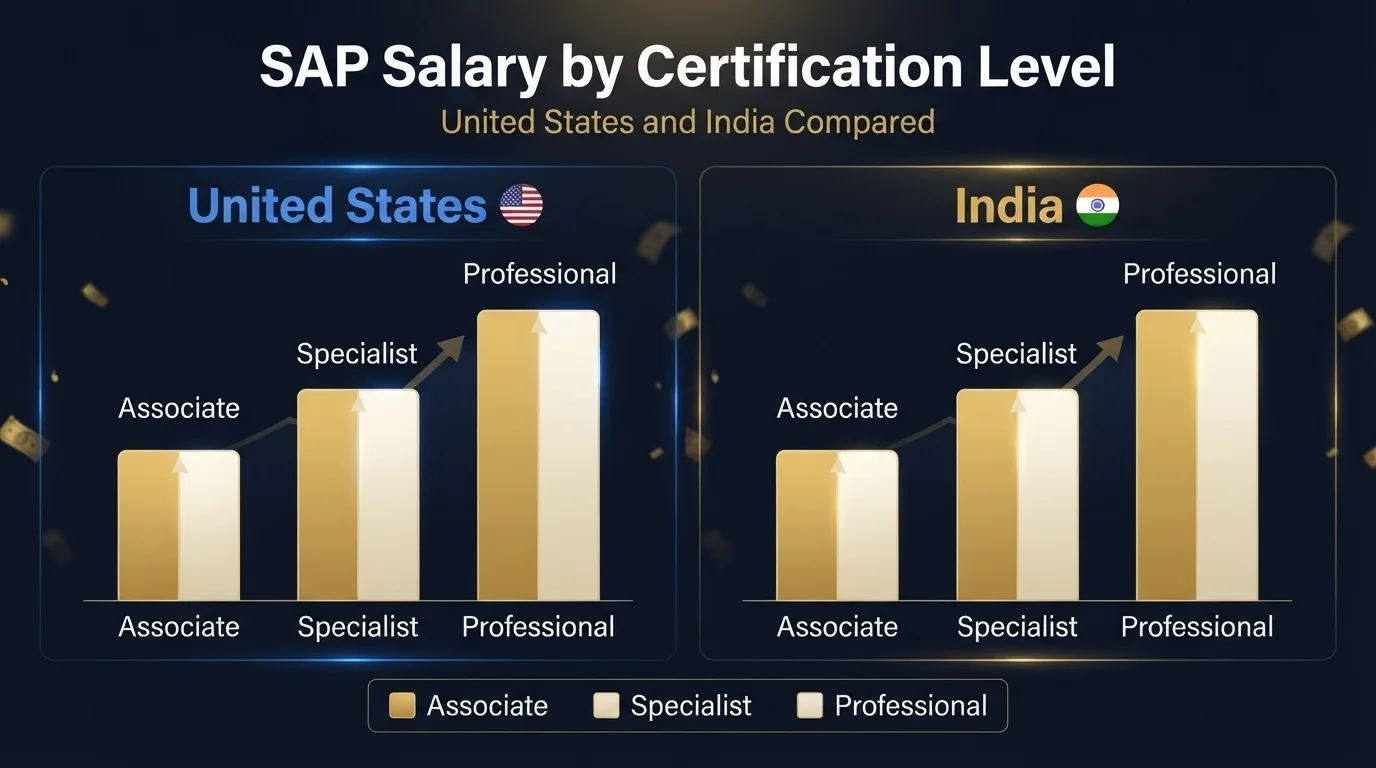
For United States:
|
Level |
Avg. Salary |
Top Earners |
|
Non-Certified |
$55,000 - $70,000 |
$85,000 |
|
Associate |
$70,000 - $90,000 |
$110,000 |
|
Specialist (AI/Cloud) |
$140,000 - $168,000 |
$200,000+ |
|
Professional |
$110,000 - $160,000 |
$200,000+ |
Source: https://www.payscale.com/research/US/Job=SAP_Consultant/Salary
For India:
|
Level |
Avg. Salary |
Top Earners |
|
Non-Certified |
₹4-7 LPA |
₹10 LPA |
|
Associate |
₹6-12 LPA |
₹16 LPA |
|
Specialist (AI/Cloud) |
₹20-24.5 LPA |
₹35 LPA |
|
Professional |
₹15-28 LPA |
₹45 LPA |
Source for SAP Certified Consultant salaries in India : https://www.ambitionbox.com/profile/sap-certified-consultant-salary
Right now, AI and Cloud Specialist certifications offer some of the fastest salary boosts. In fact, salaries can jump up to 71% in the US, and in India, people sometimes double what they’d earn in a standard SAP role.
How to Approach Your Certification
- Associate: Pick the SAP module that sparks your interest. Sign up for official training, practice in a live SAP system for at least 40-60 hours, complete practice tests, then schedule your exam. Three to four months is typical prep.
- Specialist: Once you have your Associate cert, spend a year or two getting experience in your chosen area. Take advanced courses, work on real projects, and then devote two to four months prepping for the Specialist exam.
- Professional: Three to five years’ experience is best before going for a Professional. Get involved in major projects. Focus on learning business processes, and practice complex scenarios. Most candidates prepare for four to six months.
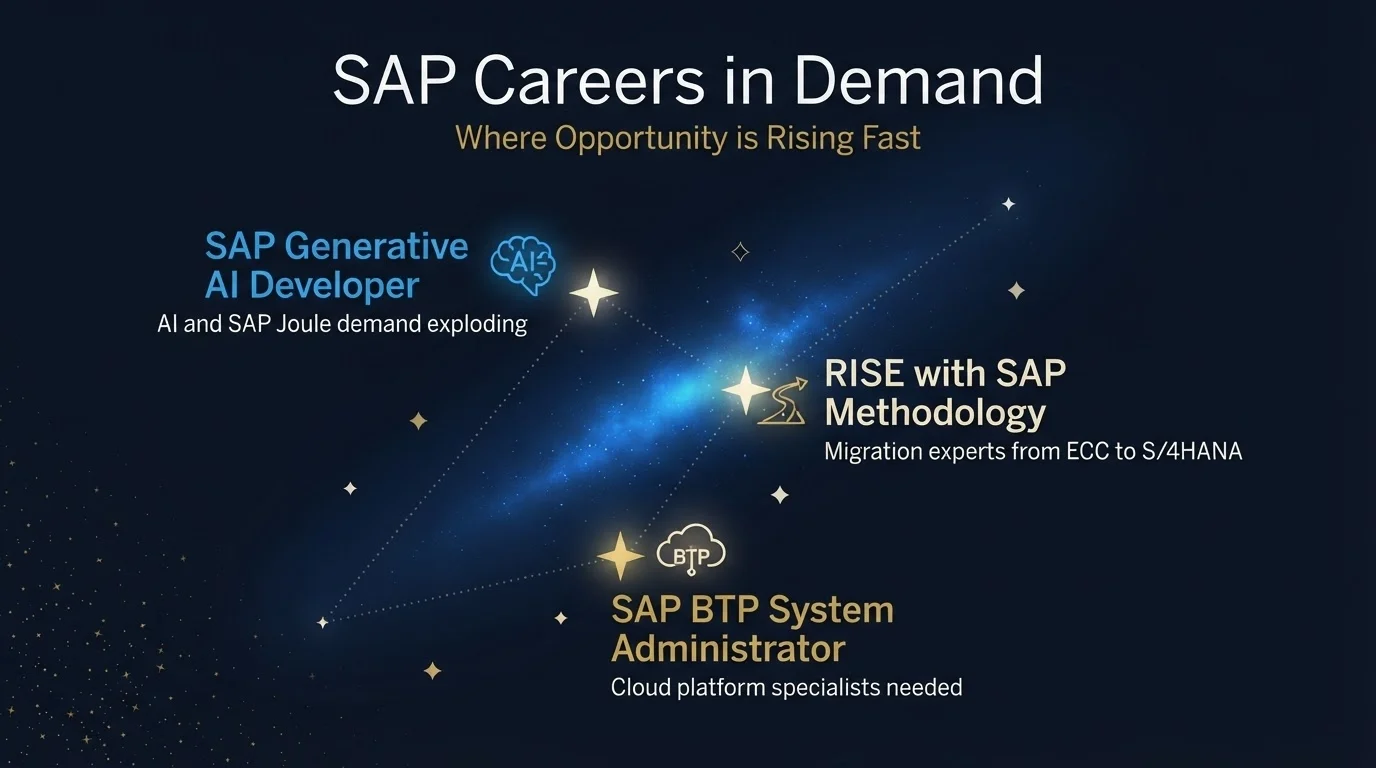
SAP Careers in Demand for 2026
1. SAP Generative AI Developer
With SAP Joule and all things AI, demand is exploding for SAP Generative AI Developers. These roles pay $140,000–180,000 in the US and ₹22–30 LPA in India. It’s a great fit for developers or consultants in finance, supply chain, or HR.
2. RISE with SAP Methodology
Companies are switching from SAP ECC to SAP S/4HANA, so experienced Professionals has huge market demand.
3. SAP BTP System Administrator
Thanks to the shift to cloud, more companies need SAP BTP System Administrators. The going rate: $126,000–192,000 in the US, and ₹20–32 LPA in India.
What’s Changing in 2026 SAP Exams
SAP is putting more weight on practical skills, not just memorizing facts. You’ll see more real-life scenarios, especially in cloud certifications. The exams also now align more with job roles rather than just SAP modules. You can checkout the latest change in SAP Exam details in the official SAP Learning site.
Common Mistakes
- Don’t jump into the Professional exam before you’re ready. Lack of hands-on experience makes it much tougher to pass.
- Ignoring Specialist certifications is a missed opportunity, especially since AI and Cloud fields often pay more than a typical SAP path.
- Whatever you do, don’t let your SAP certs get outdated. SAP is changing fast, and staying current with your certification keeps you competitive and up to date.
Conclusion
Picking the right SAP certification really comes down to where you are in your career and what you want next. If you are a beginner and want to build a good SAP foundation, then prefer the SAP Associate certification. If you do have some SAP experience and want to go into more depth on things like AI, cloud, or analytics, then the Specialist certification is the way to go. It lets you focus and sharpen your expertise. Now, if you’re already a pro- let's say you’re a consultant or you’re looking to step into leadership, architecture, or project management, the Professional certification is what really shows you’re ready for the big stuff.
SAP is always changing. There’s S/4HANA, SAP BTP, new AI tools, updates in the cloud you name it. Getting the right certification keeps your skills fresh and your career moving forward. So don’t just go for the biggest title out there. Choose the certification that matches where you are now and sets you up for your next step. That’s how you stay ahead of the game.
If you’re serious about your SAP career, then invest in your future with The Exam Questions. You will get access to scenario-focused questions and full-length online practice tests to cover everything you need.