So, you’re thinking about going freelance as an SAP consultant. Smart move. But here’s the reality: Clients won’t just hand you a contract because you’ve been around the block. They want proof you can deliver in a world where SAP changes by the minute.
That’s where certifications matter a lot.

This guide cuts through the noise. I’ll show you exactly which SAP certifications boost your earning power in 2026 and, more importantly, which ones companies are willing to pay for right now. You will get the real numbers, the market trends, and why each certification is valuable.
Here’s what you need to know, right up front: with the 2027 deadline for S/4HANA migration, customers are searching for certified experts. It’s a seller’s market for freelancers.
Let’s get into it.
Why SAP Certifications Are Crucial for Freelancers
That 2027 migration deadline is creating a gold rush. Here’s what’s shaking things up:
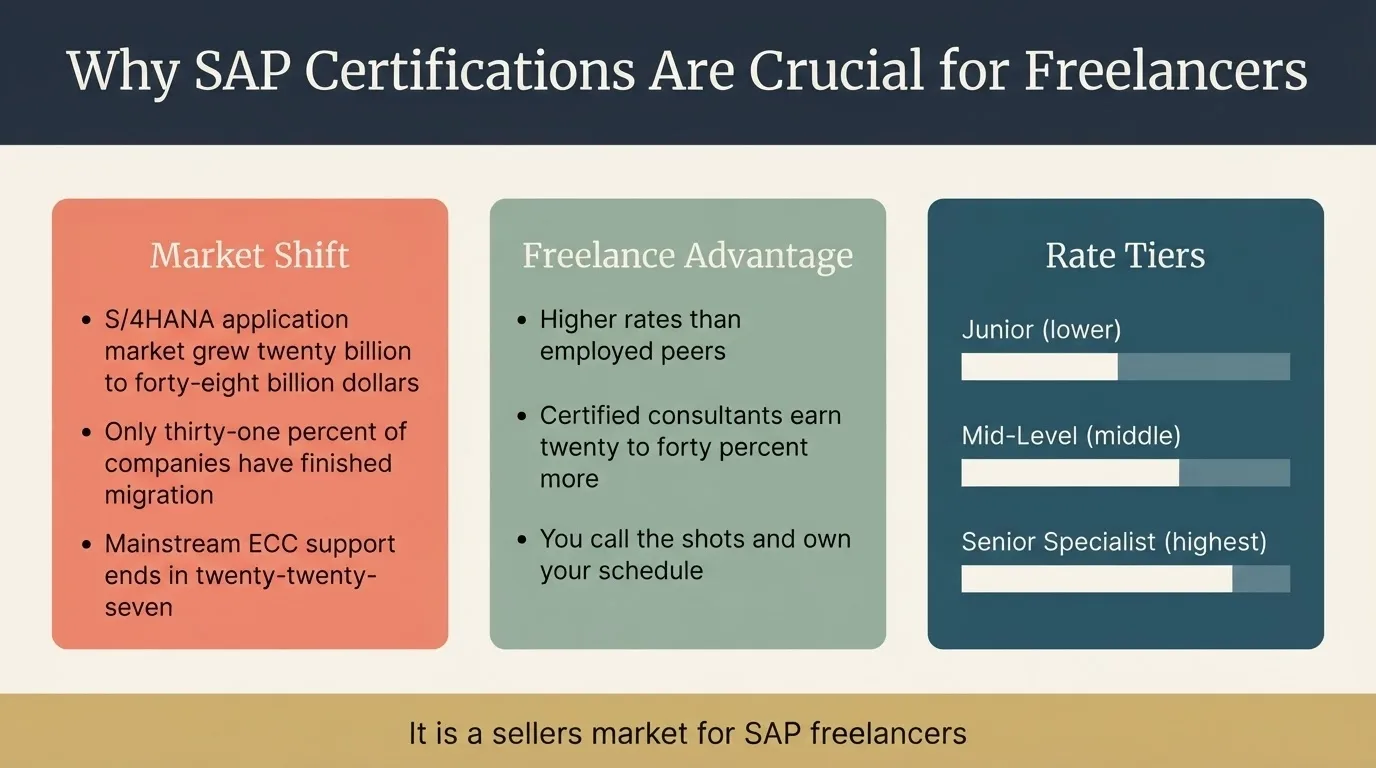
SAP is pulling the plug on mainstream ECC support at the end of 2027. Companies putting off migration are going to get hit hard with skyrocketing costs, a shortage of skilled talent, and real operational headaches.
Look at the numbers:
- Only 31% of companies have finished their S/4HANA migrations.
- The S/4HANA application market hit $20.35 billion in 2024, and projections say it’ll jump to $48.46 billion by 2033.
The takeaway? There are thousands of businesses scrambling for certified help. For freelancers, this means more work and higher rates.
And being freelance has its perks: you call the shots and, let’s be real, you make more money.
Source: SAP S/4HANA Application Market Size, Share & Trends Analysis Report
The Freelance Advantage
Freelance SAP consultants command significantly higher rates than their employed counterparts:
|
Experience Level |
Yearly Rate (EUR - Germany) |
|
Junior Consultant |
€700-€900 |
|
Mid-Level Consultant |
€900-€1,200 |
|
Senior/Specialist |
€1,200-€1,500+ |
Source: SAP Freelancer Salaries in Germany
But here’s the kicker: Certified consultants pocket 20-40% more than those without.
The 6 SAP Certifications Clients Actually Want
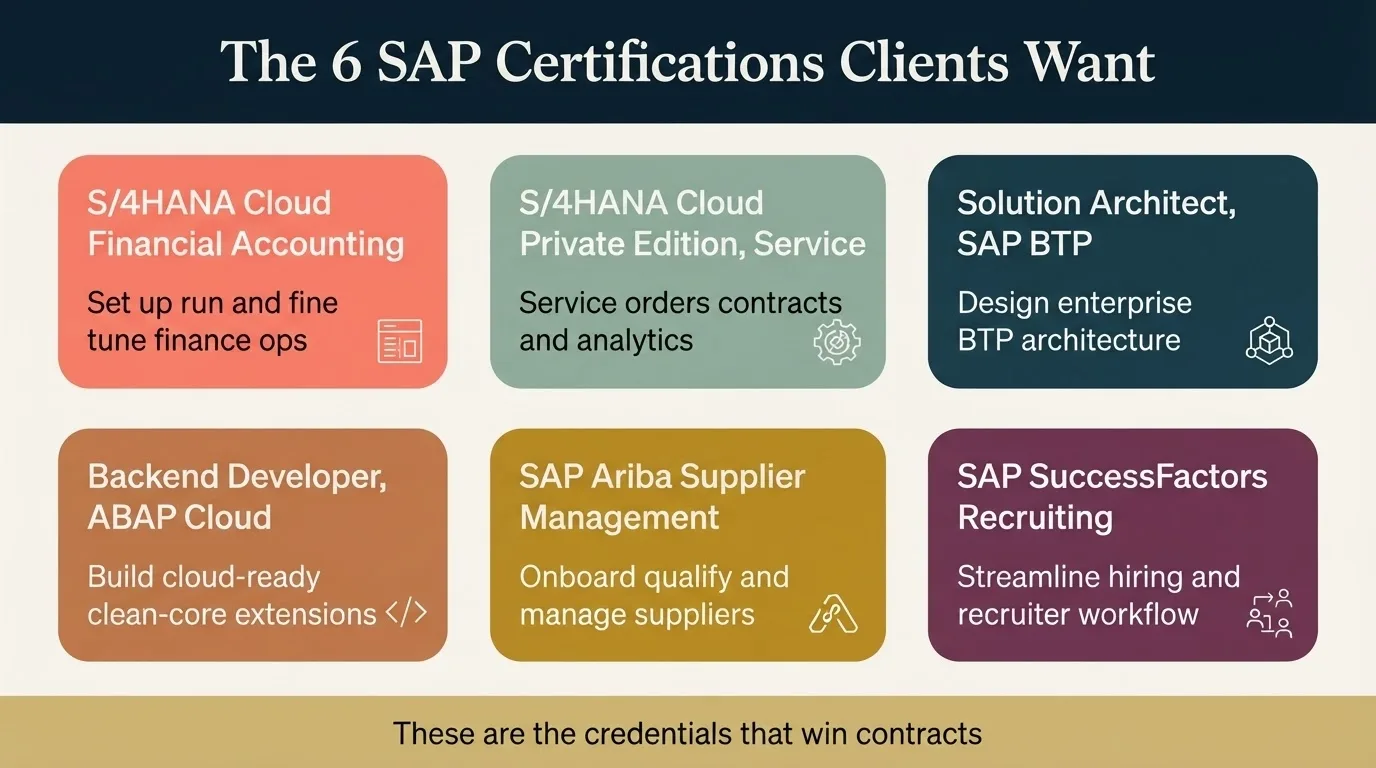
1. SAP Certified - Implementation Consultant - SAP S/4HANA Cloud Public Edition, Financial Accounting
Why it’s important: Financial Accounting is not an arbitrary function in SAP S/4HANA Cloud Public Edition. It’s the heart of the whole thing. We’re talking about the essentials: General Ledger, Accounts Payable, Accounts Receivable, Asset Accounting, financial closing, plus all the reporting you’d ever need.
Businesses lean on this foundation to keep their money matters in check, pass audits, maintain transparency, and make sure every department is on the same page. If you really know your way around these Financial Accounting tools, you can step in and help companies set up, fine-tune, and run the finance operations that keep everything moving.
2. SAP Certified - SAP S/4HANA Cloud Private Edition, Service
Why does this matter: Well, when companies start upgrading their SAP systems, cloud-based service operations aren’t just optional; they’re starting to run the show. With SAP S/4HANA Cloud Private Edition, Service, businesses get one place to handle it all: service orders, in-house repairs, service contracts, anything recurring, and even all the analytics that go with it.
People who know their way around these tools are game changers. They jump in, set up service processes, manage the data under the hood, and connect service work to everything else like logistics or controlling. Bottom line: these skills keep everything humming along without a hitch.
3. SAP Certified - Solution Architect - SAP BTP
Here’s why this matters: SAP BTP helps organizations build and extend apps, automate their workflows, connect both SAP and non-SAP systems, manage data, run analytics, and bring in AI.
Most organizations want to keep innovating, but they don’t want to scrap the tech they already have. That’s basically the job of SAP BTP Solution Architect. They design enterprise architectures that tie real business needs to BTP’s features like app development, process automation, integration, data management, and AI.
4. SAP Certified - Backend Developer - ABAP Cloud (Beta Version)
Here’s the thing: ABAP Cloud hasn’t gone anywhere; it’s still right at the heart of SAP development. But the game has changed. Now, developers have to get their heads around ABAP Cloud and figure out how to build applications, services, and extensions that actually work in the cloud with SAP S/4HANA and SAP BTP.
Businesses also want people who know how to extend S/4HANA without making a mess of the system, so following Clean Core principles is a must. On top of that, developers need to connect SAP solutions with whatever other systems a company’s already using, which means knowing your way around supported APIs and all the right connectivity tools.
5. SAP Certified Associate - Implementation Consultant - SAP Ariba Supplier Management
Why it matters: Good supplier management isn’t just some extra perk. It's essential if you want real visibility into your operation, stay on top of compliance, manage risks, and actually get the best out of your suppliers. SAP Ariba Supplier Management puts all the information you need in one place. Onboard new suppliers, qualify them, and keep tabs on their performance, all without bouncing between different systems.
If you really get these processes, you’re in a great position to simplify work, firm up relationships with suppliers and keep procurement running smoothly with no headaches.
6. SAP Certified - SAP SuccessFactors Recruiting: Recruiter Experience
Here’s the deal: Every business depends on hiring new people, and SAP SuccessFactors Recruiting steps in to make that process a whole lot easier. Companies can post jobs, sift through applications, screen candidates, make offers and even organize what recruiters do every day, all in one place.
When someone knows their way around SAP SuccessFactors Recruiting, they can set up and tweak these tasks to run smoothly. That means candidates have a better experience, recruiters waste less time, and companies end up hiring the right people faster.
What’s Coming Next for SAP Certifications in 2026-2027?
- AI and machine learning are going mainstream in SAP. Certs in AI Business Services, ML integration, and predictive analytics are about to be gold.
- More industry-specific certifications like Healthcare, Retail, Manufacturing, etc.
- You’ll see micro-credentials and skill badges popping up so you can show your expertise quickly, one skill at a time.
Choosing The Right SAP Certification For You
Step 1: The Demand and Experience Equation
Don’t hoard certs like trading cards. Use what you know, watch the market trends and focus on what your clients are struggling with.
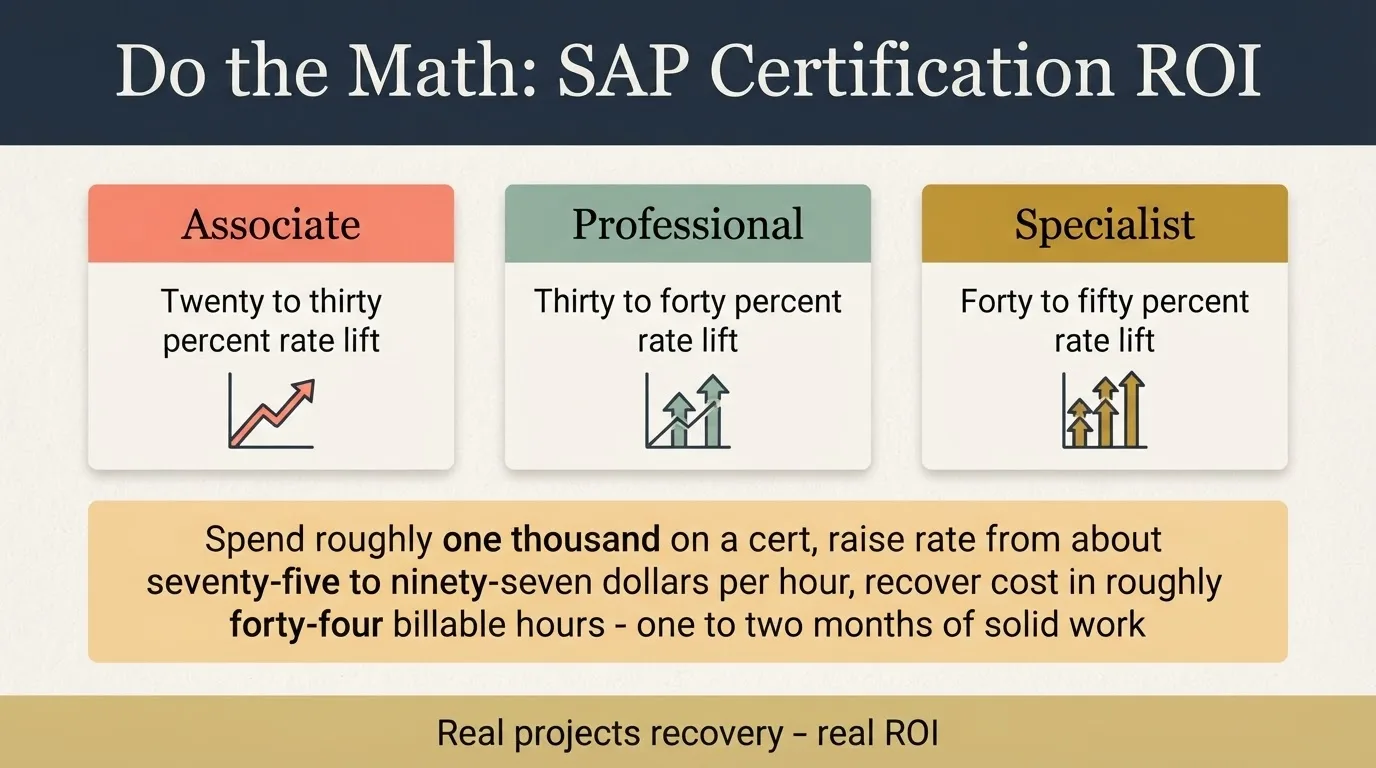
Step 2: Do the Math: ROI
Certs cost money, but they pay off.
Certification costs breakdown:
|
Certification Level |
Average Cost |
Potential Salary Increase |
|
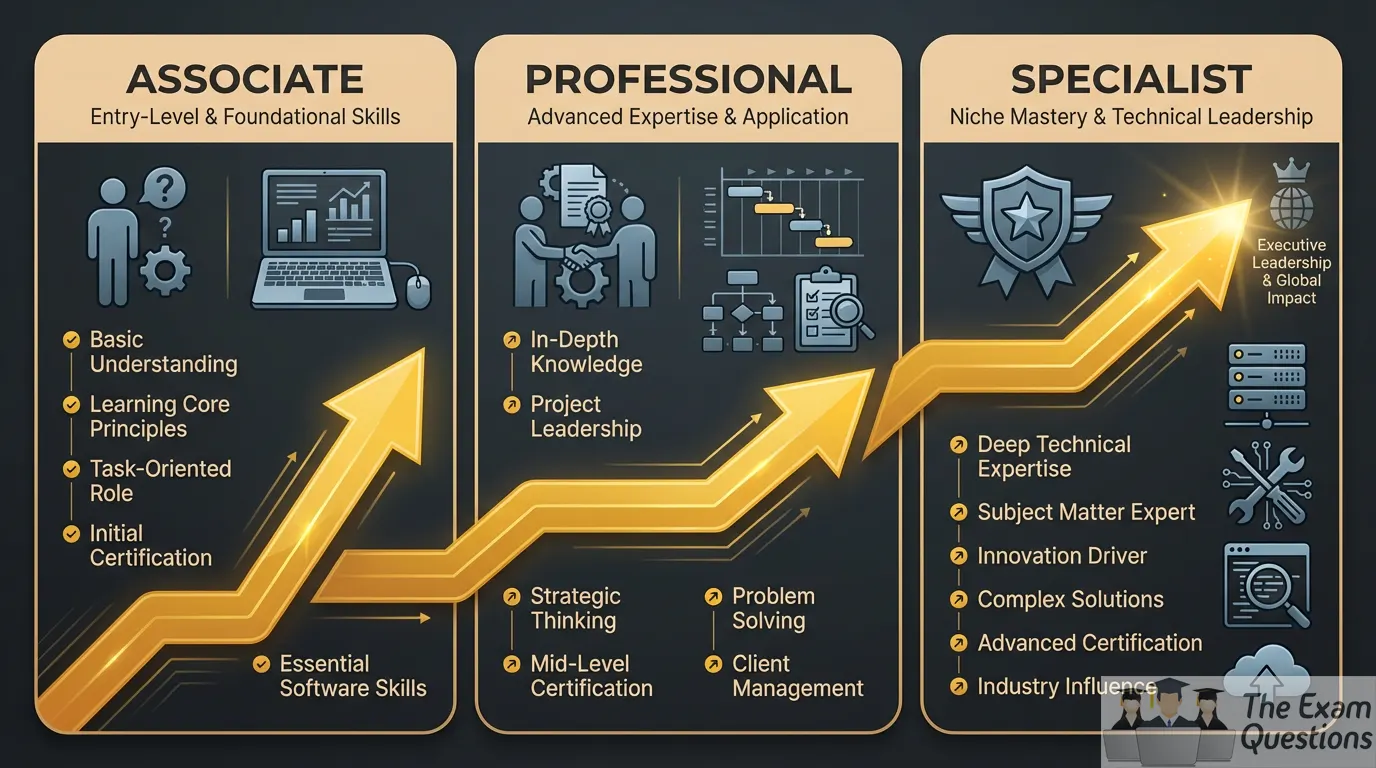
Associate |
$500 - $1,000 |
20% - 30% |
|
Professional |
$1,000 - $2,000 |
30% - 40% |
|
Specialist |
$1,500 - $2,500 |
40% - 50% |
If you spend $1,000 and your rate jumps from $75 to $97.50/hr, you make back the cost in 44 billable hours. That’s maybe 1-2 months with a pretty solid ROI.
Step 3: Pile up Complimentary Certifications
Smart blend for more value:
- FICO = Wizard of financial compliance.
- S/4HANA + BTP = The future architect.
- SCM + Ariba = Supply chain pro end-to-end.
SAP Certification Strategies for Successful Freelancing
1. Study Smart:
Use SAP’s Learning Hub, SAP Press books, and practice tests. Most consultants take 60-120 hours depending on what they already know.
2. Get Real Practice
Certs prove you know your stuff on paper. Clients want proof in the real world. Build things in trial systems, write up your success stories, join SAP forums, and answer some tough questions.
3. Market Your Credentials
Don’t just list your certifications. Show them off. Put the badges on LinkedIn, create content (articles, videos), show how your certs solve client problems, and update all your freelance profiles.
4. Never Stop Learning
SAP rolls out updates all the time. Schedule a few hours a month for new webinars, reading SAP blogs, or attending industry events.
Common Mistakes Freelance SAP Pros Make
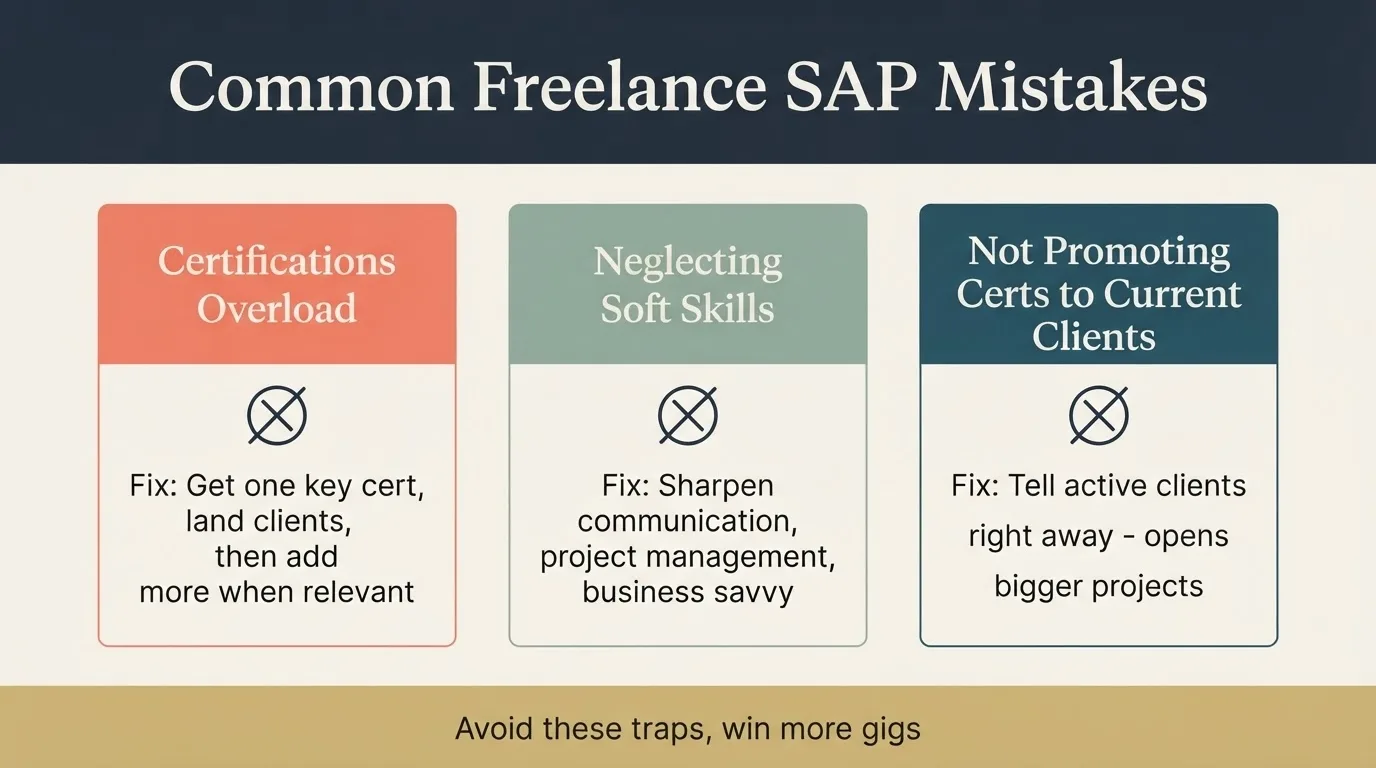
Mistake 1: Certifications Overload
Going after too many at once just waters down your expertise. Get a key certification, get clients, then add more when it makes sense.
Mistake 2: Neglecting Soft Skills
Technical wizardry will get you noticed, but communication, project management, and business savvy will help you close deals. Don’t neglect these.
Mistake 3: Not Promoting Certs to Current Clients
You get certified, but forget to let active clients know. That’s leaving money and bigger projects on the table. Send out a quick update explaining the new value you bring.
Conclusion: Your SAP Certification Game Plan
2026 is set to be a historic time for SAP freelancers. The companies racing to modernize, the 2027 deadline, and the push to cloud tech all mean opportunity.
Here’s your roadmap:
1. Pick certifications with actual market need- start with S/4HANA, Cloud, or BTP.
2. Get your money's worth- pick certs with the biggest salary jumps.
3. Real project success supports your credentials.
4. Show the world- spread your knowledge everywhere.
5. Keep learning- it’s a moving target, but that’s why clients need you.
Certifications are not shiny badges; they are tickets to better gigs and bigger paychecks. Rates hover around $200/hr, and the market is booming. The only real question is: which certification are you chasing first?
Ready to ace your SAP certification exam? The Exam Questions offer updated practice questions, realistic scenarios, and hands-on system tasks to help you prepare with confidence.