The SAP certification landscape is undergoing its most dramatic transformation in decades. If you're still thinking of SAP certifications as simple multiple-choice tests, you're about to be blindsided.

Here's the deal:
SAP has completely reimagined how professionals prove their expertise. Starting in late 2025 and rolling out through 2026, scenario-based, open-book assessments are replacing traditional exams. The 2027 S/4HANA migration deadline is creating unprecedented demand. And AI-powered certifications are emerging as the hottest new credential category.
This isn't just another industry shift - it's a complete reset that will define which SAP professionals thrive and which get left behind through 2030.
Let me show you exactly what's coming.
The Seismic Shift: SAP's New Certification Format (2026)
Goodbye Multiple Choice, Hello Real-World Scenarios
In November 2025, SAP dropped a bombshell that caught most professionals off guard:
Traditional multiple-choice exams are out. Practical, scenario-based assessments are in.
Here's what changed:
- Open-book format: You can access SAP documentation during the exam
- Live SAP environments: Work directly in actual SAP systems
- Real business scenarios: Solve problems you'd face in actual projects
- Task-based evaluation: Demonstrate skills, not memorization
Want to know the best part?
This change makes SAP certifications more valuable, not less. Why? Because employers can finally trust that certified professionals have hands-on skills - not just good memory.
By mid-January 2026, most SAP certification exams will use this new practical format. By the end of 2026, all SAP certifications will have transitioned.
What This Means for You
If you're preparing for an SAP certification in 2026 or beyond:
- Stop cramming facts - focus on understanding processes
- Get hands-on experience - theoretical knowledge won't cut it
- Practice in live systems - use SAP Learning Hub or sandbox environments
- Learn to navigate documentation - you'll need it during the exam
The professionals who adapt fastest to this new format will have a massive competitive advantage.
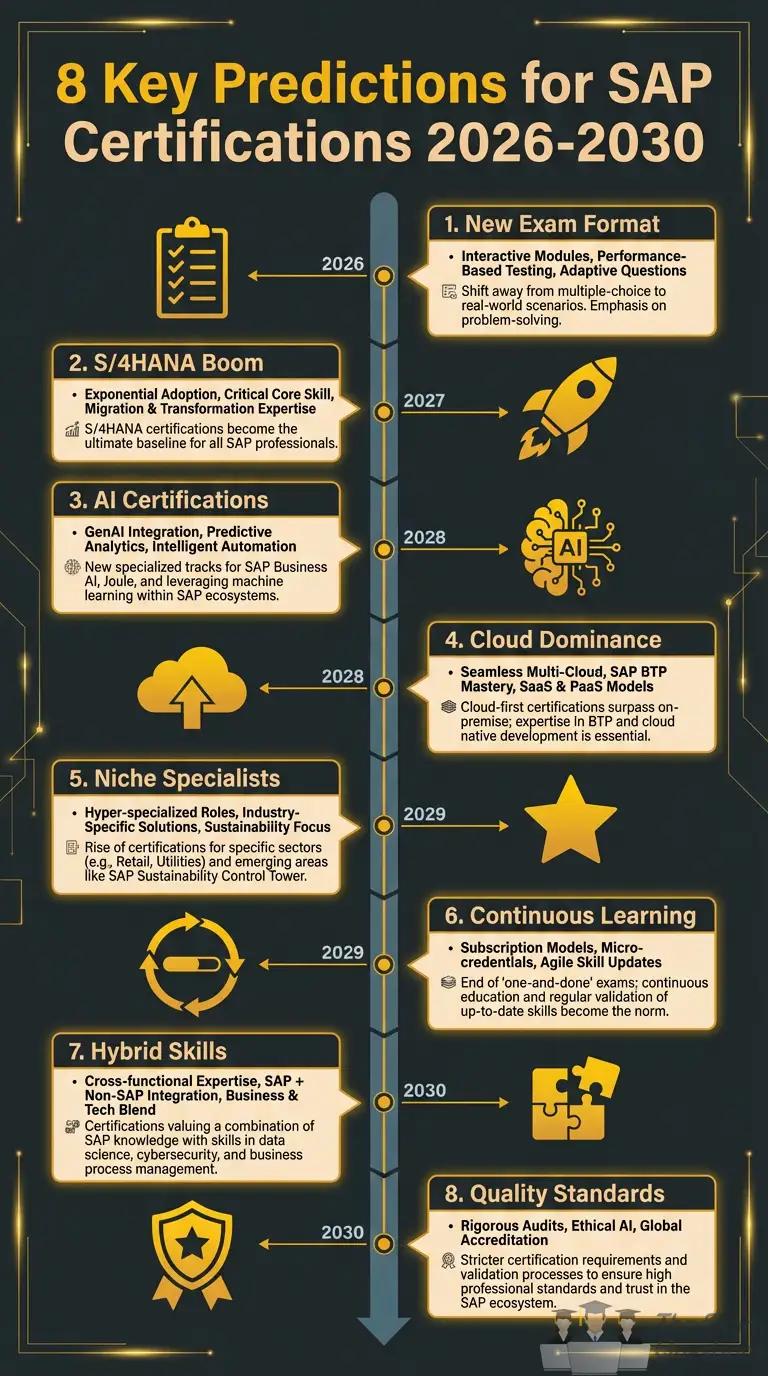
Prediction #1: The 2027 S/4HANA Deadline Creates a Certification Boom (2026-2028)
Why December 2027 Changes Everything
Here's a date that's keeping executives awake at night:
December 31, 2027 - The day SAP ECC mainstream maintenance ends.
What does this mean?
After this deadline, companies still running SAP ECC will face:
- No more security patches
- No bug fixes
- No software updates
- Increased compliance risks
- Operational vulnerabilities
The impact?
Organizations worldwide are rushing to migrate to SAP S/4HANA. This creates explosive demand for certified S/4HANA professionals.
The Certification Gold Rush
According to current market data:
- Over 30,000 open SAP positions in the United States alone
- S/4HANA certifications are the #1 most in-demand SAP credential
- Certified professionals earn 20-30% more than non-certified peers
- Companies are scrambling to build internal S/4HANA capability
Here's the kicker:
The window of maximum opportunity is 2026-2028. Organizations need certified S/4HANA talent NOW to complete migrations before the deadline.
Top S/4HANA Certifications to Target
- SAP Certified - Implementation Consultant - SAP S/4HANA Cloud Public Edition, Sales (2026 version)
- SAP Certified Associate - SAP S/4HANA Cloud Private Edition for Management Accounting
- SAP Certified Associate - SAP S/4HANA Cloud Private Edition, Financial Accounting
- SAP Certified Associate - SAP S/4HANA System Administration
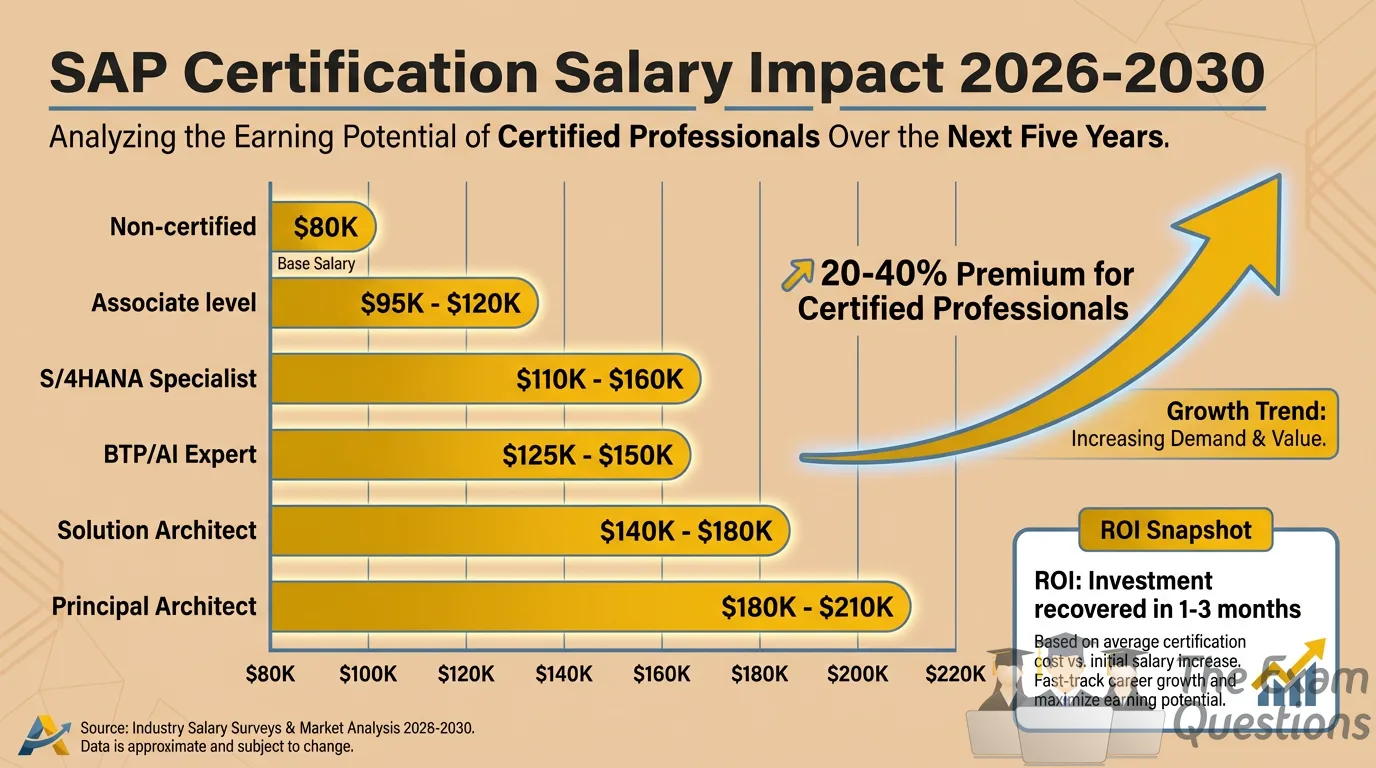
Salary impact: S/4HANA specialists typically earn $110,000 to $135,000, with senior experts commanding $135,000 to $160,000+.
Prediction #2: AI-Powered SAP Certifications Become Essential (2026-2028)
The Rise of SAP Business AI
Artificial intelligence isn't just changing how we work - it's creating entirely new certification categories.
SAP has introduced AI-focused certifications that will become must-have credentials by 2028:
1. SAP Certified - SAP Generative AI Developer
This certification validates your ability to:
- Build AI models within SAP environments
- Integrate generative AI into business processes
- Work with SAP AI Core and AI Foundation
- Deploy AI solutions that work with S/4HANA
Current status: Available now, rapidly growing in demand
Estimated cost: $500-$1,200 including study materials
2. SAP Certified - Positioning SAP Business AI Solutions as part of SAP Business Suite
Focus areas:
- Understanding how AI solves business challenges
- Positioning AI solutions for different industries
- Integrating AI with SAP Business Suite
- Delivering measurable AI outcomes
Market prediction: By 2027, this will be a baseline requirement for SAP consultants and solution architects.
Why AI Certifications Matter
Here's what the data shows:
- By 2026-27, 100% of SAP's new innovations will focus on AI-driven automation
- Machine learning and predictive analytics are becoming standard features
- Organizations expect SAP professionals to understand AI integration
You might be wondering:
"Do I really need an AI certification if I'm a functional consultant?"
Short answer: Yes.
By 2028, SAP professionals without AI knowledge will be like web developers without JavaScript skills - technically possible, but severely limited.
Prediction #3: Cloud-First Certifications Dominate (2026-2030)
The Irreversible Shift to Cloud
SAP ECC is being retired. The future is 100% cloud-based:
- SAP S/4HANA Cloud (public and private editions)
- SAP Business Technology Platform (BTP)
- SAP Analytics Cloud (SAC)
- SAP SuccessFactors (cloud-native HR)
What this means:
Traditional on-premise expertise becomes less valuable while cloud platform skills become mission-critical.
High-Demand Cloud Certifications (2026-2030)
SAP Business Technology Platform (BTP) Certifications
BTP is SAP's strategic platform for:
- Integration
- Extension
- Automation
- Innovation
Key certifications:
- SAP Certified - Solution Architect - SAP BTP
- SAP Certified Associate - Integration Developer
- SAP Certified - SAP BTP Administrator
Career impact: BTP specialists are among the highest-paid SAP professionals, often earning $125,000-$150,000+.
SAP Analytics Cloud (SAC) Certifications
As data-driven decision making becomes standard:
- SAP Certified - Data Analyst - SAP Analytics Cloud
- Focus: Planning, reporting, analytics, and predictive modeling
SAP SuccessFactors Certifications
HR digital transformation drives demand:
- SAP Certified - SAP SuccessFactors Employee Central Core and Position Management
- SAP Certified - SAP SuccessFactors Recruiting: Recruiter Experience
The Cloud Skills Gap
Here's the uncomfortable truth:
Most SAP professionals built their expertise on on-premise systems. Cloud platforms require fundamentally different thinking:
- Architecture patterns change
- Integration approaches differ
- Development paradigms shift
- Security models evolve
Organizations are desperately seeking professionals who bridge legacy knowledge and cloud expertise. Get certified in cloud platforms, and you become irreplaceable.
Prediction #4: Specialized "Niche" Certifications Command Premium Salaries (2027-2030)
The Death of the "General SAP Consultant"
By 2028, broad generalist roles will fade. The future belongs to deep specialists in high-value domains.
Here are the niche certifications that will command premium salaries ($140,000-$180,000+):
1. SAP Security & Compliance Certifications
Cybersecurity threats are escalating. Organizations need specialists who can:
- Secure cloud environments
- Ensure compliance (GDPR, HIPAA, SOX)
- Manage privileged access
- Implement fraud detection
Hot certification: SAP Certified Associate - Security Administrator
Why it matters: Security breaches in SAP systems can cost millions. Security specialists are worth their weight in gold.
2. SAP Integration Certifications
Modern enterprises run on integrated systems. Integration consultants who can connect:
- SAP with non-SAP systems
- Cloud with on-premise
- Real-time data flows
- API management
Key certification: SAP Certified Associate - Integration Developer
Market outlook: Integration specialists will see sustained high demand through 2030.
3. SAP Industry-Specific Certifications
Generic SAP knowledge isn't enough. Industry expertise matters:
- Retail (inventory, omnichannel)
- Manufacturing (production planning, quality)
- Healthcare (compliance, patient management)
- Oil & Gas (specific industry solutions)
Trend: Companies increasingly seek SAP professionals who understand their industry context, not just technical configuration.
Prediction #5: Continuous Learning Replaces "Once and Done" Certification (2026-2030)
The New Reality: SAP Certifications Valid for Only 1 Year
Here's a major change that catches many professionals by surprise:
SAP certifications now expire after one year.
Wait, what?
Yes. To maintain your certified status, you must:
- Complete ongoing training
- Stay current with updates
- Demonstrate continuous learning
- Renew annually
Why This Change Matters
SAP's rationale is sound:
Technology evolves too fast for "lifetime" certifications to remain meaningful. A certification from 2024 doesn't guarantee you understand 2026 capabilities.
The new model:
- Incentivizes continuous learning
- Ensures current knowledge
- Increases professional credibility
- Protects employer investments
How to Stay Certified
SAP Learning Hub becomes essential:
- Access to all training courses
- Four exam attempts included
- 10 practice hours per certification
- Continuous content updates
Cost consideration: While annual renewal adds expense, it also increases the value and trust in certified professionals.
It gets better:
Professionals who embrace continuous learning will have massive advantages over those who resist. By 2030, the most successful SAP careers will belong to lifelong learners.
Prediction #6: Hybrid Skills (SAP + Adjacent Technologies) Become Mandatory (2027-2030)
SAP Expertise Alone Isn't Enough
The future SAP professional needs cross-domain knowledge:
SAP + Data Science
- Understanding AI/ML models
- Data analysis and visualization
- Predictive analytics
- Business intelligence
SAP + Cloud Architecture
- Multi-cloud strategies (AWS, Azure, Google Cloud)
- Kubernetes and containerization
- Microservices architecture
- DevOps practices
SAP + Process Intelligence
- Process mining
- Business process optimization
- Digital transformation
- Change management
SAP + Low-Code/No-Code Platforms
- SAP Build
- Automation tools
- Citizen development enablement
The "T-Shaped" SAP Professional
By 2030, the most valuable SAP professionals will be "T-shaped":
- Deep vertical expertise in one SAP domain (the vertical bar)
- Broad horizontal knowledge across adjacent technologies (the horizontal bar)
Organizations will pay significant premiums for professionals who can bridge SAP with other critical business capabilities.
Prediction #7: Performance-Based Certification Drives Higher Quality Standards (2026-2028)
The Quality Revolution
SAP's shift to scenario-based exams creates a quality upgrade across the entire certification ecosystem.
Here's why:
Old model problems:
- Memorization over understanding
- Exam dumps and cheating
- Certified professionals who can't perform
- Employer skepticism
New model benefits:
- Authentic skill demonstration
- Impossible to "game" the system
- Employer confidence in certified talent
- Higher professional credibility
What This Means for Certification Value
Starting in 2026, SAP certifications will carry more weight with employers because:
- They prove practical ability
- They're harder to obtain
- They require real experience
- They validate problem-solving skills
The bottom line?
Fewer people will pass. But those who do will be significantly more valuable to employers.
Salary impact: By 2028, we predict certified professionals will earn 30-40% premiums over non-certified peers (up from the current 20-30%).
Prediction #8: Industry Consolidation Creates "Preferred" Certification Paths (2027-2029)
Not All Certifications Are Created Equal
By 2027, clear certification hierarchies will emerge:
Tier 1: High-ROI Certifications
- S/4HANA (all modules)
- SAP BTP
- SAP Generative AI Developer
- SAP Analytics Cloud
- Industry-specific specialist certifications
Characteristics: High demand, excellent salaries, strong career progression
Tier 2: Solid Foundation Certifications
- SAP FICO (Finance)
- SAP MM (Materials Management)
- SAP SD (Sales & Distribution)
- SAP HCM (Human Capital Management)
Characteristics: Steady demand, good salaries, established career paths
Tier 3: Legacy/Declining Certifications
- Older ECC-specific certifications
- On-premise-only expertise
- Technology being phased out
Characteristics: Declining demand, career limitations unless updated
Strategic Certification Planning
Smart professionals will:
- Start with foundation (Tier 2)
- Pivot to growth areas (Tier 1)
- Avoid legacy traps (Tier 3)
- Stack complementary certifications
By 2029, the most successful SAP careers will follow deliberate certification roadmaps, not random accumulation of credentials.
The Certification Investment: Costs and ROI (2026-2030)
What SAP Certifications Cost
Let's talk numbers:
Direct costs per certification:
- Exam fees: $500-$600 (includes 2 attempts)
- Training materials: $200-$500
- SAP Learning Hub subscription: $1,800-$2,500/year
- Practice exams: $50-$150
Total investment per certification: $1,000-$2,000
For professionals pursuing multiple certifications (recommended), annual investment can reach $3,000-$5,000.
The ROI Calculation
Here's where it gets interesting:
Salary increase from certification: 20-40% premium
Example:
- Non-certified SAP consultant: $80,000/year
- Certified S/4HANA specialist: $110,000/year
- Annual gain: $30,000
ROI timeframe: Most professionals recover certification investment in 1-3 months.
Beyond Salary: Hidden ROI Benefits
Certifications also provide:
- Job security during economic downturns
- Career mobility (easier to change employers/industries)
- Consulting opportunities (higher hourly rates)
- International opportunities (globally recognized credentials)
- Faster promotions to architect and leadership roles
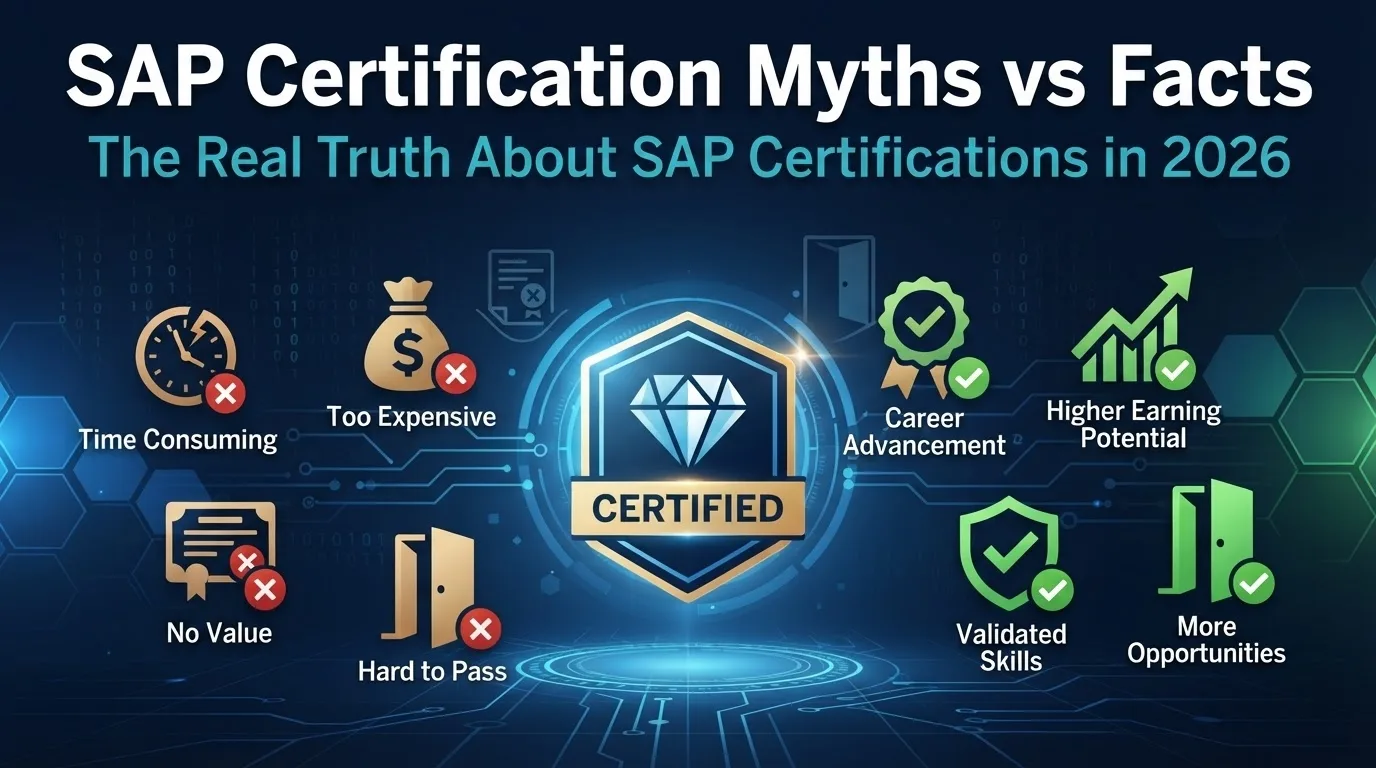
By 2030, SAP certification won't just be "nice to have" - it will be the baseline expectation for serious SAP careers.
How Organizations Should Think About Certification (2026-2030)
The Business Case for Employer-Sponsored Certification
Forward-thinking organizations are treating SAP certification as strategic investment, not employee perk.
Here's why:
Reduced Dependency on External Consultants
- External consultants: $150-$300/hour
- Certified internal staff: Already on payroll
- Savings: $100,000+ per major project
Faster, More Stable Implementations
- Certified teams deliver 20-30% faster
- Quality improves
- Rework decreases
- Risk reduces
Improved Retention
- Professionals value development investment
- Certified employees stay 2-3 years longer
- Replacement costs avoided
Competitive Advantage
- Better system utilization
- Faster adoption of new features
- Innovation enablement
The 2026-2030 Organizational Strategy
Smart organizations will:
- Build certification roadmaps for all SAP roles
- Fund certification programs (exams + training)
- Create time/space for study and preparation
- Reward achievement (bonuses, promotions, recognition)
- Mandate continuous learning (annual recertification)
Organizations that underinvest in SAP certification will face:
- Talent shortages
- Higher external consulting costs
- Implementation delays
- Competitive disadvantage
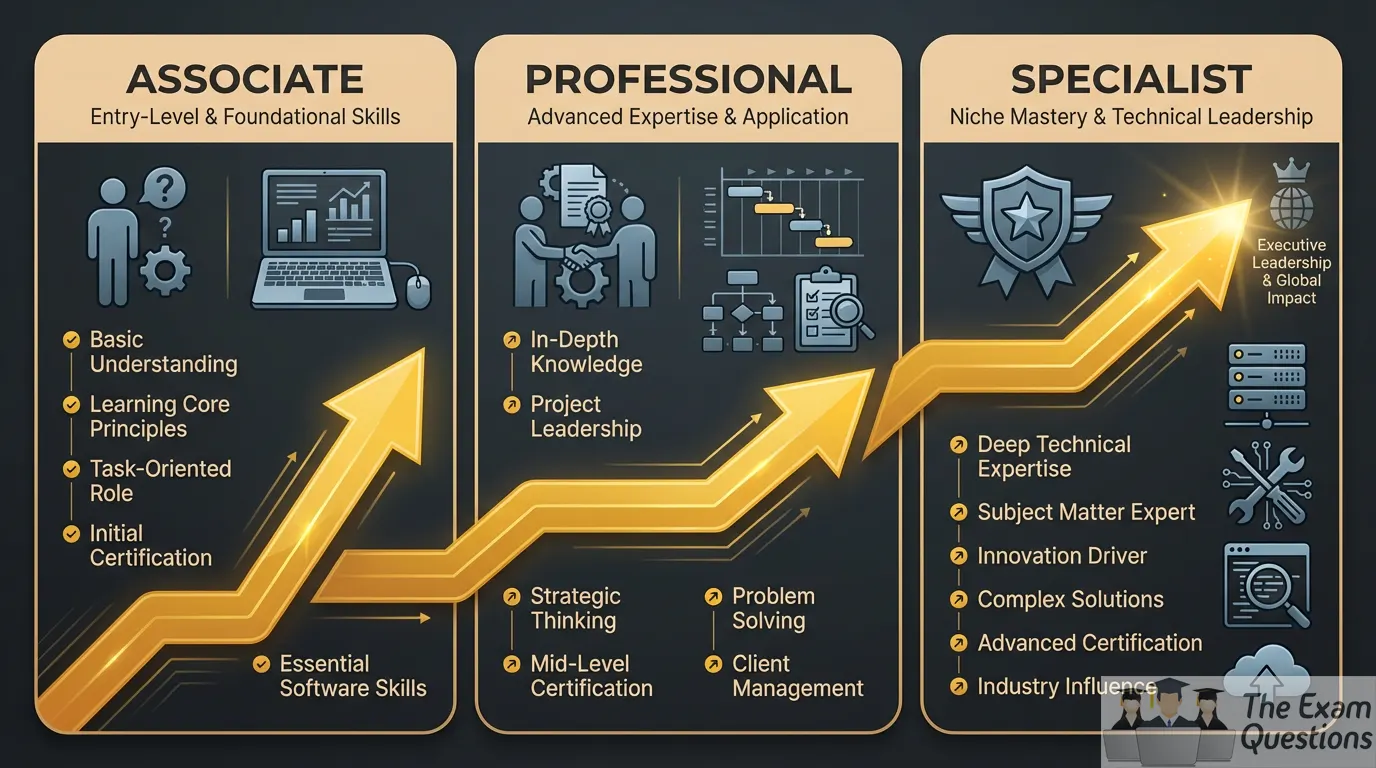
Your SAP Certification Action Plan for 2026-2030
Here's the deal:
The SAP certification landscape is transforming faster than most professionals realize. Those who adapt strategically will thrive. Those who wait will fall behind.
If You're Starting Your SAP Career (2026-2027)
Step 1: Get foundational certification
- Choose: SAP S/4HANA module aligned with your interest (Finance, Sales, Supply Chain)
- Timeline: 4-6 months preparation
Step 2: Gain hands-on experience
- Apply skills in real projects
- Build portfolio of practical examples
Step 3: Add specialist certification
- Target: BTP, Analytics Cloud, or AI certification
- Timeline: 6-12 months after foundation
If You're Mid-Career (2026-2028)
Step 1: Update legacy certifications
- Migrate from ECC to S/4HANA certifications
- Timeline: Immediate (before 2027 deadline pressure peaks)
Step 2: Add cloud platform expertise
- Get certified: SAP BTP or Integration Suite
- Timeline: 3-6 months
Step 3: Pursue specialist/professional level
- Target: Solution Architect or AI Developer
- Timeline: 12-18 months
If You're Senior/Leadership (2027-2030)
Step 1: Achieve professional-level certification
- SAP Certified Development Professional
- Demonstrates enterprise leadership capability
Step 2: Build strategic expertise
- Industry-specific certifications
- AI and business transformation focus
Step 3: Mentor and build teams
- Create organizational certification programs
- Develop next-generation talent
The Bottom Line: Why 2026-2030 Is the Golden Era for SAP Certifications
Let me be crystal clear:
The next five years represent the greatest opportunity in SAP certification history.
Why?
- Unprecedented demand (2027 migration deadline)
- Higher credibility (performance-based exams)
- Emerging technologies (AI, cloud, analytics)
- Salary premiums (30-40% above non-certified)
- Career security (certified professionals are recession-proof)
But here's the kicker:
This window won't last forever. By 2029-2030, as migrations complete and the market stabilizes, competition for SAP roles will intensify. The professionals who invest in certification now will have established themselves as industry leaders.
Those who wait? They'll be playing catch-up.
What's Your Next Move?
The future of SAP certifications isn't something that happens TO you - it's something you actively shape through strategic decisions made today.
Will you be the professional who:
- Embraced the new practical exam format?
- Got S/4HANA certified before the 2027 rush?
- Added AI skills when they were still emerging?
- Built hybrid expertise across platforms?
Or will you look back in 2028 wishing you had started in 2026?
The choice is yours. But the opportunity is right now.
Ready to transform your SAP career? Start with one certification. Choose strategically. Invest consistently. The next five years will define SAP careers for the next decade.