Picking the right SAP certification can feel a bit overwhelming, like you’re staring at a map with a dozen winding roads and no clear signs. SAP, meanwhile, has plenty of options. With more than 90+ certifications in a variety of areas, one bad move can cost you time, money, and even some career momentum.
But here’s the thing: you don’t have to figure it out alone. This guide breaks down all the domains SAP covers and helps you match the right one to your goals, your background, and where you see yourself heading. It doesn’t really matter if you’re new to SAP, already working as a consultant, or deep into development; you’ll finish reading with a clear plan for your next step.
Let’s get into it.
Understanding SAP Certifications: The Basics
First things first: how are SAP certifications organized?
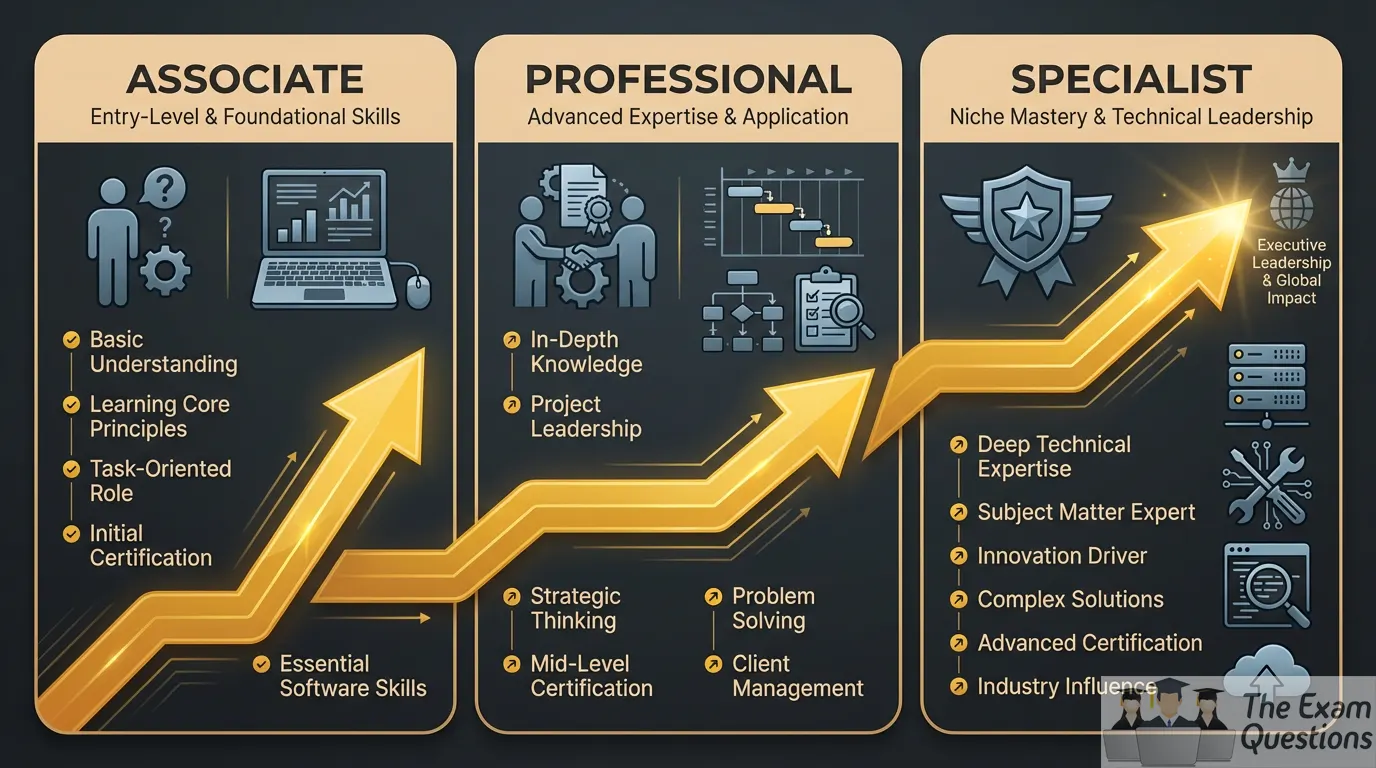
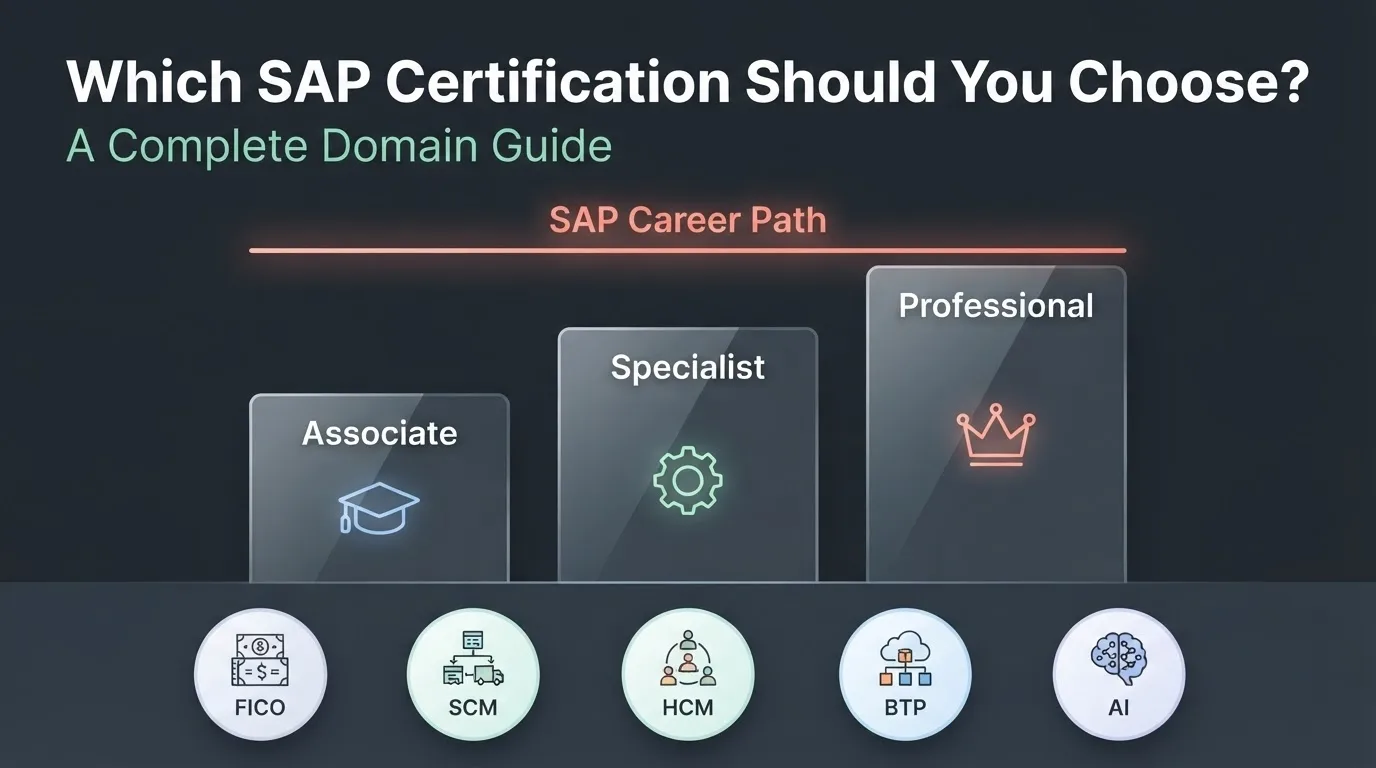
1. Associate Level
This is the entry point. It’s designed for beginners or anyone shifting into SAP roles. These certifications prove you know the basics of a specific SAP solution or module.
Need-to-know: You’ll answer between 40–80 questions, the test runs 90–180 minutes, and you need to hit a 60–65% passing score.
2. Specialist Level
A step up, these are geared toward folks who already have practical experience under their belt. The specialist certifications are built around advanced features, specific roles, or integration points in a specific domain.
3. Professional Level
If you’re applying for a senior consultant, solution architect, or project manager role, this level demonstrates your broad expertise and strategic vision.
Picking Your SAP Domain: A Quick Guide
Let’s run through the main SAP domains so you can figure out where you fit.
1. Finance & Controlling (FICO)
This area covers everything in financial accounting, management accounting, and internal controlling processes. Honestly, if you’re looking for a high-demand SAP specialization, FICO is it; it’s the backbone for financial management in just about every organization.
- Who’s it for? Accountants, finance pros, management accountants, financial analysts, and anyone making the jump from Excel-based accounting.
- Typical salary: $85,000 to $130,000 in the U.S., and with the 2027 S/4HANA migration deadline, demand is just increasing.
- Source for your reference: Sap Fico Consultant salaries
Popular certification include:
2. Supply Chain Management (SCM)
Full end-to-end coverage of the whole supply chain. Procurement, manufacturing, distribution, whatever.
- Consider modules like Material Management (MM), Sales & Distribution (SD), Production Planning (PP), Quality Management (QM), etc.
- Who is it for? Manufacturing Leads, Warehouse Managers, Supply Chain Pros, Procurement Specialists, Logistics Managers.
- Today’s supply chain disruptions make the need for certified SCM professionals more relevant than ever. Step it up a notch by getting your certification in SAP Ariba or Integrated Business Planning.
Popular pick:
3. Human Capital Management (HCM)
This domain covers every part of managing a workforce from hiring through retirement.
- There are two paths: the classic SAP HCM modules (think core HR, payroll, time, organizational management, talent) and the newer, cloud-based SAP SuccessFactors, which is now dominant.
- Who thrives here? HR professionals, HRIS specialists, payroll and compensation folks, talent acquisition pros basically, if you care about employee experience, this is your place.
- The market’s moving fast toward cloud HCM (HXM), so SuccessFactors certifications are especially valuable.
Popular Course:
4. Technical Development & Administration
Here’s where the technical crowd lives. If you're the sort who likes to build things from the ground up, or keep complex systems running, check these out:
- ABAP Development: Build custom reports, interfaces and enhancements with SAP’s language. If you have a developer or programming background, it’s a natural progression.
- Basis Administration: SAP “engine room” system configuration, monitoring, security and performance tuning. Good for system admins and IT infra people.
- SAP HANA Administration, in contrast, goes in-depth into managing SAP’s in-memory database. Your responsibilities will include backups, system tuning, and replication.
If you like to roll up your sleeves and work hands on with database tweaking, maintaining, and pushing for top performance. This is where you want to be.
5. SAP Business Technology Platform (BTP)
This is SAP’s “innovation engine.” If you want to work with cutting-edge tech and cloud-native apps, BTP is where the action is. Why? As organizations increasingly keep their S/4HANA systems “clean” and standard, they extend and connect everything with BTP.
Five core pillars:
- Database & Data Management: SAP HANA Cloud, data warehousing
- Analytics: SAP Analytics Cloud (SAC), data visualization, predictive analytics
- Application Development: Low-code/no-code tools, SAP Build, CAP (Cloud Application Programming Model)
- Integration: Connecting SAP and non-SAP systems seamlessly
- AI Foundation: Joule (SAP's AI copilot), AI Business Services
- Who’s this for? Cloud architects, integration specialists, data and BI professionals, developers interested in low-code/no-code tools.
- This domain is seeing some of the highest salary spikes, as high as $148,509 annually (in the US).
- Source for your reference: Sap BTP Salary
6. Business Intelligence and Analytics
If you love taking raw data and converting it to insights, this is your highway.
- You’ll find modules like SAP Analytics Cloud (SAC), BusinessObjects, Data Warehouse Cloud, and embedded analytics inside S/4HANA.
- Who should consider this? Business and data analysts, financial planning professionals, or anyone who’s been a super-user in Excel but wants to move up.
- There’s massive demand for people who can truly bridge data and decision-making. Combine SAC with a functional area like Finance or SCM, and you’ll be in even higher demand.
7. Emerging Technology: Joule, AI, Machine Learning
SAP doubles down on AI. Joule is their new AI copilot, launched in 2023, and it’s getting smarter fast.
- With SAP’s push into natural language, automation, predictive insight, and AI-based business services, there’s a real chance to get in on the ground floor here.
- Who should go for this? To break into data science or process automation, or to future-proof the skills you already have, you will stand out by combining SAP expertise with AI.
Basic Rules for Selecting the Right Domain
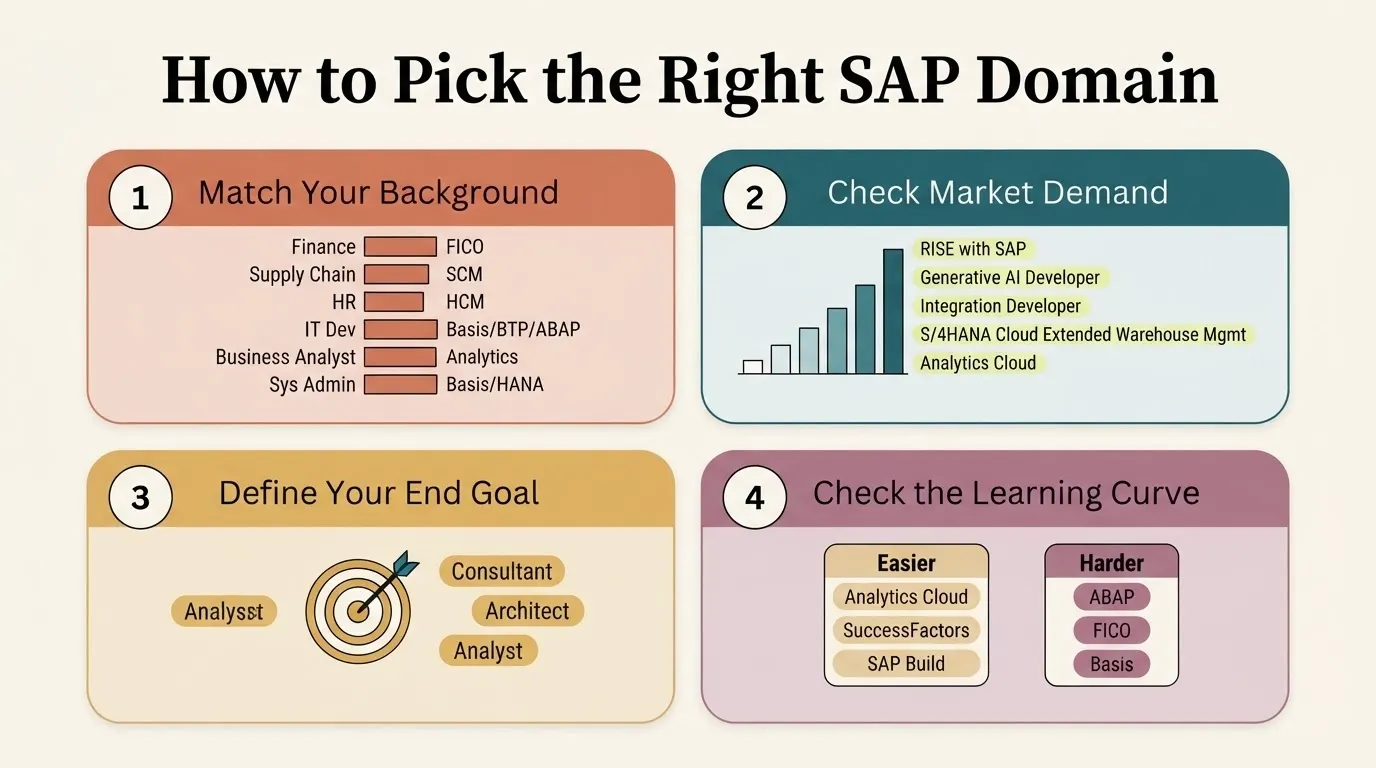
Step 1: Background- Finance/Accounting? Look at FICO or Analytics Cloud.
- Supply chain/operations? Go for SCM modules (MM, PP, SD).
- HR pro? Aim for HCM or SuccessFactors.
- IT or developer? Basis, BTP, or ABAP make sense.
- Business analyst? Mix Analytics Cloud with a functional setup.
- System administrator? Basis Administrator/HANA
Step 2: Market Needs
Below you will see the list of the top 5 SAP Certifications to watch out for in 2026:
- RISE with SAP Methodology and Experience Certified by SAP.
- SAP Certified – SAP Generative AI Developer.
- SAP Certified – SAP Integration Developer.
- SAP Certified - S/4HANA Cloud Private Edition Extended Warehouse Management.
Step 3: Think about your end goals
Where do you want to be in a few years? If you see yourself as a functional or technical consultant, architect, or analyst, pick the domain that lines up with your industry and long-term interest. If you want to go deep, specialize and stack certifications in one domain.
Step 4: Verify the learning curve
- Easier on-ramps: Analytics Cloud (if you know BI tools), SuccessFactors (intuitive cloud UI), SAP Build (low-code).
- Harder climbs: ABAP (have to learn a programming mindset), FICO (have to learn an accounting mindset), Basis (have to learn an IT infrastructure mindset).
Bottom line: Pick a path that builds on what you already know, but puts you in a position to grow.
Major Changes are coming to SAP Certification in 2026
SAP is moving to open-book and scenario-based practical exams rather than testing just what you recall. You’ll need to demonstrate what you can actually do, not just what you’ve memorized. Employers notice this shift, too. The value of certification is going up, because now it proves you can deliver real results.
What’s Different About SAP Certification in 2026?
Remember: In 2026, SAP’s certification exams become practical, open-book, and scenario-based. Translation? You’ll need to prove you can really use SAP, not just answer questions on paper.
Here’s how you prepare:
- Hands-on work in SAP trial systems or Learning Hub.
- Solve case studies, not just memorize facts.
- Get comfortable using SAP documentation on the fly.
- Sharpen your problem-solving over rote memorization.
How to Actually Get Certified: A Realistic Plan
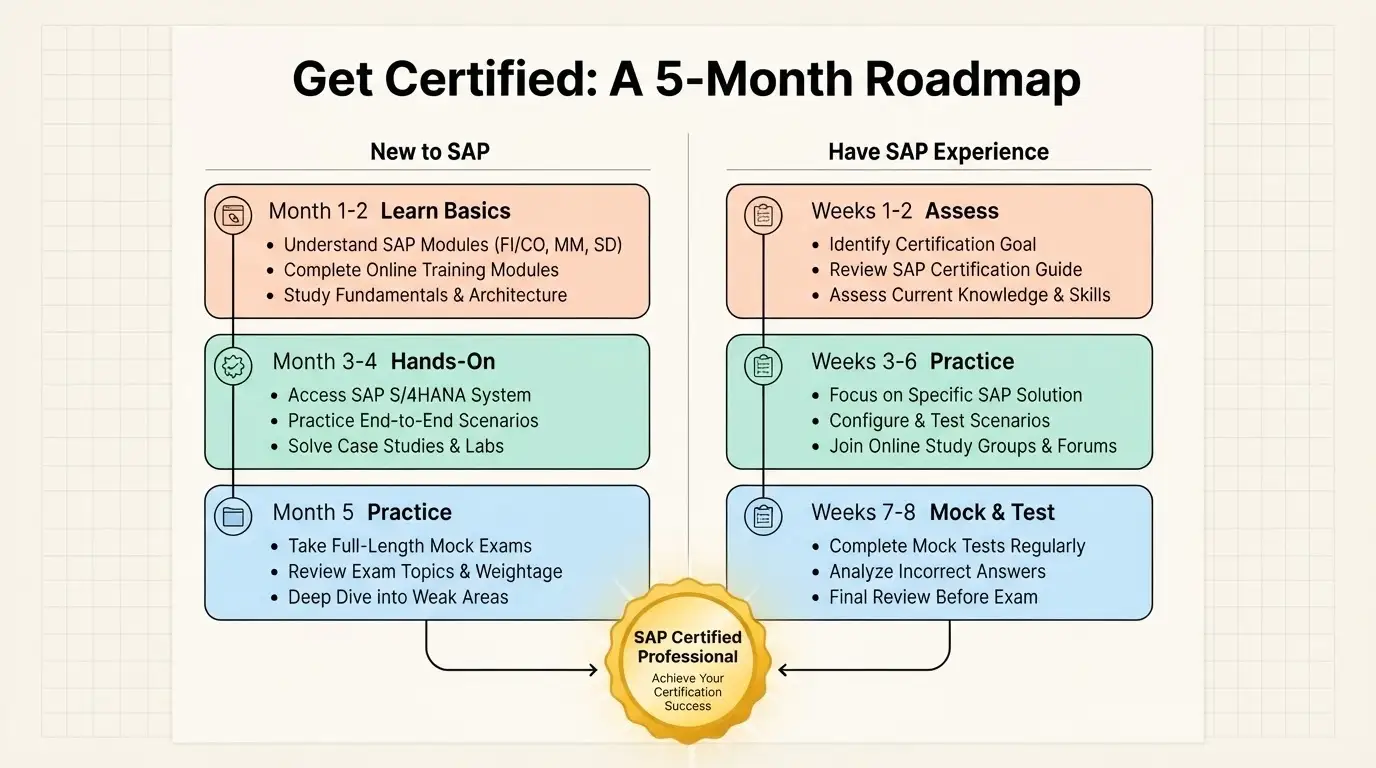
New to SAP?
- Months 1–2: Learn the basics (use SAP Learning Journeys, join forums, get comfortable navigating).
- Months 3–4: Get hands-on with your field. Get trained, answer the scenario questions, and practice on the real platform for a while.
- Month 5: Practice Exams and Weak Areas. When you’re feeling good, schedule your exam.
Have experience already?
- Weeks 1–2: Figure out exactly where you stand. Review the topics for the exam and shore up any holes you see.
- Weeks 3- 6: Now it's time to practice questions, get your hands dirty with labs, and test yourself with real-world scenarios to see how you go.
- Weeks 7–8: Tackle mock exams, run through scenario drills, and then take the certification.
Mistakes You Want to Avoid
- Don’t just go for the “easiest” certificate; make sure it fits your career plans.
- Don’t rely only on theory. Test the things on real SAP systems before you register for the test.
- Don’t ignore new tech. Keep an eye on AI, BTP, and Joule as they reshape what’s valuable.
- Don’t skip scenario-based questions. The new format depends on them.
- Don’t get certified without experience. Pair the credential with hands-on work wherever you can.
Conclusion: What’s Your Next Step?
We just walked through more than ten SAP domains, a clear decision-making process, the big 2026 exam changes, tips on how to prep, and the major missteps to avoid.
Here’s what really matters: SAP certifications open the door to high-paying, future-proof careers whether you’re into finance, supply chain, tech, cloud, or AI.
Your turn: pick the domain that fits your path, research the certifications, practice with real-world scenarios, and schedule your exam with confidence. SAP’s world is moving fast. If you adapt, upskill, and certify with purpose, you’ll be ready for anything.
Ready to get your hands dirty and start practicing for the new exams? This is where your SAP journey begins: the right domain and the right approach.
If you're set on becoming SAP certified, dig in now. With The Exam Questions, you get the latest scenario-based questions, hands-on system tasks, and full online practice exams.