Starting a career in SAP can be a lot to take in. There’s no shortage of opportunities: high salaries, solid job security, and companies worldwide looking for SAP talent. But staring down the lineup of certifications? That’s where most newcomers get stuck. Which one really opens doors for someone just starting?
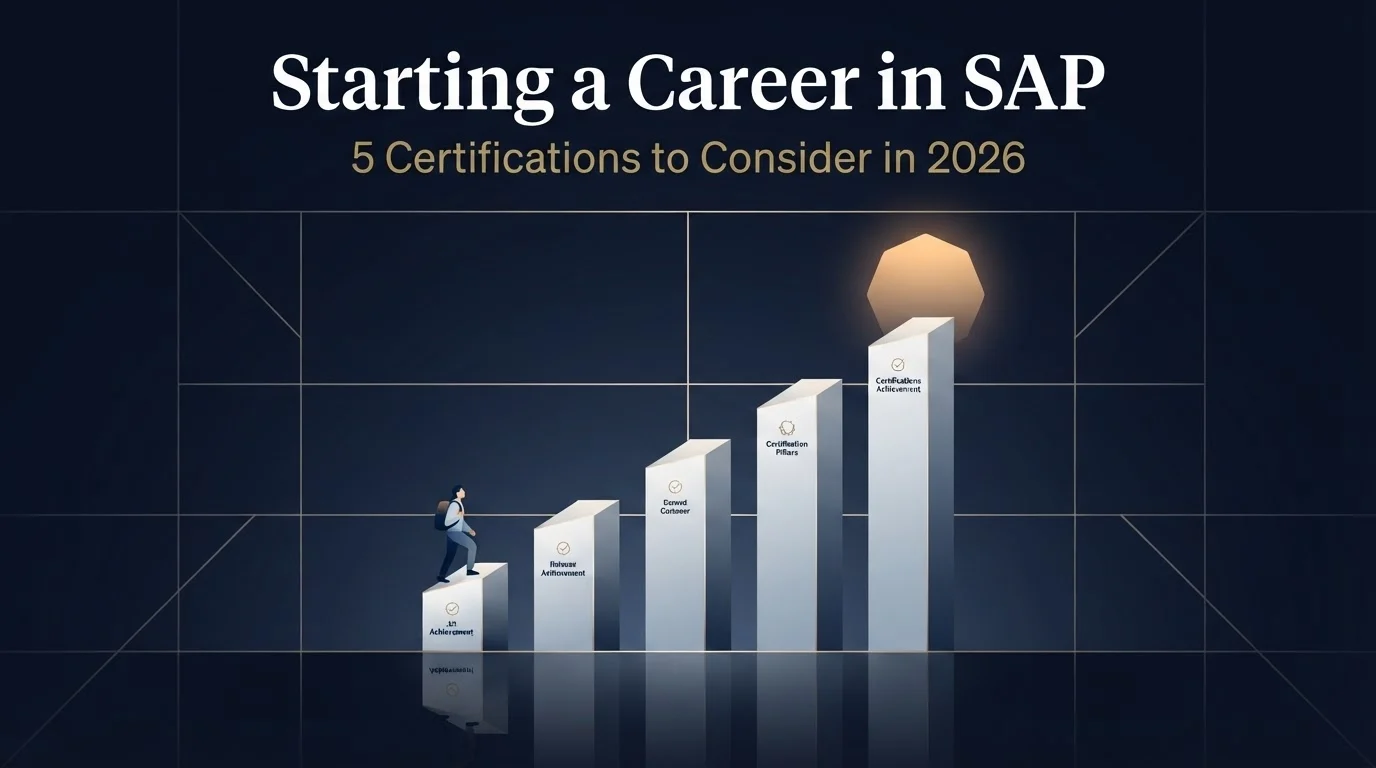
Let’s break this down together. Not all SAP certifications are equally useful if you’re new. Some can land you that first job, while others might throw you into the deep end, up against consultants with years of experience. This guide tells you exactly what employers will be looking for in 2026, how much those certifications cost, how to pick the right one, and insider moves to actually land a job after you pass your exam.
Ready? Let’s get into it.
Why Certifications Matter When You’re New to SAP
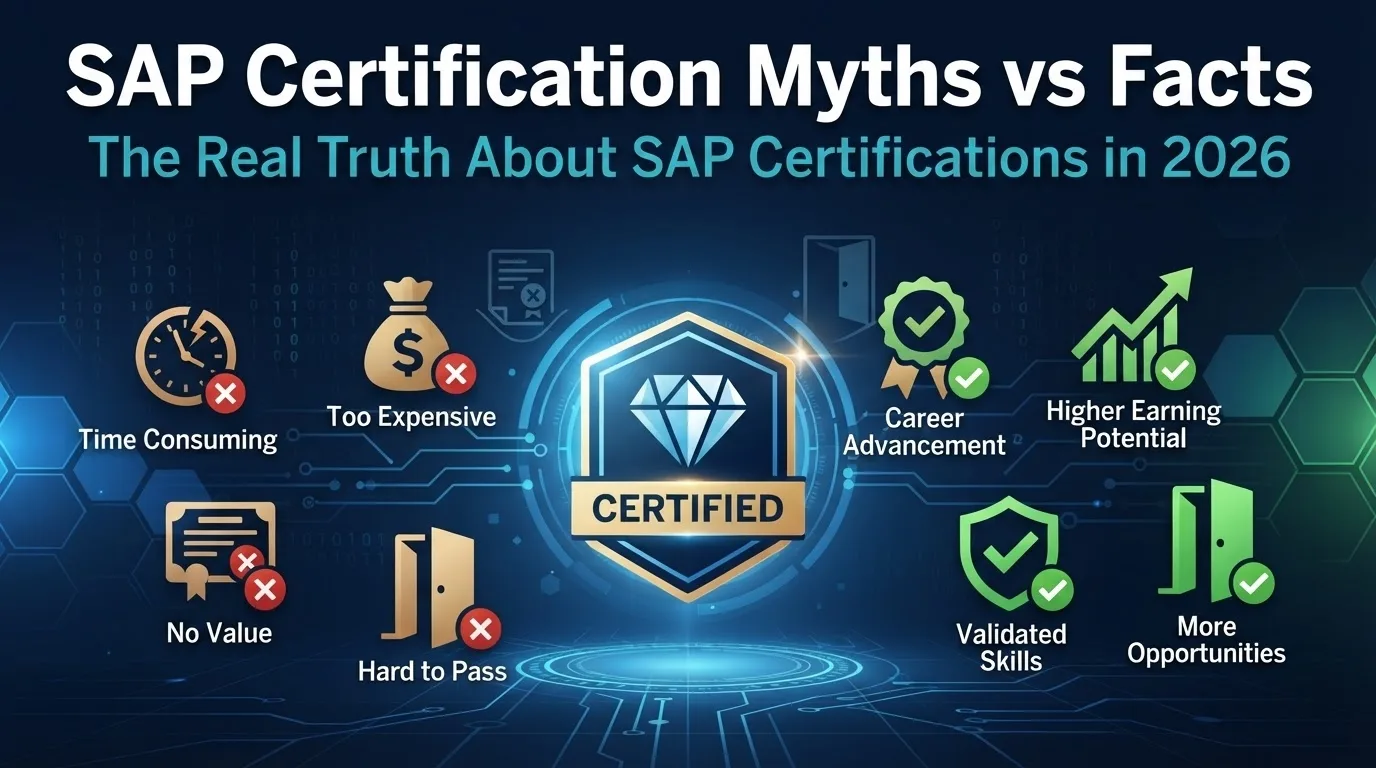
Do you need certification to get your start in SAP? Yes and no. Some people manage to slide in through hands-on experience alone. But for most entry-level candidates, certification is what gets your resume seen.
Here’s why it matters:
- It proves you have real, verified SAP skills, not just a passing familiarity.
- A lot of HR teams use certifications to weed out stacks of applicants.
- Pay is higher on average; certified applicants earn 20-35% more.
- It shows employers you’re serious about joining the SAP community and keeping your skills current.
If you look at entry-level SAP jobs in the U.S., salaries run from $36,000 to $65,500 a year. Got certified? You’re starting closer to $70,000–$80,000. It’s not just a piece of paper; it’s potentially tens of thousands more in your pocket.
Source: https://www.ziprecruiter.com/Salaries/Sap-Entry-Level-Salary
Top 5 SAP Certifications Employers Want in 2026
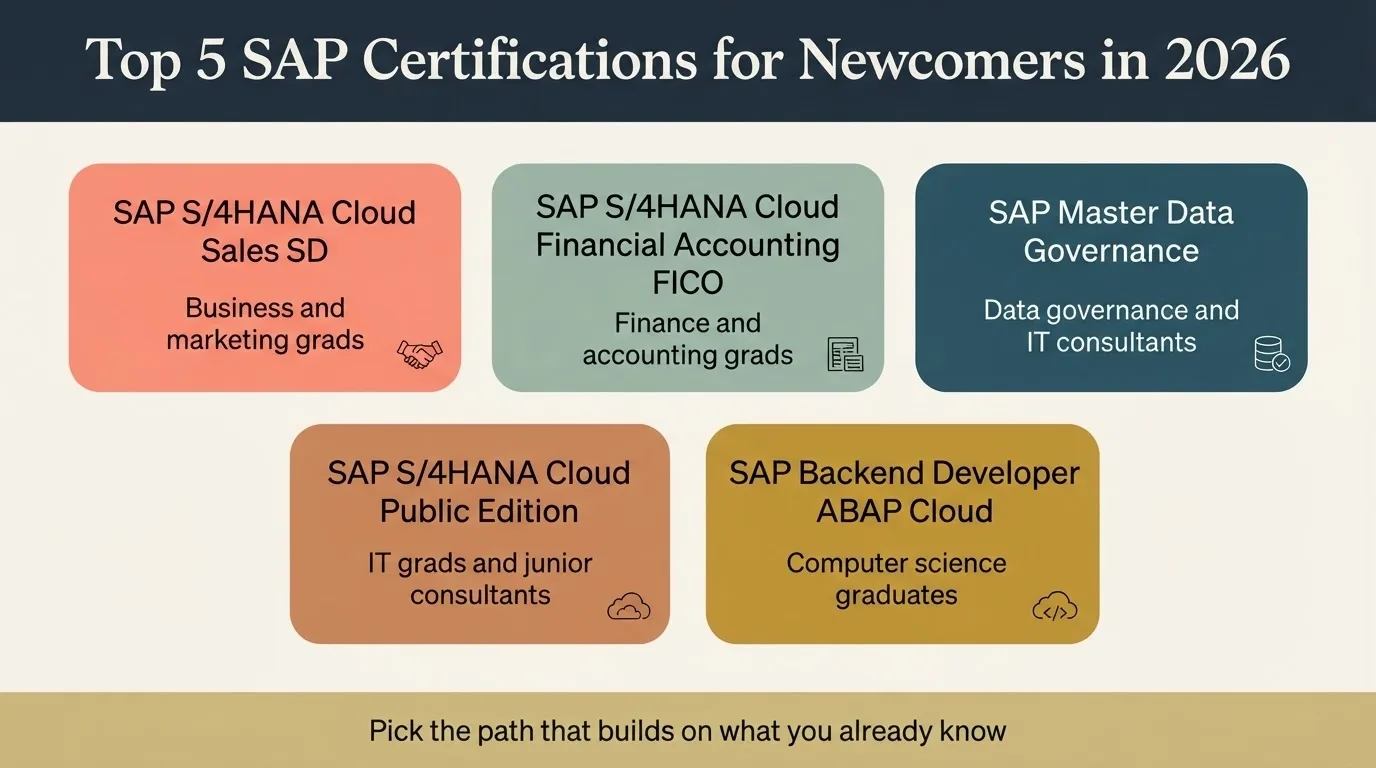
After digging through the latest job market numbers, here’s what actually gets attention for entry-level candidates:
1. SAP Certified: Implementation Consultant: SAP S/4HANA Cloud Public Edition, Sales
Every company has to sell something, so SAP Sales and Distribution (SD) is always in demand. This certification is all about SAP S/4HANA Cloud, SAP’s “now and future” platform.
- Who should consider it: Business grads, anyone with sales/marketing experience, or folks who like working with customers.
- Covers: Sales orders, pricing/billing, delivery, shipping, and managing customer info.
- Jobs: Always plenty out there; this is one of SAP’s most posted roles.
2. SAP Certified: Implementation Consultant: SAP S/4HANA Cloud Public Edition, Financial Accounting
Money makes business go, so SAP S/4HANA Cloud Public Edition, Financial Accounting (finance + controlling) is never going out of style.
- Best for: Accounting/finance grads, people with some bookkeeping behind them, or those who love numbers.
- What you learn: Ledger accounting, accounts payable/receivable, asset and cost center accounting, internal orders.
- Jobs: Extremely high demand. FICO is everywhere.
- Tip: FICO is a good springboard into roles such as SAP Finance Manager, Controller.
3. SAP Certified – SAP Master Data Governance
Data is useless if it’s not clean and accurate. MDG keeps a company’s information accurate and coordinated. This cert demonstrates you can centralize and manage key info, which is a big deal for digital transformations.
- Who it's for: Data analysts, IT consultants, EIM professionals, people with database backgrounds.
- What you learn: You will learn how to set up your system, how to manage materials and customers, how to clean data, how to build data workflows, how to integrate systems, and how to keep information accurate.
- Job market: Growing, and fast. Everyone needs clean data, which has made C_MDG experts highly sought after.
4. SAP Certified: Implementation Consultant: SAP S/4HANA Cloud Public Edition
SAP is shifting from heavy customization to “clean core” SaaS solutions. If you’re excited about helping companies get up and running on the latest systems using SAP Activate, then SAP S/4HANA Cloud Public Edition Certification is for you.
- Best for: IT grads, junior consultants, project managers, or anyone moving from on-premises to cloud.
- Main topics: SAP Activate methodology, configuration and lifecycle management, cloud extensibility, data migration, process integration, cloud architecture, and security.
- Jobs: The market’s practically begging for people who know how to implement “GROW with SAP” cloud projects.
5. SAP Certified: Backend Developer: ABAP Cloud (Beta Version)
Classic ABAP is evolving; now companies want “cloud-ready” developers who won’t break things when the system upgrades. If you like coding and want future-proof job security, start here.
- Great match for: Computer science grads, legacy ABAP devs needing to get up-to-date, full-stack developers, technical consultants.
- Covered: RAP programming, data modeling, cloud ABAP syntax, building extensions, automated testing, and integration.
- Jobs: Massive demand, especially as companies scramble to move to S/4HANA.
How to Choose Your Certification
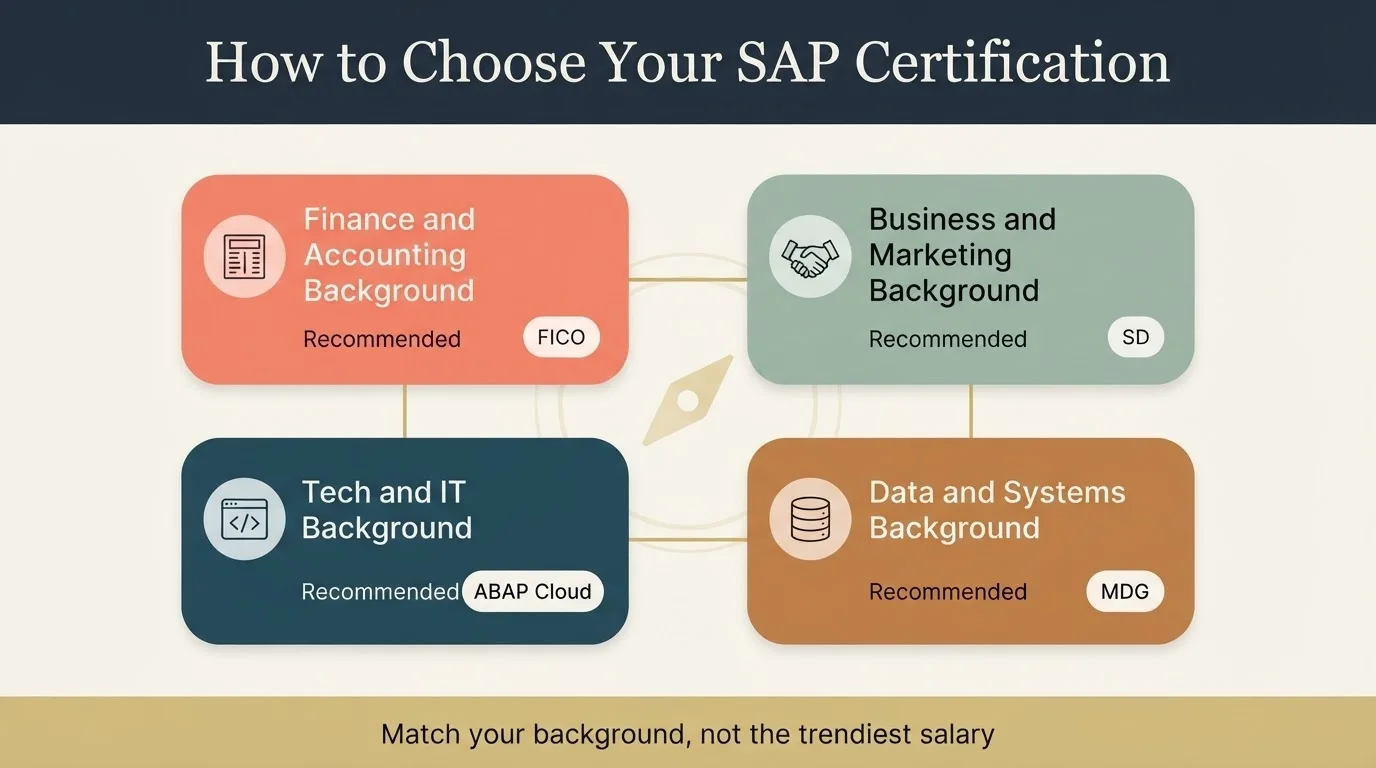
Don’t pick the “hottest” cert just because of salary. What’s best for you lines up with where you’re starting from:
- Finance/accounting background?
- Go for FICO.
- Fastest path to your first SAP role, lines up well with your skills.
- Business/marketing?
- SD (Sales & Distribution) fits.
- Use what you already know about customers and sales.
- Tech/IT?
- ABAP Cloud is your ticket.
- Put your programming skills front and center.
Explore to know: Which SAP Certification Should You Choose?
How Much Does SAP Certification Cost?
Here’s the real-world math:
|
Cost Category |
Price Range (USD) |
Notes |
|
Training Course |
$500-$2,000 |
Optional but highly recommended |
|
SAP Learning Hub Subscription |
$1500/year |
Includes learning paths + exams |
|
Exam Retake Fees |
$220-$550 |
If you don't pass the first attempt |
Total typical investment: $770–$3,300.
Good news: a lot of companies pay you back for your certification once you’re hired. Some will even cover it before you join.
What are the Exams Like?
Here’s what you’re in for:
- 24-hour online exam window (time to complete is limited, but flexible).
- Scenario-based or system-based assessment.
- Passing score is usually 60–70%.
- Available in several languages.
How long should you prepare?
- If you’ve got a solid background: 4–6 weeks of focused study, 3–4 hours a day.
- Changing careers with some related experience: 8–12 weeks, 2–3 hours daily.
- Complete beginner: Plan for 3–6 months, 1–2 hours a day with courses and lots of practice.
Study resources that actually help: SAP Learning Hub, official SAP training, SAP community forums, SAP study groups on Reddit or elsewhere, and practice exams and mock tests.
Breaking in With No Experience
Here’s what works for people totally new to SAP:
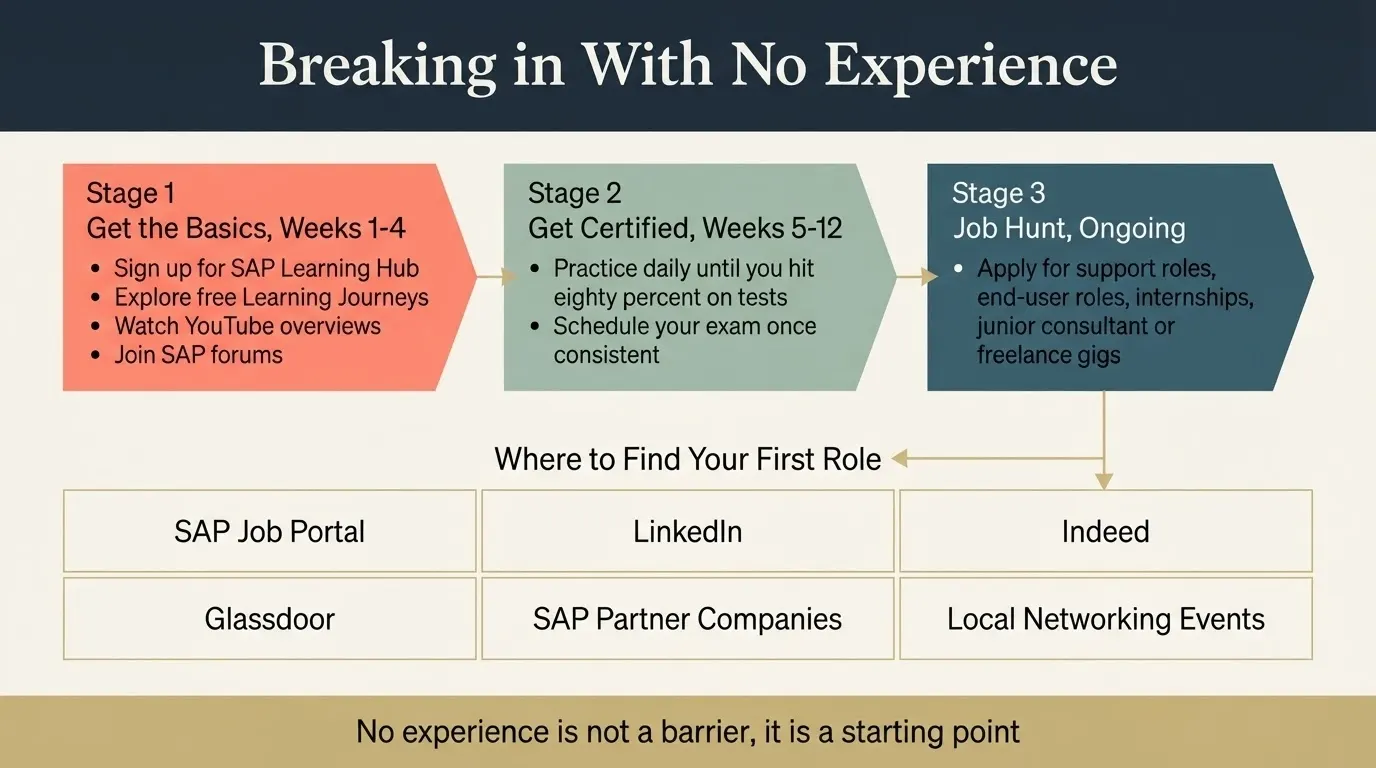
1. Get the basics (Weeks 1-4): Sign up for SAP Learning Hub. Explore free SAP Learning Journeys. Watch YouTube overviews. Join SAP forums.
2. Get certified: Don’t schedule the exam until you’re consistently scoring 80% or better on practice tests. Aim for week 5–12.
3. Job hunt (Ongoing): Apply for support roles, SAP end-user roles, internships, junior consultant roles, or freelance gigs
Where to find your first role: on SAP’s own job portal, LinkedIn, Indeed, Glassdoor, at SAP partner companies and at local SAP networking events.
Mistakes to Avoid
- Chasing the highest salary certification, not the one that fits your strengths. You’ll only regret it when you’re miserable or can’t pass.
- Skipping real-life practice. Every employer can tell who’s just read books vs. who’s actually worked in SAP.
- Taking the exam too soon and blowing $550. Wait until you’re reliably scoring 80%+ on practice tests.
- Ignoring soft skills. SAP is about translating tech for business people.
- Not networking. Most SAP jobs are through referrals and not cold applications.
Is SAP Still Worth It in 2026?
You bet. SAP isn’t going anywhere. Demand is steady or growing year over year especially with S/4HANA and the rush to cloud. New tech like AI and automation? It’s making SAP more powerful, not less relevant. Companies need people who can bridge these worlds.
Here’s what’s really going on in the SAP world:
- Companies everywhere still need SAP, and the numbers back it up through 2026.
- The big move to SAP S/4HANA isn’t slowing down; job openings are popping up left and right, and that’s expected to keep going through 2027.
- Everyone’s racing to the cloud, so certified cloud experts are hotter than ever.
- AI and automation aren’t stealing SAP jobs; they’re making them more interesting, with new skills in the mix.
- Big businesses aren’t dropping SAP anytime soon; they’re more hooked than ever.
Industry folks like BAER Group see it, too. Their 2024 report says, “Demand for specialized SAP S/4HANA expertise has steadily grown throughout 2024, and all signs are pointing toward a hyper-accelerated market in 2025.” So, if you’re in SAP, you’re riding a wave that’s only getting bigger.
Job market snapshot:
- 15,000+ SAP entry-level jobs now in the US
- 50,000+ tech consultant jobs filled every year, $76,000+ median salary as per glassdoor.
- Flexible options: remote, contract, freelance
- SAP roles aren’t being replaced; they’re changing and expanding
What’s Next? Your 30-Day SAP Roadmap
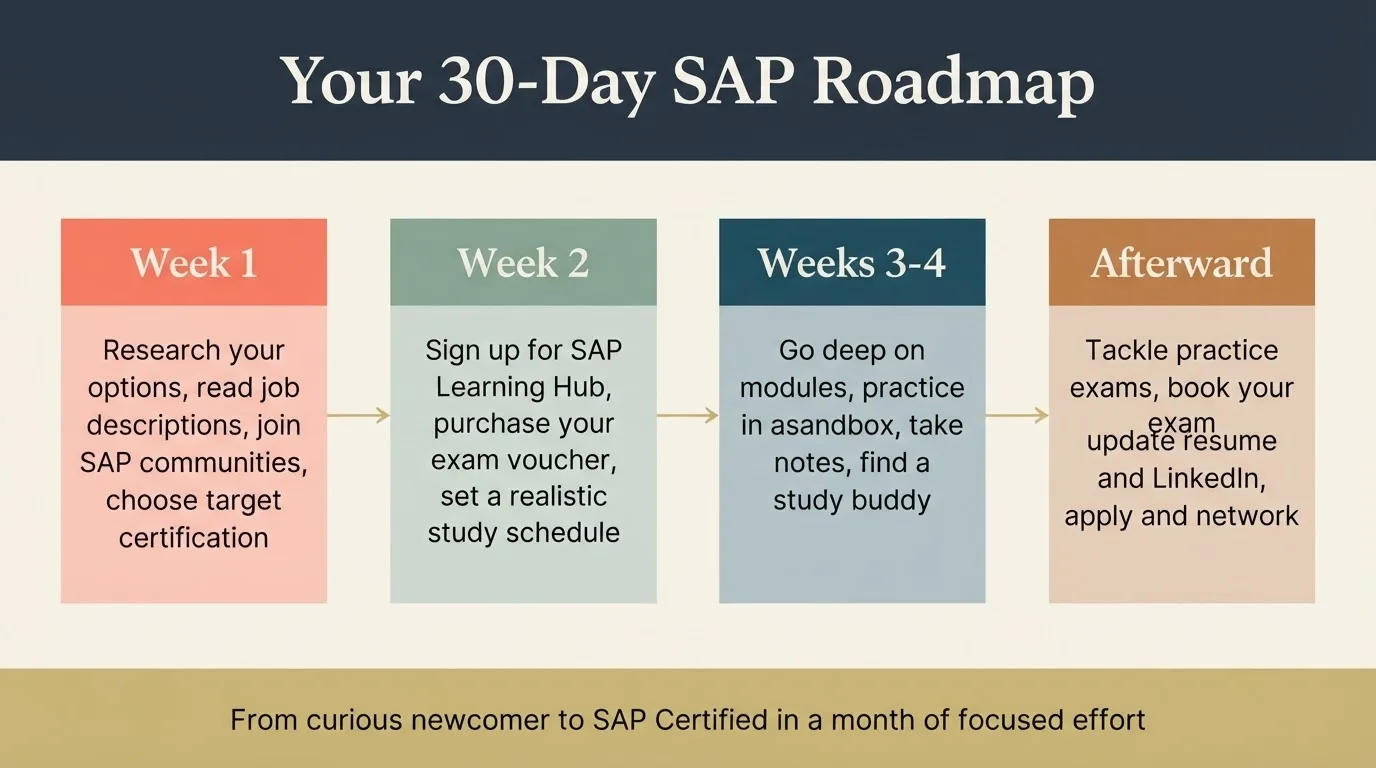
Week 1:
- Research all your options, read up on job descriptions, join SAP communities, choose your target certification.
Week 2:
- After signing up at SAP Learning Hub, make sure to purchase your exam voucher. For learning , download the learning materials, and set a realistic study schedule.
Weeks 3-4:
- Go deep. Modules, practice in a sandbox, take notes, find a study buddy/group.
Afterward:
- Tackle practice exams, book your exam, update your resume and LinkedIn, then get your applications and networking going.
Conclusion
An SAP certification isn’t just a certificate. It’s your jump-start into a huge global tech community, one of the safest and best-paying fields in IT. The only real question is where you want to begin.
Choose your path, start preparing, take the shot. A few months from now, you might just have “SAP Certified” next to your name and a whole new career ahead. Ready to start? Visit SAP’s learning materials page and get moving. Your future self will be glad you did.
Ready to get serious about your SAP certification? The Exam Questions gives you access to updated practice questions, system tasks, and real exam scenarios so you can prepare with confidence.