Yeah, you know the feeling, right? It’s the night before your SAP certification exam, and you’re cramming in practice questions, rattling off transaction codes that you don’t really understand, hoping that it will be enough. You might pass the test, but then Monday rolls around at work and suddenly all that memorized info feels like it vanished overnight.
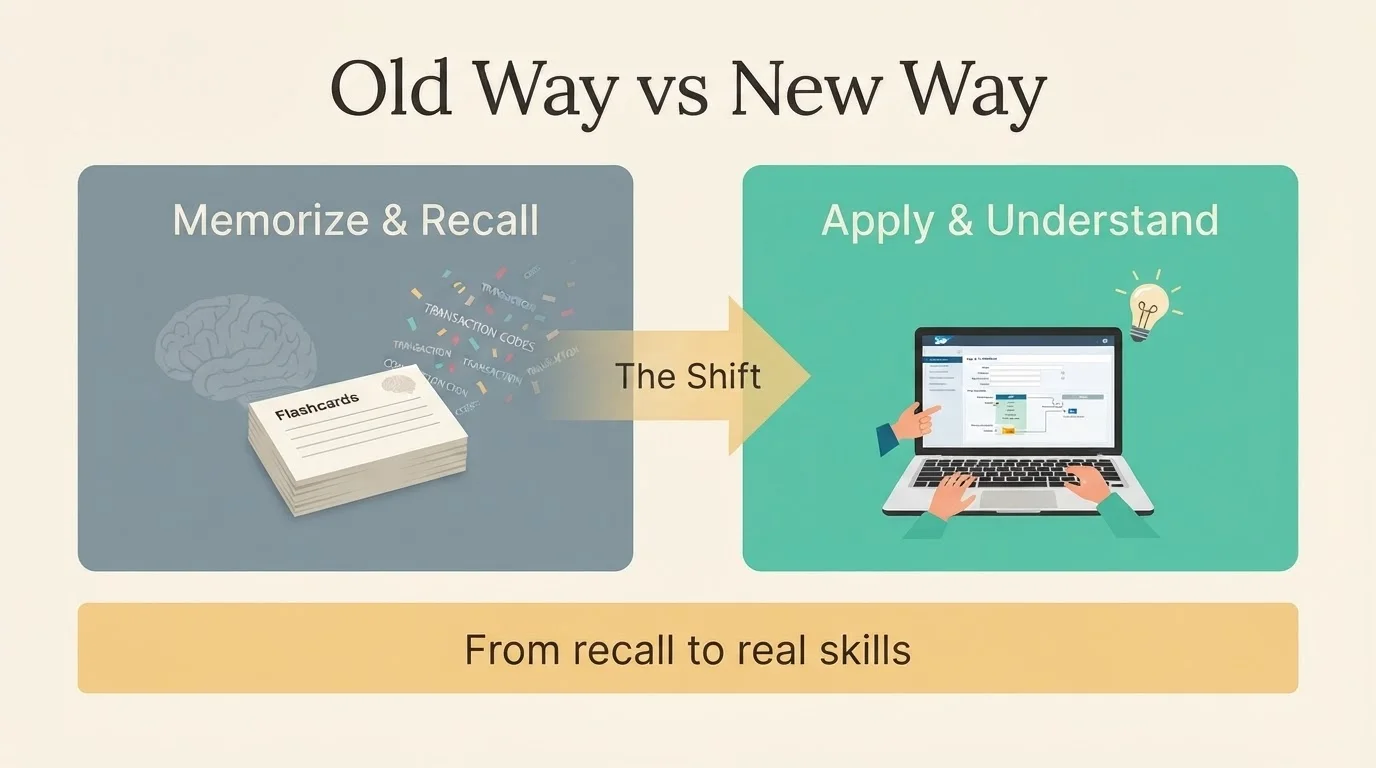
Here’s the real story: SAP is changing how certifications work. Starting November 2025, SAP swapped out the old memorization-heavy exams for practical, open-book formats that actually reflect what you do on the job. So, the days of stuffing your head with codes and short answers? Gone.
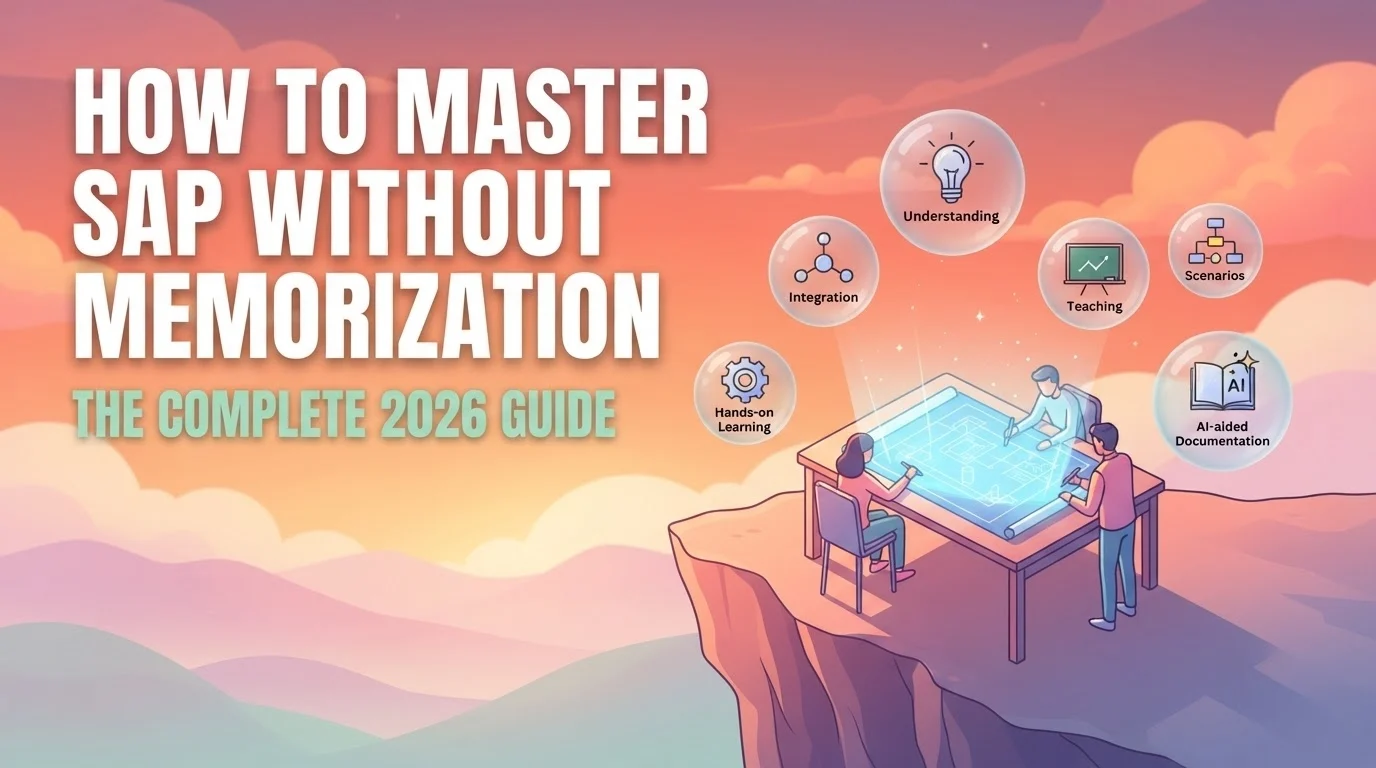
This guide lays out clear, battle-tested ways to truly master SAP not just for the exam, but for day-to-day work. You’ll get the development of real skills that employers are looking for, get to know SAP concepts in depth, and set yourself up for long-term success no matter which module you are working on: SAP S/4HANA, BTP, or otherwise.
Let’s get started.
Why Memorizing SAP Just Doesn’t Work
Straight up: Cramming SAP facts and codes got you through past exams, but it fails you later. Here’s why:
- What you memorize disappears fast: Studies show that information you don’t actually use fades in two or three days. No wonder “test brain” goes blank by Monday.
- It doesn’t help with real SAP work: You’ll be dealing with integration challenges, setting up systems, and making judgement calls, not just giving answers.
- SAP’s new exams ask more: The new certifications test if you really know your stuff and can apply it in real-life situations when you have open books, AI helpers and reference guides available.
But here’s what’s cool: When you understand SAP concepts instead of memorizing, you’re ready to work across modules, keep up with updates, and instantly become a bigger asset to your team.
The New SAP Approach: Real Skills, Not Just Theory
SAP finally admitted the old certification approach missed the mark. Here’s what changed when they rolled out the next-gen model:
|
Old Model (Before 2025) |
Next-Generation Model (2025+) |
|
Proctored multiple-choice tests |
Practical, open-book assessments |
|
Theoretical knowledge focus |
Hands-on Experience, Scenario Questions Based Evaluation and |
|
Memorized concepts |
Day-one job readiness |
|
Single-attempt, closed-book |
AI-enabled, real-world scenarios |
Basically, SAP is making sure you really “get it”, not just that you can regurgitate what you studied.
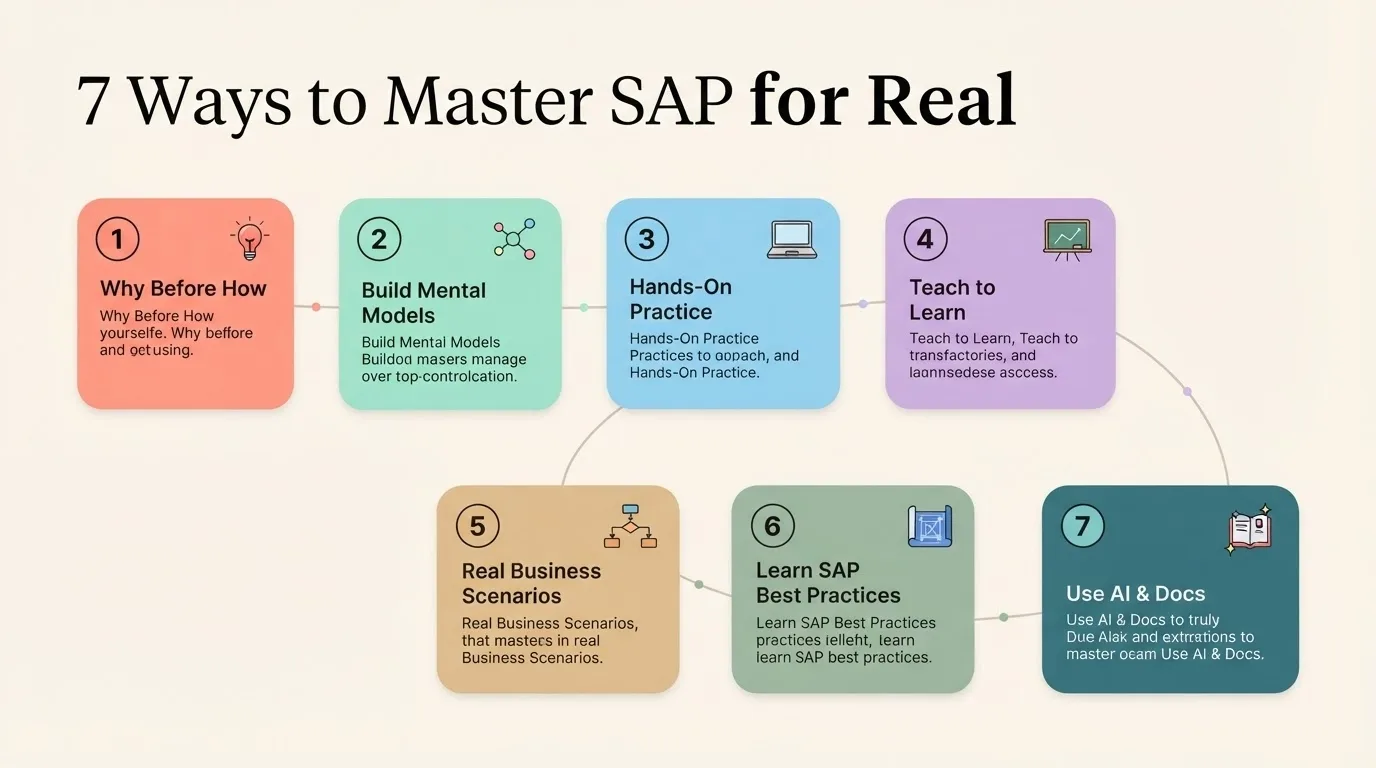
7 Ways to Actually Master SAP
So, here’s how you build deep SAP skills that stick:
1. Start With “Why,” Then “How”
Before you learn how to run a transaction, look for the reason behind it. Don’t just know that ME21N makes a purchase order; understand why businesses need POs (to control spending, for audit trails), how they fit in the overall process, and what happens when you make one (inventory reserved, approval workflow kicks in, vendor gets notified).
For every SAP process, ask yourself:
- Why do we do this?
- What business problem does it address?
2. Build Mental Models for Integration
SAP is all about integration. Don’t study modules in silos.
Here’s what you really need to watch with integration patterns:
- SD-MM-FI Triangle: When you change a sales order, it shakes up both your inventory and your financials. Don’t miss that.
- PP and MM Connection: Planning production? That tells you exactly what materials you need, plain and simple.
- HR-FI Link: Payroll moves right into your accounting.
- CRM-SD Flow: Sales pull in customer data without any friction.
Pro tip: Draw flowcharts, use Lucidchart or sketch them by hand.
3. Hands-On Practice (Done Right Way)
You might think you need fancy access to practice SAP. Actually, SAP Learning Hub offers live system access (about $3,000/year, but lots of companies cover it). You get sandbox environments, ready-made scenarios, and practice systems S/4HANA, SuccessFactors, you name it.
Other options:
- SAP Learning gives free courses and some hands-on practice.
- Try SAP cloud trials for short-term access.
- If you are an SAP partner, request sponsored access.
What do you need to work on?
- Building end-to-end business processes, not transactions.
- Make mistakes on purpose and see how the system responds.
- Document your configs and explain your choices.
4. Teach to Learn
The Feynman Technique works wonders.
- Pick an SAP topic, say, “Material Master Data.”
- Try to explain it to someone brand new.
- Spot where your explanation falls apart, go back, clarify it, and try again.
Who can you teach? Write a blog post, answer forum questions, make internal docs, mentor a junior colleague. Teaching forces you to organize and deepen your understanding; it exposes all the gaps memorization hides.
5. Relate SAP to Real Business Scenarios
SAP isn’t just buttons on a screen. It is designed to solve business problems. Don’t just learn transaction VA01. Understand how a customer order leads to delivered goods and revenue.
Scenarios:
- Pick a business process, say hiring.
- Map all SAP steps (Recruiting, Onboarding, Payroll, Asset Management).
- Trace what data flows between steps.
- Find possible failure points and what happens if they’re not handled.
This is what SAP’s new certification format wants: real problem-solving.
6. Study SAP Best Practices (and Know Why)
SAP Best Practices give you pre-built, optimized business processes. They're perfect for learning concepts.
How to use them:
- Access them via SAP Best Practices Explorer.
- Don’t just set them up; study why SAP made certain choices.
- Compare them with your company’s processes to learn about customization.
- Following the process flows they reveal integration points.
Bonus: Best Practices docs give you some good business context so you understand why some configurations matter.
7. Use AI and Open Resources: Like SAP’s New Exams
SAP’s new certifications let you use AI tools and documentation in the exam. That’s modern work.
How to train this way:
- Look up official SAP documentation when practicing.
- Use AI (like ChatGPT) to untangle tricky concepts.
- Develop your collection of solutions and explanations.
- Focus on knowing where to find answers, not memorizing everything.
Reality check: You’ll always have resource docs, colleagues, and forums on real SAP projects. Employers want people who know how to use them.
Common SAP Learning Mistakes (And How to Avoid Them)
Even SAP veterans trip up sometimes. Here are a few pitfalls you definitely want to dodge:
1. Module Tunnel Vision
It’s easy to pick one module, say, MM, and forget the rest. The real magic is in the connections. Learn at least two related modules, see how they integrate, and you’ll understand the bigger picture.
2. T-Code Obsession
Some people memorize transaction codes like phone numbers. But t-codes are just shortcuts. Don’t miss the actual business process behind them. Focus on the workflows; that’s what matters in real projects.
3. Passive Learning
Binging tutorials won’t get you far. Spend most of your time doing, not watching; aim for 80% hands-on, 20% reading or video.
4. Ignoring Configuration Logic
Blindly following step-by-step guides is a trap. Every config has a reason. Ask yourself, "What business need does this really solve?"
5. Only Caring About the Exam
Getting certified is good, but being useful on the job is better. Don’t just aim to pass the test; aim to master the work.
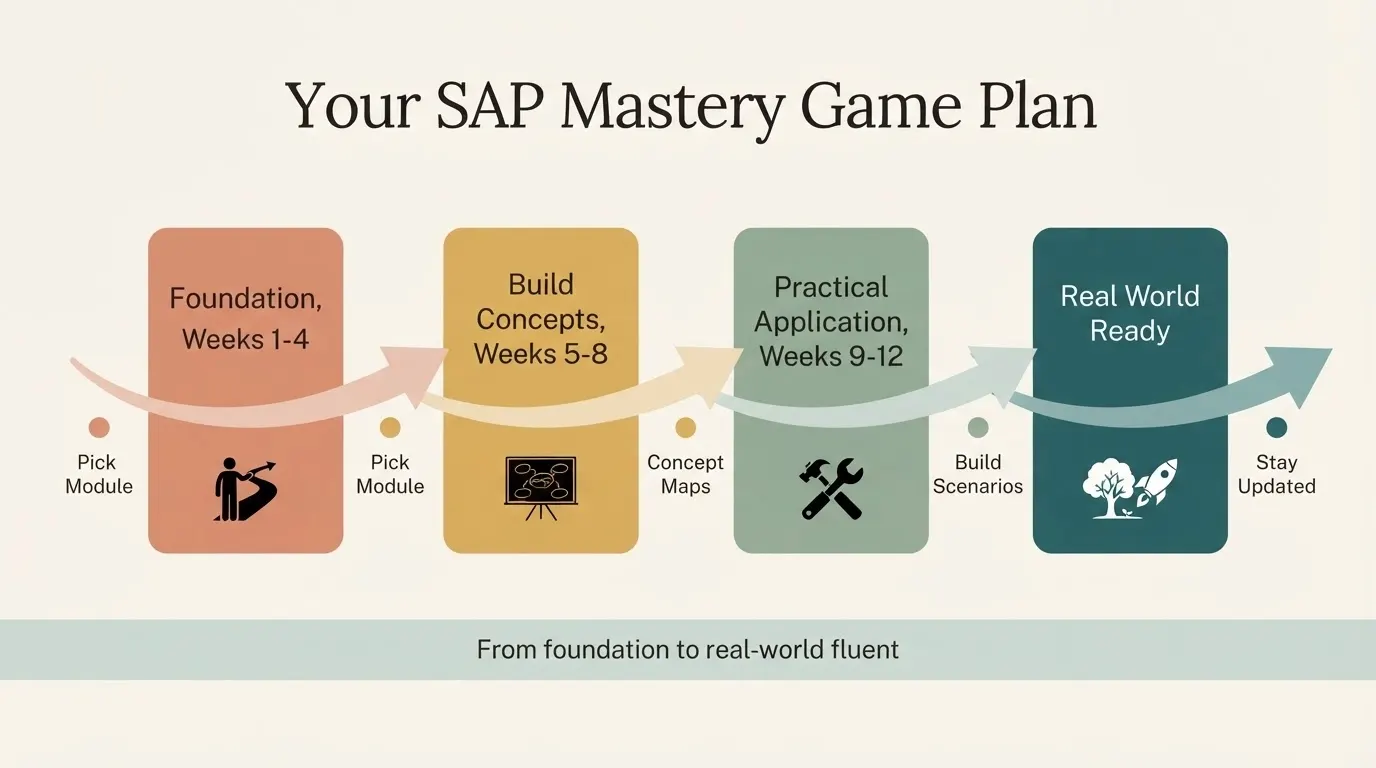
Your SAP Mastery Game Plan
Phase 1: Foundation (Weeks 1-4)
- Choose a module that corresponds to your career goals.
- Understand the business process it supports.
- Map its relation to other modules.
- Get to know SAP navigation and basics.
Phase 2: Build Concepts (Weeks 5–8)
- Dig into why SAP does things a certain way.
- Check out Best Practices docs.
- Create your own flow charts for process integration.
- Get practical with guided exercises.
Phase 3: Practical Application (Weeks 9-12)
- Build your own complete business scenarios.
- Break things on purpose, then figure out how to fix them.
- Give the solutions and the reasoning behind each solution.
- Share your knowledge with others, either by writing blogs/forums or helping a coworker.
Phase 4: Ready for the real world (ongoing)-
- Solve real problems of business not text book problems.
- Stay in the loop with SAP’s latest updates.
- Join discussions in the SAP Community.
- Go for practical certifications that prove your skills.
SAP’s New Certification Model
Starting November 2025, SAP is flipping certification on its head. Exams are open-book and focus on what you actually do, not what you can recite.
What’s changing:
- You’ll use official docs and AI tools during the exam.
- The problems are real, not just multiple-choice.
- You’ll get hands-on tasks instead of trivia.
- Certifications tie directly to specific job roles.
The first new certs cover: Solution Architects for BTP, Build Developers, Gen AI Specialists, and Business Data Cloud Consultants.
Bottom line: Stop memorizing. Show you can do the work.
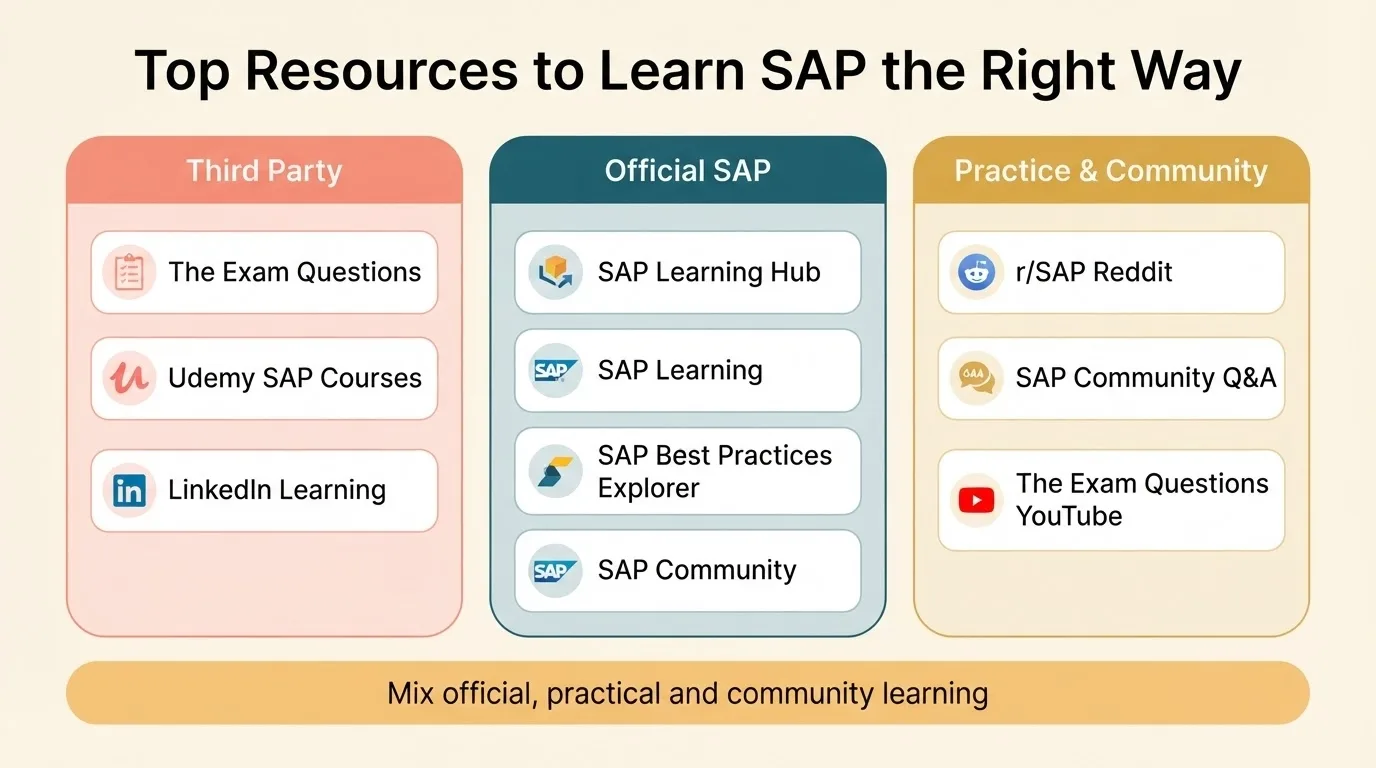
Top Resources for Learning SAP the Right Way
Third Party:
- The Exam Questions- Scenario based Practice questions.
- Udemy SAP Courses - Economical, Structured Lessons.
- LinkedIn Learning- Solid SAP process overviews.
Official SAP:
- SAP Learning Hub- Complete access, live systems, but it’s pricey (around $3,000 per year).
- SAP Learning- Free courses and some hands-on labs.
- SAP Community- Forums, blogs, and help from real practitioners.
- SAP Best Practices Explorer- Workflow blueprints pre-assembled.
Practice & Community
- r/SAP Reddit - Real talk, real advice.
- SAP Community Q&A- Answers from your peers, powered by the community.
- The Exam Questions YouTube- Step-by-step visual guides.
Your Next Steps: How To Actually Master SAP
Here’s how you go from memorizing to true understanding:
Today:
- Choose one SAP module that fits your goals.
- Sign up (free) at SAP Learning.
- Post an intro in the SAP Community.
This Week:
- Map out your module’s key business processes.
- Create a diagram linking it with other modules.
- Take something you learned by heart, and break down why it works.
This Month:
- Get hands-on practice (through SAP Hub, a trial account, or at work).
- Set up and configure a complete business process.
- Write a blog post on what you learned.
Everyday:
- Post questions and answers in the SAP forums.
- Stay informed on SAP news and updates.
- Get started on the practical certifications.
Conclusion
Learning about SAP concepts is more than simply passing a test. It is about solving real business problems. SAP’s new certification approach makes it crystal clear: practical skills beat memory tricks.
Follow this roadmap, and you’re not just chasing a certificate; you’re building a career. Go make it count.
Get exam-ready fast. Build your skills with system-based tasks, challenge yourself with The Exam Questions, and step into your test with confidence.