Everything you need to know about C_PO_7521 exam
Official Exam SAP Process Orchestration Details
SAP official SAP Process Orchestration exam has Code C_PO_7521. The exam will be referred by this Code everywhere only. The C_PO_7521 exam contains 80 questions with completion time of 180 mins. Please check below details for more information:
- Exam Name: SAP Certified Technology Associate - SAP Process Orchestration
- Exam Code: C_PO_7521
- Pass percentage: 65 Percentage
- Exam duration: 180 mins
- Exam Format: Multiple-choice and Multi-select
- Language of exam: English
- Level: Associate
- Eligibility/Pre-Requisite: NIL
- Exam cost: 200 USD
Keep reading to know more information?
Why should you take the exam C_PO_7521
- Gain a globally recognized credential from SAP
- Showcase your capability in implementing and configuring service-related processes in SAP Certified Technology Associate - SAP Process Orchestration
- Stand out in the job market for SAP consulting and implementation roles
Goals achieved through C_PO_7521 Exam
- You will gain a highly recognized accreditation of excellence.
- You can differentiate yourself in the labour market.
- You can validate your skills to execute with confidence.
- You will have possibility to attain higher wages and billable rates with a highly valued credential.
Who should take exam C_PO_7521 / Target Audience?
- Application Consultant - Business Process Architect - Business Process Owner/Team Lead/ Power User - Developer - Development Consultant - Enterprise Architect - Solution Architect - System Architect - Technology Consultant - Project Manager - Super/Key/Power User - System Administrator
C_PO_7521 Syllabus or Topic areas
- Business Processes Modeling and BPMN 2.0 (Business Process Management Notation), (> 12%) => Explain the difference between BPM, and Business Workflow, sequence diagrams, the perspectives in NWDS, Message Flow, Data Flow, Association, the Configuration of BPMN models; Model a business process List the BPMN types of Process Diagrams; Describe the elements of BPMN 2.0; Develop business processes and flow models. - The Role of the Advanced Adapter Engine Extended (AEX), (8% - 12%) => Define the Advanced Adapter Engine Extended (AEX), list the functionality of the Advanced Adapter Engine Extended (AEX); Explain how to Create an Advanced Adapter Engine Extended (AEX) integration flow. - Basic Concepts System Landscape Directory (SLD) and Enterprise Service Repository (ESR), (8% - 12%) => Describe the use of the System Landscape Directory (SLD), the Enterprise Service Repository (ESR), the Business systems Technical systems and the use of Software Components in the ESR; Analyze Interface Objects in the Enterprise Services Repository. - Mappings, (8% - 12%) => Explain how to create Message Mapping objects, the message and value mapping process and describe the types of mapping programs, describe how to create an operation mapping in the ESR and the default matcher. - Operations and Process Monitoring in SAP Process Orchestration, (8% - 12%) => Explain how to Use the SAP NetWeaver Administrator functionality, the Operations tab in the NetWeaver Administrator, Certificates, Restart and Recovery and how to Access SAP Process Integration Monitoring; Start Business Processes; Define the Lifetime of Business Processes; Configure Process Orchestration in NetWeaver Administrator (NWA)Describe monitoring of the business processes and the AEX. - Configuration of iFlows in NetWeaver Developer Studio (SAP NWDS), (8% - 12%) => Describe the use of the perspective in SAP NetWeaver Developer Studio, and how data types are mapped in SAP NetWeaver Developer Studio; Describe data objects and iFlows; List the available data types; Describe Data Types in BPMN Processes. - SAP Business Process Management Development Steps, (8%) => Outline the configuration of business processes. - SAP Business Rules Management (BRM), (8%) => Describe SAP Business Rules Management (BRM), the justification process for developing a new Business Rule and describe rulesets; Describe Rulesets. - SAP Processes Integration Architecture, (8%) => Explain the difference between Process Orchestration and Process Integration, and how to establish the work environment for process creation; Describe the basic SAP Process Integration Architecture, the tools available for business process development, and message processing. - Roles and Authorizations of a BPMN Process, (8%) => Describe Software Catalog (Products and Software Components), the SAP Component mode and the use of the Objects of the Component Model. - Integration Objects in the Integration Directory, (8%) => Explain how to configure a scenario in the Integration Directory, how to process messages using the advanced adapter engine and the integration objects in the Integration Directory. - Basic Concepts for SAP Business Process Management Integration Flow (iFlow), (8%) => Explain process context.
C_PO_7521 Study guide or how to prepare for C_PO_7521?
- First step is to go through the learning journey or courses provided by SAP. You can access these C_PO_7521 courses here.
These learning journeys are referred to as the best and most valuable source of knowledge. Studying smart is a new strategy these days. Build your knowledge from the ground up with courses and study guides, then expand your understanding with video tutorials. Combine your preparation with practice questions to reap the benefits of both. It helps you connect concepts together and helps you understand and learn in the right way.
- Go through the quizes given at the end of each Unit of SAP Certified Technology Associate - SAP Process Orchestration learning journey.
Certification Quizes are the best way to test your knowledge and realize how prepared you are. It helps the candidates to know in which subjects they are still weak and which they have mastered. Incorporating practice tests into your exam preparation routine is extremely beneficial.
Steps (Buying Guide) to take exam C_PO_7521
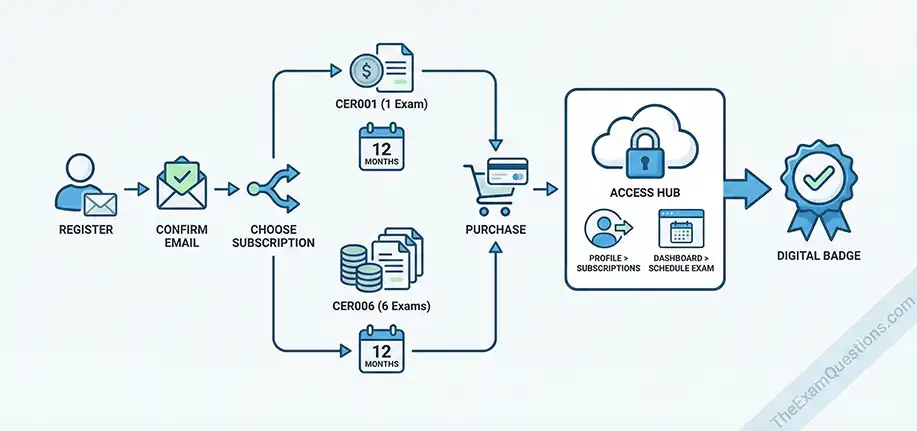
- Go to training.sap.com and register with your E-Mail id.
- Confirm your email address and finish the registration.
- If you are planning to take only this exam, then you need to buy for Single attempt subscription which is CER001. CER001 giver 12 months period in which you can schedule the C_ABAPD_2507 exam.
- Search for product CER001 on SAP website and add it to cart and do the checkout.
- If you are planning to do multiple SAP certifications, then you should consider buying CER006 product. CER006 also gives 12 months period in which you can schedule maximum 6 exams.
- Once you have purchased either CER001 or CER006, you will get access to SAP certification hub.
- Click on your profile icon and select "Access purchased Subscriptions":
- Go to SAP certification hub. click on "Exam Dashboard". Next, click on "Schedule an exam" and you are good to go.
- Successful completion will make you receive an SAP Certification digital badge for your accomplishment.
Retake rules of exam C_PO_7521
If you are not able to pass SAP Process Orchestration certification examination, then you can reappear for it 2 more times. If you do not pass even after 3 attempts, then you will have to wait for next version launch of C_PO_7521 exam.
Keeping certification validity up to date
SAP Global Certification has validity for each exam which is launched. You need to keep an eye on it through list of valid SAP exam. You can appear for delta exam of C_PO_7521 certification exam or stay current assessments, if launched any.
Tags:
C_PO_7521 FAQ | C_PO_7521 detail | C_PO_7521 study material