Everything you need to know about C_FSM_2601 exam

Official Exam SAP Field Service Management Details
| Item | Details |
| Certification title | SAP Certified - SAP Field Service Management |
| Latest exam version surfaced in page data | C_FSM_2601 |
| Current format | 1 activity, Scenario Based Assessment, NEW FORMAT |
| Duration | 120 minutes |
| Cut score | 60% |
| Language | English |
| Role focus | Consultant |
| Official preparation path | Implementing and Managing SAP Field Service Management |
| Learning journey size | 3 courses, free, intermediate-led journey |
| Certification validity | 12 months |
| Staying certified | Pass the annual stay-certified assessment before expiry, or retake the full exam if you do not have SAP Learning Hub |
Source: Certification Page, Learning Journey, Step-by-Step Guide for Practical Exams, How to Stay Certified
If you want a current, practical guide to the SAP Field Service Management certification, start here. The official SAP certification page now presents this credential in the newer practical certification framework, and that changes how you should read older advice online. Instead of relying on outdated fixed-price claims, generic salary promises, or legacy retake rules, focus on the current SAP signals: the certification page, the official learning journey, the practical-exam rules, and the annual stay-certified model. Source Source
Pro Tip: Save the certification page, the learning journey, and the scenario-based FAQ in one browser folder before you start preparing. Those three pages answer most real candidate questions faster than forum posts.
What Is SAP Certified - SAP Field Service Management?
This certification verifies that you have the core skills required for the implementation consultant profile in SAP Field Service Management. SAP describes it as proof that you have overall understanding and functional configuration skills to participate in an SAP Field Service Management project team in a mentored role. The page also frames it as a recommended entry-level qualification, which makes it a sensible target for consultants who want a formal starting point in FSM rather than an expert-only badge. Source
That positioning matters. This is not just a memory test for product terminology. It is a role-focused validation designed to show that you can understand field service processes, navigate key solution capabilities, and apply configuration knowledge in a practical context. Source
Pro Tip: Read the certification description as a job-role statement, not as marketing copy. If your day-to-day goals involve implementation support, mentored project work, dispatching processes, mobile service execution, or administrator-facing configuration work, you are in the right lane.
Warning: Do not let older blog posts convince you this is still a classic multiple-choice-only exam. SAP has shifted this credential into the newer practical certification model. Source
Exam Format
The current C_FSM_2601 certification page shows a NEW FORMAT label and lists 1 activity (Scenario Based Assessment), with a 120-minute duration, 60% cut score, and English as the language. That is the core exam reality you should prepare for first. Source
SAP's broader certification program explains that the company is moving certifications into practical, performance-based formats that validate applied skills in real SAP environments. The scenario-based assessment FAQ adds that candidates launch the exam from either the certification page or the learning journey, review the time available and attempts remaining, then start the assessment and countdown. Source Source Source
For scenario-based assessments in general, SAP says the experience may use an AI-guided option or a human-review path depending on the assessment flow shown in your dashboard. SAP also states that if you use the pause button during a scenario-based assessment, the interaction pauses but the overall exam timer does not. That means pacing and response discipline matter just as much as product knowledge. Source
SAP's practical-exam guidance also says these newer practical exams are non-proctored and open-book in the sense that candidates may use publicly available SAP resources such as SAP Learning and SAP Help Portal during practical exams, where applicable. The safest interpretation for C_FSM_2601 is simple: prepare to solve realistic problems, and always check the exam page and dashboard you see on launch day for the exact rules attached to your attempt. Source
Pro Tip: Practise answering like a consultant under time pressure. You need to connect business context, FSM functionality, and execution steps without rambling.
Warning: A break is not a time extension. If you pause the interaction, the clock still moves. Source
Quick Win: Before exam day, rehearse one 120-minute study block with no distractions. That single habit exposes timing problems early.
Scenario-based exams feel difficult when you only read theory and never rehearse decision-making under pressure. SAP Field Service Management new format questions helps you practise realistic answer patterns after the official learning journey.
👉 Explore it here: Visit now
Syllabus and Topic Areas
SAP's current certification page tells candidates to study the relevant learning journey, complete the practical test, and then take the theoretical exam. In the accessible official content reviewed here, SAP does not expose a fully verifiable per-topic percentage breakdown for C_FSM_2601. Treat the topic areas below as a practical study map built from the official certification page, learning journey, and course objectives, not as a guaranteed scoring matrix. Source Source
Core SAP Field Service Management concepts and implementation fundamentals
Weightage: Not publicly disclosed in the reviewed official page Difficulty rating: Medium
Start with the business purpose of SAP Field Service Management itself. The official learning content consistently frames the solution around real-time workforce scheduling, planning, dispatching, and technician execution through web and mobile applications. If your foundation is weak here, every later topic feels fragmented. Source Source
Administration, configuration, and customisation
Weightage: Not publicly disclosed in the reviewed official page Difficulty rating: Hard
The official course objectives explicitly mention performing configurations and customisations using the Field Service Management Administration module. This is the zone where candidates often move from passive understanding to practical implementation thinking. You should know where configuration lives, what business outcomes it supports, and how admin choices affect dispatchers, technicians, and service operations. Source Source
Master data management
Weightage: Not publicly disclosed in the reviewed official page Difficulty rating: Medium
The learning journey and the FSM110 course both point to master data as a core capability area. That makes master data a practical study priority, not a background topic. Focus on how clean, complete, well-structured data supports planning, execution, and service consistency across the solution. Source Source
Planning, dispatching, and workforce scheduling
Weightage: Not publicly disclosed in the reviewed official page Difficulty rating: Hard
This is one of the most important and most easily underestimated parts of C_FSM_2601. SAP's official course descriptions repeatedly highlight real-time, automated workforce scheduling, planning, and dispatching as central value drivers. Candidates who understand the process flow but cannot explain the operational logic behind assignment and execution decisions usually struggle in practical formats. Source Source
Pro Tip: Study this topic through scenarios, not isolated definitions. Ask yourself what a dispatcher needs to decide, what data supports that decision, and what the technician must see next.
👉 Planning and dispatching is where many candidates realise too late that reading notes is not the same as solving a service scenario. C_FSM_2601 Scenario Questions turns this topic into practical decision drills so you can think faster and answer more clearly.
Mobile applications and field technician execution
Weightage: Not publicly disclosed in the reviewed official page Difficulty rating: Medium
SAP's learning journey states that candidates should understand both web and mobile applications and gain hands-on familiarity with mobile service tools. In practical terms, that means understanding what technicians do in the field, what they need to complete service work efficiently, and how mobile execution connects back to service operations. Source
SmartForms and service documentation
Weightage: Not publicly disclosed in the reviewed official page Difficulty rating: Medium
The official journey specifically mentions hands-on experience with SmartForms. That makes this more than a niche subtopic. Make sure you understand why service documentation matters, how structured forms support field execution, and where SmartForms fit into the wider service process. Source Source
Self-service and partner collaboration
Weightage: Not publicly disclosed in the reviewed official page Difficulty rating: Medium
The learning journey description explicitly mentions partner collaboration and self-service capabilities. This is a good reminder that C_FSM_2601 is not only about internal service execution. It also covers how the solution supports a more connected field service model across customers, partners, and service teams. Source
First-level support, best practices, and documentation use
Weightage: Not publicly disclosed in the reviewed official page Difficulty rating: Easy to Medium
SAP's official objectives say learners should be prepared to provide first-level support and know where to access best practices, documentation, and additional resources. That matters in a practical exam because good candidates do not only know features. They also know how to navigate support-oriented reasoning and use documentation intelligently. Source
Quick Win: Build your notes around process flows: admin setup, data, planning, dispatching, mobile execution, and service documentation. That structure mirrors how the official learning content naturally fits together.
Learning Journey
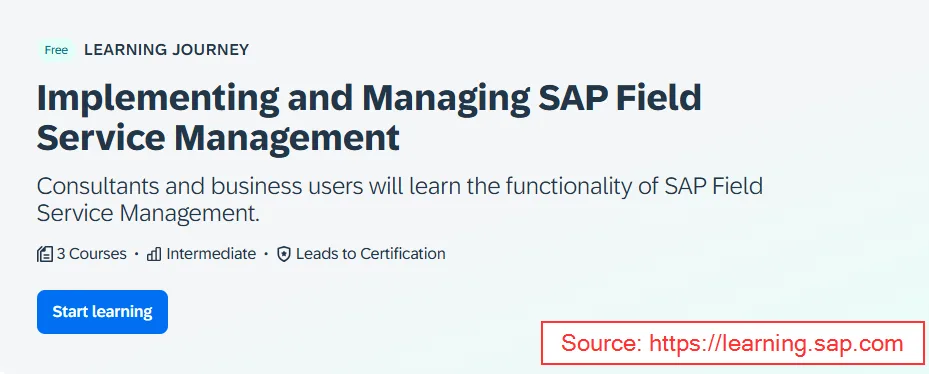
The official preparation path for this certification is the Implementing and Managing SAP Field Service Management learning journey. SAP labels it as free, positions it at an intermediate level, and shows 3 courses that lead toward the certification. Source

The three courses currently surfaced in the journey are:
- FSM100 - Implementing SAP Field Service Management
Duration: about 12 hours, 10 units.
Focus: key business scenarios, main solution concepts, dispatcher support, workforce scheduling and planning, configuration and customisation, and administrator/dispatcher/technician use cases. Source - FSM110 - Managing SAP Field Service Management
Duration: about 4 hours 20 minutes, 6 units.
Focus: web and mobile solution understanding, master data, planning and dispatching, SmartForms, and mobile field service functionality. Source - SL_RISE419 - Introducing RISE with SAP Methodology for SAP Partners and Customers
Duration: about 1 hour 35 minutes, 3 units.
Focus: RISE with SAP methodology phases, recommended tools, and customer-success storytelling. This is useful context, but it is not the core FSM skills driver in the same way FSM100 and FSM110 are. Source
Together, the learning journey gives you roughly 15 hours 50 minutes of structured study time before additional revision and exam rehearsal. It is the clearest official study spine available for this certification. Source
Pro Tip: Give FSM100 the highest priority. It is the heaviest course in the journey and carries most of the implementation-context depth you need for the certification.
Warning: Do not give equal study weight to all three courses. The methodology course has value, but your scoring outcome will depend far more on how well you understand the FSM product itself.
Who Should Take This Exam
This certification makes the most sense for candidates moving into an SAP Field Service Management implementation path, especially those working in consultant-facing responsibilities. The certification page explicitly signals the Consultant role, while the learning journey also includes Business User as a role context. Source Source
You are a strong fit if you are:
- an implementation consultant building or validating FSM capability
- a business user who works closely with FSM process execution
- a project-team member expected to support mentored delivery, first-level support, planning, dispatching, mobile execution, or admin-facing configuration work
You are a weaker fit if you only want a broad SAP brand credential without real interest in field service operations. In that case, the learning effort may feel too specific.
Pro Tip: Match the certification to your target role, not to a vague desire to "collect SAP badges." Role fit improves preparation quality.
Quick Win: Compare your daily tasks against the official journey objectives. If you regularly touch planning, dispatching, mobile service, admin setup, or service data, this exam is highly relevant.
Career Benefits
SAP's official certification program emphasises market differentiation, trusted expertise, career growth, and competitive advantage. For C_FSM_2601 specifically, the value comes from showing that you can connect field service processes with SAP Field Service Management functionality in a practical, implementation-oriented way. Source Source
In real-world terms, the strongest career value is not that the badge magically guarantees a salary increase. The stronger value is that it gives hiring managers, project leads, and clients a cleaner signal that you understand the implementation consultant profile for FSM and have validated that understanding against SAP's own certification process.
Pro Tip: Use the certification as evidence of role readiness, not as a standalone argument for seniority.
Warning: Avoid unsupported salary claims in your CV or LinkedIn posts. The official SAP sources do not make compensation promises for this credential.
How to Register and Schedule
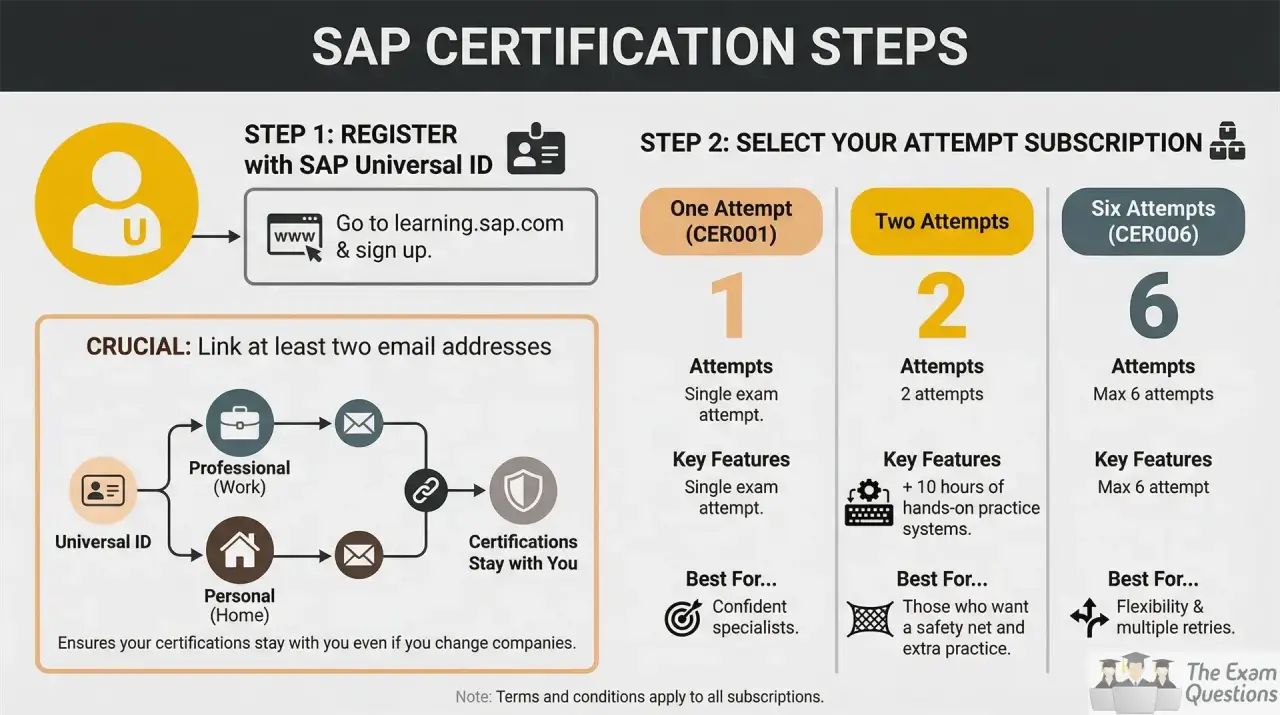
SAP's official practical-exam guide says your first step is to set up an SAP Universal ID with at least two email accounts with different domains assigned. That setup is not optional admin clutter. It is foundational to how SAP tracks certification activity, badges, and ongoing validity. Source Source

Next, you need either an SAP Learning Hub subscription or a separate exam-attempt purchase. SAP's certification program page currently describes these main paths:
- one exam attempt
- two exam attempts, plus 10 hours of hands-on practice system access
- six exam attempts
- SAP Learning Hub, which includes four certification exam attempts per year plus stay-certified assessments and preparation resources Source
Once your account and attempts are in place, SAP says you can launch the exam from either:
- the certification details page using Go to Certification Exam
- the learning journey using Open Source Source
Before you start, review the dashboard details carefully. SAP states that this page shows the assessment type, the exact time available, and the number of attempts remaining for both the certification and your subscription. Source
If you are dealing with a system-based assessment in SAP's broader practical framework, some systems may require a reserved slot and cancellations may be possible up to 24 hours in advance. For C_FSM_2601, the most reliable rule is to follow the dashboard flow attached to your active attempt instead of assuming older proctored scheduling logic still applies. Source
Pro Tip: Do your SAP Universal ID setup before you buy anything. It prevents avoidable badge, scheduling, and tracking issues later.
Quick Win: After purchase, immediately check your active attempts in My Learning so you know exactly what is available before booking study time. Source
6-Week Study Plan
A good C_FSM_2601 study plan should move from product understanding to process reasoning and then to timed scenario practice.
Week 1 - Build the product foundation
Complete the opening sections of FSM100 and map the core business flow of SAP Field Service Management: service demand, planning, dispatching, technician execution, and documentation. Focus on understanding what the product does before worrying about exam tactics. Source
Week 2 - Learn administration and configuration logic
Study the admin and customisation parts of FSM100. Your goal is to understand why settings exist, not just where they are. Make notes in business language so you can explain configuration choices clearly in a scenario-based context. Source
Week 3 - Master data, mobile work, and SmartForms
Move into FSM110 and reinforce master data, mobile execution, SmartForms, and the relationship between dispatcher setup and technician outcomes. Use short revision sessions to connect these areas into one end-to-end service story. Source
Week 4 - Planning and dispatching depth
Spend this week on the hardest operational logic: planning, workforce scheduling, assignment choices, and dispatch execution. This is where the certification stops rewarding shallow memorisation and starts rewarding applied thinking. Source Source
Week 4 is where many candidates discover knowledge gaps they did not notice while reading the learning journey.
👉 Use SAP Field Service Management Real Scenario Questions to stress-test your planning and dispatching logic before exam day.
Week 5 - Simulate the exam style
Practise expressing clear, structured answers under time pressure. Review the official scenario-based assessment FAQ so you understand launch flow, timing, language handling, and what the score review process looks like. Source
Week 6 - Final review and timed rehearsal
Run a full 120-minute rehearsal, revisit weak areas, and verify your account, browser, and access setup. Do not spend the final week collecting more notes. Spend it simplifying what you already know so you can think faster during the real assessment. Source Source
Final-week anxiety usually comes from not knowing whether your preparation will hold up under time pressure.
Use C_FSM_2601 EXAM QUESTIONS: FREE SAP PRACTICE TESTS [2026] for a last-pass confidence check and faster weakness spotting.
👉 Try it here: C_FSM_2601 Free Questions
Pro Tip: End every week by explaining one topic out loud without your notes. If you cannot explain it simply, you do not own it yet.
Retake Rules
The old three-attempt rule is no longer the right rule to publish for this certification context. SAP's current practical-exam guide states that you are allowed up to 4 attempts per certification, and if you do not pass after 4 attempts, you must wait 12 months before retaking it. The scenario-based assessment FAQ also states that you must wait 24 hours between exam attempts. Source Source
There is also an important scenario-based nuance: SAP says that if you fail a scenario-based assessment and still have time remaining on the clock, you may be able to retake the exam immediately and it still counts as one exam attempt. That is a format-specific rule that many older articles miss. Source
If a technical issue prevents completion, SAP advises creating a support case with details and screenshots. If the issue is confirmed as a system-related error, a new attempt may be granted. Source Source
Warning: Do not burn attempts casually. Under the current policy, poor planning can cost you a full year of waiting after a fourth failed attempt. Source
Retakes are expensive in time, energy, and confidence.
👉 A focused practice layer from C_FSM_2601 Real Exam Questions can help you fix weak spots before you risk another attempt.
Keeping Certification Valid
SAP states that this certification is valid for 12 months. The certification page also says you can extend it for another 12 months each time you successfully complete an assessment. Source
To stay certified under the current SAP model, you need an SAP Learning Hub subscription to access the stay-certified preparation materials and assessment. SAP describes the stay-certified assessment as a short, non-proctored quiz with unlimited trials, and you must pass it before your stay certified due date to extend the certification by another 12 months. Source Source Source
If you miss the due date, your certification status becomes expired and SAP recommends recertifying by passing the exam of the current release. If you do not have SAP Learning Hub, SAP says your alternative path is to retake the full certification exam every year. Source Source
There is also a retirement rule worth knowing. If SAP retires a certification, valid certifications that are still valid on the retirement date automatically receive an additional 12 months of validity from that retirement date. That gives certified professionals a limited protection window, but it does not remove the need to monitor successor paths and renewal deadlines. Source
Pro Tip: Check your certification status directly in My Learning instead of assuming your badge is still current. SAP's current model is date-driven and action-driven. Source
Conclusion
C_FSM_2601 is no longer the kind of certification you should approach with generic exam dumps, recycled bullet lists, or outdated policy assumptions. The official SAP sources now position it inside a practical certification model that values applied thinking, clear process understanding, and current product familiarity. If you build your preparation around the official learning journey, learn the logic behind planning and dispatching, and rehearse how to respond in realistic field service scenarios, you give yourself a far stronger chance of passing on the first attempt. Source Source Source
If you want a practical next step, begin with FSM100, map the full service workflow in your own notes, and then pressure-test your understanding with scenario practice before scheduling your attempt.
Tags:
C_FSM_2601 FAQ | C_FSM_2601 detail | C_FSM_2601 study material | C_FSM_2601 practice tests | C_FSM_2601 Pdf questions | C_FSM_2601 Free questions