If you are looking for the detailed information related to the C_CPI_2601 exam, then this article from The Exam Questions will help you explore all the required information from the latest exam format, study plan, current syllabus to exam guidelines.
This article lists all the valuable details from the official source and is regularly updated as per latest changes in official listing.

Official Exam SAP Integration Developer Details
The SAP Certified - Integration Developer exam has its official code which is referred to as C_CPI_2601. The C_CPI_2601 exam contains 1 activity with completion time of 3 hours.
|
Item |
Updated Details |
|
Certification |
SAP Certified - Integration Developer |
|
Exam code |
C_CPI_2601 |
|
Format |
New format, 1 activity, System Based Assessment |
|
Time limit |
180 minutes |
|
Language |
English |
|
Cut score |
90% |
|
Role focus |
Developer |
|
Validity |
12 months |
|
Learning journey |
Developing with SAP Integration Suite |
|
Main course in journey |
SAP Cloud Platform Integration Service Overview |
|
Journey level |
Intermediate |
|
Journey access |
Free to access with SAP login |
Source to verify latest information: https://learning.sap.com/certifications/sap-certified-associate-integration-developer
What is C_CPI_2601 Certification?
The C_CPI_2601 certification exam validates core knowledge of the candidate for the SAP Integration Developer profile.This certification is built for professionals who work with SAP Integration Suite and desires to get expertise in integration strategy, implement cloud integration, and event-driven integration concepts in a real project environment.
For SAP professionals, the certification becomes the boon when your day job already touches integration design, middleware logic, APIs, flows, or BTP-connected solution architecture. It is much less useful as a vanity badge for someone who has never opened the relevant learning content or practiced integration scenarios.
We have listed basic to advanced frequently asked questions related to C_CPI certification exam where you can clear your exam doubts with well-curated C_CPI_2601 FAQs.
- Pro Tip: If your work already includes interface design, API exposure, iFlows, or integration architecture discussions, then C_CPI_2601 is much more likely to pay off quickly.
- Warning: As the certification format has been changed completely, do not rely on old third-party pages that still describe E_S4CPE_2601 as a pure MCQ exam.
- Quick Win: For the latest syllabus update, bookmark the official certification page and learning journey before you build your study plan.
What Changed for C_CPI_2601 in 2026
The biggest change in the C_CPI_2601 certification exam is the update in the exam format. The certification format has shifted to system based tasks with real-business implementation scenarios. It is no longer a classic memory-first certification test anymore. The official SAP site has listed this certification as a practical, system-based assessment with one activity.
It changes the way one should prepare or create a study plan for a high success rate. It is more than simply reading summaries, one must need to be comfortable navigating SAP Integration Suite concepts, API management, cloud integration design, and event-driven integration.
Tip: Your study plan should mirror the learning journey structure, exam format and current certification objectives.
Exam Format
The current SAP certification page shows C_CPI_2601 as a new-format certification with 1 activity. System Based Assessment is the only activity with the time limit of 180-minute. It is available in the English language with a 90% cut score.
System-based assessment rewards execution and applied understanding. The timer for the system-based assessment starts as soon as you launch them and results are typically available after review within about 15 minutes of confirmation. In other words, this is not a relaxed browse-and-guess experience, rather it requires time based proper execution and implementation.
As per official SAP's practical exam FAQ Guide, the practical exams are open-book and non-proctored where the candidates can use publicly available SAP resources during the exam.
- Pro Tip: Practice working with a clock. A candidate who knows 80% of the content but moves cleanly often beats a candidate who knows 95% but freezes in the environment.
- Warning: Do not confuse C_CPI_2601 with SAP's scenario-based assessments. The current C_CPI_2601 page specifically shows a system-based assessment.
- Quick Win: Build a 3-hour practice block this week and solve one topic at a time without pausing.
Syllabus and Study Priorities
The official SAP learning journey connected to C_CPI_2601 is Developing with SAP Integration Suite. It is currently free, positioned at an intermediate level and lists 1 course.The study map lists these five units under the course which are as follows:
|
S. NO. |
Topic Area |
Difficulty · Course Mapping |
What It Covers & Means in Practice |
SBA Context & Pro Tip / Warning |
|
1 |
Describing the Integration Strategy of SAP |
2/5 · CLD900 Unit 1 |
The foundation layer: SAP's integration strategy, why integration patterns matter, and how clean-core thinking affects solution choices. In practice: be able to explain why one integration approach fits better than another, not just name services. |
This knowledge guides your task choices and architecture judgment. Pro Tip: If you cannot explain SAP integration strategy in your own words, you are not ready for the later hands-on topics. |
|
2 |
Introducing SAP Integration Suite |
3/5 · CLD900 Unit 2 |
The platform itself: what SAP Integration Suite is, what problems it solves, and how its capabilities fit together. In practice: know the platform capabilities, their purpose, and where they fit in an integration landscape. |
You must recognise the right capability before you can execute the right action. Warning: A fuzzy platform picture creates mistakes everywhere else. Candidates read this too quickly and struggle later, better to slow down here. |
|
3 |
Understanding API Management |
4/5 · CLD900 Unit 3 |
Components, lifecycle, provider setup, proxies, policies, editing, developer hub, and product exposure. Definitions alone are not enough. In practice: focus on API structure, policy logic, governance, and lifecycle flow. |
Exposes gaps fast, because partial understanding feels complete until you need to act. Pro Tip: Build a one-page cheat sheet with components, policies, lifecycle stages, and deployment flow. |
|
4 |
Implementing Cloud Integration |
5/5 · CLD900 Unit 4 |
The hardest section and the one most likely to separate pass-level candidates from everyone else. Covers basic concepts, connectivity options, operating model, system scope, design guidelines, integration content development, monitoring, Camel expressions, and integration flow understanding. In practice: you need working confidence, not passive recognition. |
If any section deserves your deepest practice, it is this one. Pro Tip: Spend more time on integration-flow thinking than on rereading notes. Warning: Candidates over-focus on definitions and under-practise monitoring, expressions, and flow logic. |
|
5 |
Exploring Event Mesh |
4/5 · CLD900 Unit 5 |
Event-driven architecture basics, direct versus guaranteed messaging, SAP Event Mesh, and the Event Mesh capability within SAP Integration Suite. Feels unfamiliar if your daily work is mostly request-response. In practice: understand when asynchronous, event-driven patterns make sense and how SAP frames them. |
Tests whether you can think beyond classic point-to-point flow logic. Quick Win: Make a comparison note: request-response vs event-driven, synchronous vs asynchronous, direct vs guaranteed messaging. |
The visible core course in that journey is CLD900 - SAP Cloud Platform Integration Service Overview.
Who Should Take This Exam
- SAP Integration Developers: (Best Fit)
- BTP Developers using Integration Suite: (Strong Fit)
- Integration and Technical Consultants: (Good Fit)
- Solution Architects with delivery involvement: (Useful)
- Functional Consultants with light technical exposure: (Conditional- Only commit if you are genuinely transitioning into technical integration work)
Quick Win: If 60% or more of your week is technical integration work, C_CPI_2601 is probably relevant.
A lot of candidates fail not because they lack knowledge, but because the live assessment format feels unfamiliar under time pressure.To help you have exam-like testing experiences, we have designed C_CPI_2601 Exam Questions PDF.
Steps (Buying Guide) to take exam C_CPI_2601
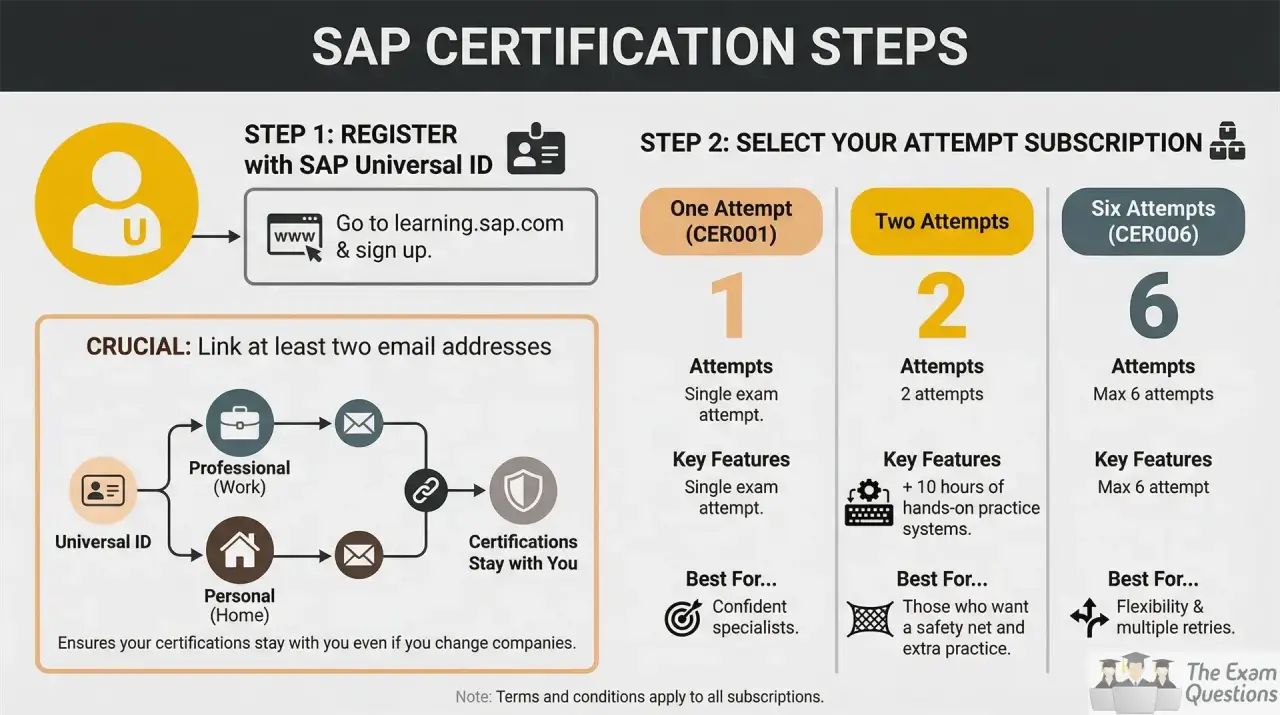
- Set up your SAP Universal ID by signing up at SAP Learning. Link at least two email addresses (professional and personal) to your Universal ID to ensure your certifications is secured even if you change the company further
- Purchase SAP Learning Hub or exam attempts based on the one that fits your needs.
- Choose your SAP certification on the SAP Training Shop or directly through the pricing links on SAP Learning.
- Launch the exam from the certification page or learning journey
- Review the time and attempts remaining
- Complete the exam
- Receive your digital badge after passing which requires an annual "maintenance" to remain valid after every 12 months.
6-Weeks Study Plan For C_CPI_2601
Week 1 - Build the foundation
Study Integration Strategy and the SAP Integration Suite overview. Create your own map of services, roles, and why the suite exists. Source
- Quick Win: Make one page of notes titled "When do I use what in SAP Integration Suite?"
Week 2 - Lock in platform understanding
Revisit the SAP Integration Suite fundamentals and close any terminology gaps. If you are fuzzy on components now, fix it before moving on. Source
- Pro Tip: Explain the platform out loud as if you were teaching a new teammate.
Week 3 - Go deep on API Management
Study lifecycle, proxies, policies, products, and developer hub concepts. This is where surface-level confidence can mislead you. Source
- Warning: If you only read definitions, Week 3 will feel easy and your exam will not.
Week 4 - Master Cloud Integration
This week should be the heaviest. Focus on connectivity, design guidelines, content development, monitoring, Camel expressions, and integration-flow logic. Source
Final-stage preparation usually breaks down when candidates know the topic but cannot move fast enough through the task flow.
- Pro Tip: Week 4 becomes practical, not just theoretical. TheExamQuestions helps you rehearse the system-task rhythm for Cloud Integration.to train you’ll before your real attempt with well-curated C_CPI_2601 Learning Materials.
Week 5 - Add Event Mesh and mixed-topic review
Study event-driven architecture, direct versus guaranteed messaging, and the Event Mesh capability. Then begin mixed-topic revision so you stop thinking in silos. Source
- Quick Win: Create a compare-and-contrast sheet for APIs, iFlows, and event-driven scenarios.
Week 6 - Simulate exam conditions
Do a full timed practice session using a 180-minute block. Review weak areas, fix your admin setup, and confirm your live dashboard details before booking. Source
- Pro Tip: Your goal in Week 6 is calm execution, not more content accumulation.
Retake rules of exam C_CPI_2601
As per the SAP Integration Developer certification examination rule, the candidate can reappear 4 times for the exam in a 12 month period. If you do not pass even after 4 attempts, then you will have to wait till next year to reapply again. The exam includes a 24-hour waiting period between each attempt.
If you fail the assessment but have time remaining on the exam clock, SAP permits you to retake the assessment immediately, and it will register as one exam attempt. Upon confirmation that a technical issue is system-related, a new attempt may be permitted post-review.
Pro Tip: Manage your attempts carefully, and do not rely on old retake folklore unless SAP shows it directly in your live subscription environment.
Keeping certification valid
As per SAP’s official note, the certification is valid for 12 months. To extend it further, you typically need to complete the required stay-certified assessment successfully before expiry(12 months). SAP also says SAP Learning Hub is the simplest path because it includes access to those assessments and preparation materials.
There is one more important edge case: if a certification is retired while your badge is still valid, you receive an additional 12 months of validity from the retirement date.
- Quick Win: Add a recurring calendar reminder for 10 months after the issue date.
- Pro Tip: Staying certified is easier when you treat it as continuous maintenance, not an annual emergency.
Test yourself with SAP C_CPI_2601 Practice Exam
These Free C_CPI_2601 Practice Questions will help you clear the exam by testing your knowledge. These exam-like questions are designed based on system-based tasks and real-world practical scenarios to brush up your understanding on "SAP Integration Developer" concepts. In addition, answering questions can help you identify any areas where you require more practice.
Conclusion
If integration is really a part of your working life and your day-to-day work lives under SAP Integration Suite, then C_CPI_2601 is a good one to take. The exam is designed to assess the candidate's practical competence, their capacity to choose the best solution for the demand and their ability to execute neatly within the 180-minute timeframe.
Design your study plan based on the official learning path, allocate the largest part of your hours to Cloud Integration. Make Event Mesh a real concern, not an afterthought. Then practice with a clock, because it's the format itself that trips most people up.
To simplify your preparation journey, begin your SAP adventure with The Exam Questions. Our 2026-updated C_CPI_2601 system tasks are mapped unit by unit to the syllabus, so the hardest area feels familiar long before the exam day.
Check Out More C_CPI_2601 Related Study Resources Below:
C_CPI_2601 FAQs | C_CPI_2601 system tasks | C_CPI_2601 Exam Questions PDF | Free C_CPI_2601 Practice Questions | C_CPI_2601 Learning Materials